Making Smarter AI Decisions, Managing Your Budget, and Focusing on What Matters Most
Artificial intelligence is opening exciting opportunities for entrepreneurs.
New AI tools.
Smarter website assistants.
Automated customer support.
Personalized digital experiences.
Advanced analytics.
And new ways to help businesses operate more efficiently.
But there's one important challenge.
YOU CAN'T DO EVERYTHING AT ONCE.
Maybe your website assistant needs more accurate answers.
Maybe your Contact form could use improvement.
Maybe customers are having trouble finding information.
Or perhaps you've discovered a new AI tool that promises to transform your business.
Where should you begin?
And how do you know whether an improvement is worth the investment?
The answer is prioritization.
Prioritizing AI website improvements means identifying which changes will provide the most meaningful value while considering cost, effort, risk, and customer needs.
It's not about choosing the newest technology.
It's about choosing the right improvements at the right time.
In Blog #108, we're exploring 50 practical ways to make smarter decisions about AI website upgrades.
PART 1: UNDERSTAND WHY PRIORITIZATION MATTERS
1. Recognize That Resources Are Limited
Every business has limits.
Time.
Money.
Energy.
Technical resources.
And attention.
A good improvement strategy respects those limits.
2. Avoid Trying to Upgrade Everything
Changing too many things at once can create confusion and make results difficult to measure.
3. Focus on Real Business Needs
Ask whether a proposed improvement solves a genuine problem.
4. Separate Wants From Needs
A new AI feature may look exciting.
But fixing an unreliable Contact form may be more important.
5. Understand the Cost of Doing Nothing
Some problems can continue affecting customers if they're ignored.
Prioritization should consider both implementation costs and the consequences of delaying an important fix.
PART 2: IDENTIFY YOUR WEBSITE'S BIGGEST PROBLEMS
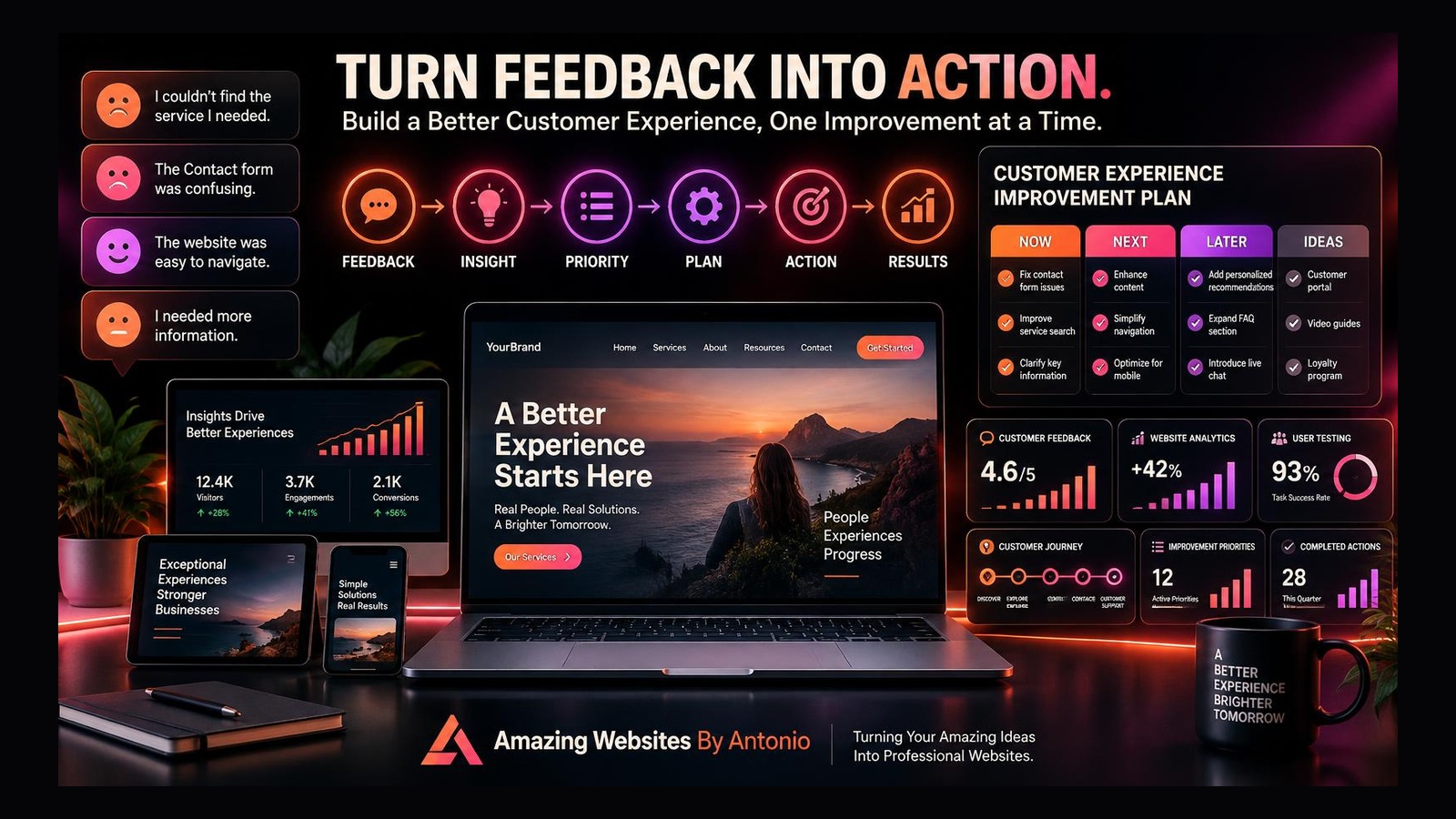
6. Review Customer Feedback
Look for repeated complaints, confusing experiences, and unmet needs.
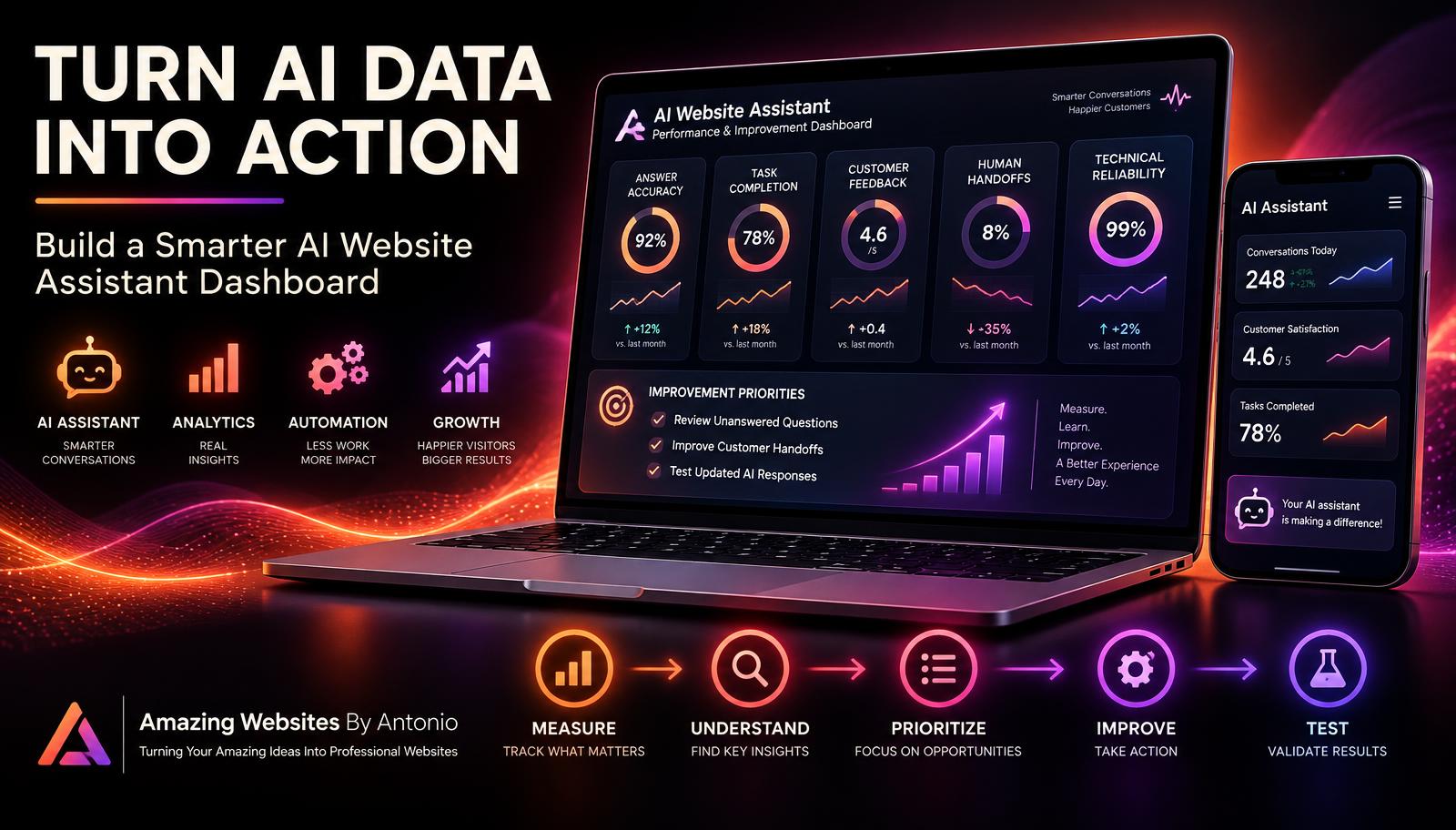
7. Review AI Assistant Performance
Examine:
Answer accuracy.
Task completion.
Customer satisfaction.
Human handoffs.
Technical reliability.
8. Identify Unanswered Questions
If customers repeatedly ask questions your assistant cannot answer, your knowledge base may need improvement.
9. Look for Broken Customer Journeys
Test whether visitors can successfully move from exploring services to contacting your business.
10. Create a Problem Inventory
Write down every meaningful issue you discover.
Don't begin implementing solutions before understanding the problems.
PART 3: EVALUATE CUSTOMER IMPACT
11. Ask How Many Customers Are Affected
A problem affecting many visitors may deserve attention.
However, a serious issue affecting one person can also be urgent.
12. Evaluate the Severity
Does the issue cause minor inconvenience?
Or does it prevent customers from completing an important task?
13. Consider Accessibility
Barriers that prevent people from using essential features should receive appropriate priority.
14. Consider Trust
Incorrect AI answers, misleading claims, or unclear policies can damage customer confidence.
15. Focus on Meaningful Outcomes
Prioritize improvements that help customers find information, complete tasks, and receive appropriate support.
PART 4: EVALUATE BUSINESS IMPACT
16. Connect Improvements to Business Goals
A service business might prioritize project inquiries.
An online store might prioritize product discovery and checkout.
Choose improvements relevant to your business model.
17. Identify Revenue-Related Problems
A broken checkout or inquiry process may directly affect business opportunities.
18. Consider Time Savings
Some automation improvements may reduce repetitive administrative work.
Estimate time savings realistically.
19. Consider Customer Retention
Better support and communication may improve the overall customer relationship.
20. Avoid Assuming Every AI Feature Creates Growth
Technology alone doesn't guarantee more customers or revenue.
Evaluate potential benefits rather than treating them as certain.
PART 5: UNDERSTAND THE TRUE COST
21. Review Setup Costs
Some tools require development, configuration, integration, or professional assistance.
22. Review Subscription Costs
Consider recurring monthly or annual fees.
23. Review Usage-Based Costs
Some AI services charge based on requests, messages, processing, or other usage measures.
24. Include Maintenance Costs
A feature may need ongoing testing, content updates, monitoring, and troubleshooting.
25. Consider Opportunity Cost
Time spent building one feature is time unavailable for another task.
A useful budget considers more than the initial purchase price.
PART 6: EVALUATE EFFORT AND COMPLEXITY
26. Estimate Implementation Time
How long might the improvement take?
27. Identify Technical Requirements
Will it require integrations, custom development, or platform changes?
28. Consider Testing Requirements
More complex features may require extensive testing.
29. Review Dependencies
Some improvements require another task to be completed first.
For example, an AI assistant may need a reliable knowledge base before its responses can improve.
30. Choose Manageable Starting Points
When possible, begin with improvements you can implement, test, and maintain responsibly.
PART 7: IDENTIFY QUICK WINS
31. Understand What a Quick Win Is
A quick win is an improvement that can provide meaningful value with relatively limited effort or resources.
32. Improve Confusing AI Answers
Sometimes updating one knowledge base article can address a recurring customer question.
33. Fix Broken Links
A working link to the correct Contact page may solve a frustrating customer problem.
34. Improve Assistant Welcome Messages
A clearer greeting can help visitors understand what the assistant can do.
35. Simplify Important Forms
Removing unnecessary fields or improving instructions may make forms easier to complete.
Quick wins should still be tested.
PART 8: CREATE A PRIORITY SCORING SYSTEM
36. Define Your Evaluation Criteria
Consider:
Customer Impact.
Business Impact.
Confidence in the Evidence.
Implementation Effort.
Estimated Cost.
37. Use a Consistent Rating Scale
For example, rate each criterion from 1 to 5.
Make sure everyone understands what the ratings mean.
38. Create a Simple Priority Formula
One illustrative formula is:
Priority Score = (Customer Impact + Business Impact + Evidence Confidence) ÷ (Effort + Cost)
Higher results may indicate attractive opportunities.
This is a planning aid, not a scientifically validated decision model.
39. Keep Critical Risks Outside the Formula
Security vulnerabilities, privacy failures, serious misinformation, and barriers to essential access may require immediate attention.
Don't delay them simply because their calculated score is low.
40. Use Judgment Alongside Numbers
A scoring system should support decision-making.
It shouldn't replace careful thinking.
PART 9: BUILD YOUR IMPROVEMENT ROADMAP
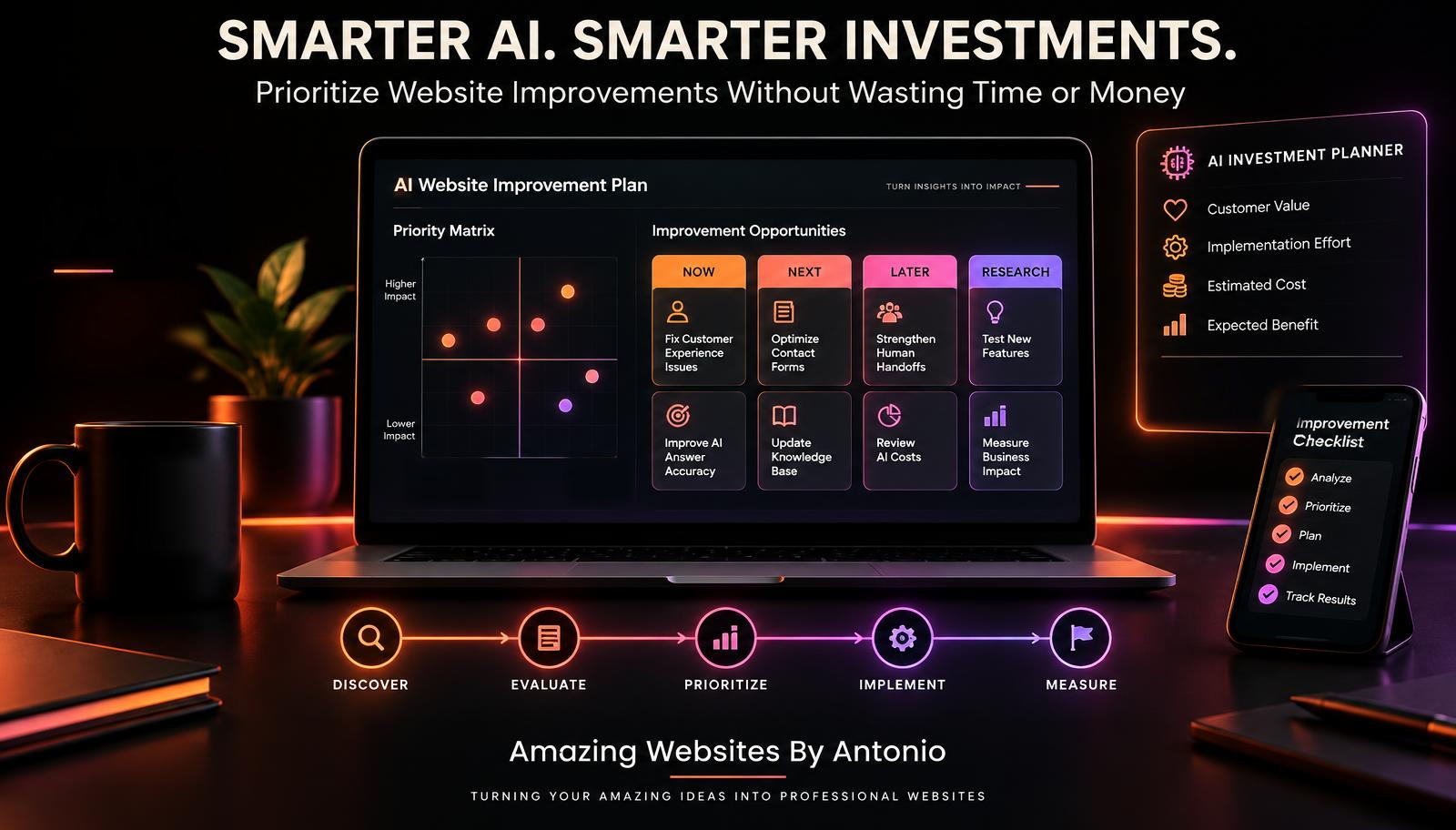
41. Organize Improvements Into Categories
Use:
NOW
Urgent fixes and current priorities.
NEXT
Important improvements planned after current work.
LATER
Useful ideas that can wait.
RESEARCH
Opportunities requiring more evidence.
42. Limit Work in Progress
Choose a manageable number of improvements.
43. Assign Ownership
For a solo entrepreneur, that may simply mean identifying what you personally need to complete.
44. Define Success Before Starting
Write down what should improve.
45. Review Your Roadmap Regularly
New evidence may change your priorities.
A roadmap should guide decisions without becoming inflexible.
PART 10: MEASURE THE VALUE OF YOUR DECISIONS
46. Test Improvements Before Expanding
Start with a limited implementation when practical.
47. Compare Results
Review relevant before-and-after information using consistent measurements.
48. Track Actual Costs
Record implementation and ongoing expenses.
49. Learn From Unsuccessful Changes
Not every improvement will produce the expected result.
Use those experiences to make better decisions.
50. Keep Improving Your Prioritization Process
Review which decisions created meaningful value.
Adjust your criteria.
Improve your estimates.
And continue focusing on customer needs.
THE AI WEBSITE IMPROVEMENT PRIORITY FRAMEWORK
DISCOVER
Identify website problems and opportunities.
↓
EVALUATE
Understand customer and business impact.
↓
ESTIMATE
Review costs, effort, and dependencies.
↓
PRIORITIZE
Choose the most important improvements.
↓
IMPLEMENT
Make focused changes.
↓
TEST
Evaluate whether the improvement works.
↓
MEASURE
Review meaningful results.
↓
REFINE
Update your roadmap.
EXAMPLE AI WEBSITE IMPROVEMENT DECISION MATRIX
The following ratings are fictional examples for demonstration purposes only.
| Improvement | Customer Impact | Business Impact | Evidence Confidence | Effort | Cost | Priority Score |
|---|---|---|---|---|---|---|
| Fix broken Contact link | 5 | 5 | 5 | 1 | 1 | 7.50 |
| Update inaccurate FAQ answer | 4 | 4 | 5 | 1 | 1 | 6.50 |
| Improve AI welcome message | 3 | 3 | 4 | 1 | 1 | 5.00 |
| Add advanced AI personalization | 3 | 3 | 2 | 5 | 5 | 0.80 |
| Build a new analytics integration | 4 | 4 | 3 | 4 | 4 | 1.38 |
How to interpret the results:
A higher score suggests an improvement may offer more value relative to estimated effort and cost.
However, these scores are illustrative.
Real priorities depend on business goals, evidence, risks, resources, and customer needs.
COPY-READY AI WEBSITE IMPROVEMENT PRIORITY TEMPLATE
BUSINESS NAME:
[Enter Business Name]
REVIEW DATE:
[Enter Date]
PROPOSED IMPROVEMENT:
[Describe the change.]
PROBLEM BEING SOLVED:
[Explain the customer or business problem.]
EVIDENCE:
[Customer feedback, analytics, testing, or observations.]
CUSTOMER IMPACT (1–5):
[Score]
BUSINESS IMPACT (1–5):
[Score]
EVIDENCE CONFIDENCE (1–5):
[Score]
IMPLEMENTATION EFFORT (1–5):
[Score]
ESTIMATED COST (1–5):
[Score]
PRIORITY SCORE:
[Calculate using your chosen formula.]
CRITICAL RISK OR URGENT ISSUE?
Yes / No
DEPENDENCIES:
[What must happen first?]
SUCCESS MEASURE:
[How will you evaluate results?]
DECISION:
NOW / NEXT / LATER / RESEARCH
PERSON RESPONSIBLE:
[Name]
TARGET REVIEW DATE:
[Date]
YOUR 30-DAY AI IMPROVEMENT ACTION PLAN
WEEK 1 — DISCOVER
Review AI performance.
Collect customer feedback.
Identify broken workflows.
Create a list of potential improvements.
WEEK 2 — EVALUATE
Estimate customer impact.
Estimate business impact.
Review evidence.
Consider costs and effort.
Identify urgent risks.
WEEK 3 — PRIORITIZE AND IMPLEMENT
Choose one or two meaningful improvements.
Define expected outcomes.
Make the changes.
Test essential functionality.
WEEK 4 — MEASURE AND REFINE
Review the results.
Document actual costs.
Collect relevant feedback.
Decide what worked.
Update the improvement roadmap.
AI WEBSITE IMPROVEMENT CHECKLIST
- ☐ I understand my website's business goals.
- ☐ I have reviewed customer feedback.
- ☐ I have reviewed AI assistant performance.
- ☐ I have identified important problems.
- ☐ I understand customer impact.
- ☐ I understand business impact.
- ☐ I have considered accessibility.
- ☐ I have reviewed privacy and security risks.
- ☐ I have estimated setup costs.
- ☐ I have considered recurring expenses.
- ☐ I have estimated implementation effort.
- ☐ I have identified dependencies.
- ☐ I have defined a success measure.
- ☐ I have identified possible quick wins.
- ☐ I have organized improvements into a roadmap.
- ☐ I am limiting work in progress.
- ☐ I will test changes before expanding.
- ☐ I will review actual results.
- ☐ I will update priorities when new evidence appears.
FINAL THOUGHTS
Artificial intelligence can help entrepreneurs build more capable websites.
But adding more technology isn't always the answer.
Sometimes the best improvement is simple.
A clearer FAQ.
A working Contact link.
A better assistant greeting.
A more reliable human handoff.
Or a faster, easier customer experience.
The key is knowing what deserves your attention.
SMART AI INVESTMENT ISN'T ABOUT SPENDING MORE.
IT'S ABOUT CHOOSING BETTER.
Start with real customer problems.
Use evidence.
Understand the costs.
Evaluate the effort.
Choose manageable improvements.
And measure what happens next.
Because the goal isn't to build the most complicated AI-powered website.
The goal is to build a website that serves your customers and supports your business.
FOCUS ON VALUE.
SPEND WITH PURPOSE.
IMPROVE WHAT MATTERS.
GROW WITH CONFIDENCE.
Amazing Websites By Antonio
Turning Your Amazing Ideas Into Professional Websites