Turning Business Information Into Smarter, More Reliable Customer Support
Imagine visiting a business website.
You have a question.
Maybe you want to know what services the business offers.
Maybe you're wondering how to get started.
Maybe you need information about pricing, appointments, or project timelines.
Instead of searching through multiple pages, you ask the website's AI assistant.
And within moments, you receive a clear, helpful answer.
Sounds convenient, right?
But here's an important question:
HOW DOES THE AI ASSISTANT KNOW WHAT TO SAY?
An AI assistant needs reliable information.
Without it, the assistant may provide incomplete, outdated, or incorrect answers.
That's where an AI knowledge base becomes valuable.
An AI knowledge base is an organized collection of approved business information that an AI-powered system can use to help answer questions.
It might contain service descriptions, frequently asked questions, policies, business details, and customer support instructions.
But building a knowledge base isn't simply about uploading a pile of documents.
It's about creating a reliable information system.
Let's explore 50 practical ways to build one.
PART 1: UNDERSTAND THE PURPOSE OF AN AI KNOWLEDGE BASE
1. Understand What a Knowledge Base Is
A knowledge base is a structured collection of information.
For a business website, it can include:
- Services
- FAQs
- Policies
- Contact information
- Processes
- Product information
- Support instructions
The purpose is to make approved information easier to find and use.
2. Understand How AI Uses Information
Some AI assistants can retrieve relevant information from connected documents or databases when answering questions.
This approach is often called retrieval-augmented generation, or RAG.
However, connecting a knowledge base does not guarantee that every answer will be correct.
The system still needs testing and appropriate safeguards.
3. Start With Customer Needs
Before creating documents, identify what customers regularly ask.
For example:
What services do you offer?
How do I get started?
What is included?
How do I contact you?
How long does the process take?
These questions provide a useful starting point.
4. Define the Knowledge Base's Purpose
Decide what your system should support.
Possibilities include:
Customer support.
Service guidance.
Product questions.
Booking information.
Internal team assistance.
Start with a clear purpose rather than trying to support everything immediately.
5. Set Realistic Expectations
A knowledge base can improve access to information.
But it cannot automatically fix unclear policies, missing information, or unreliable AI behavior.
Quality still matters.
PART 2: COLLECT YOUR BUSINESS INFORMATION
6. Gather Your Official Business Details
Collect accurate information about your business.
Include:
Business name.
Official website.
Approved contact methods.
Business hours, if applicable.
Service areas, if relevant.
7. Document Every Service
For each service, explain:
What it is.
Who it helps.
What it includes.
What it doesn't include.
How customers get started.
8. Document Your Service Process
Customers often want to understand what happens next.
Create a simple process such as:
INQUIRY → CONSULTATION → PROPOSAL → APPROVAL → PROJECT → DELIVERY
Adapt the process to your actual business.
9. Document Pricing Information Carefully
If your business publishes prices, maintain approved pricing information.
Include relevant limitations or conditions.
Don't let an AI assistant invent quotes, discounts, or guarantees.
10. Collect Frequently Asked Questions
Gather questions from:
Contact forms.
Customer emails.
Sales conversations.
Support requests.
Website surveys.
Use real recurring questions to guide your FAQ content.
PART 3: ORGANIZE THE KNOWLEDGE BASE
11. Create Clear Categories
Organize information into categories such as:
ABOUT THE BUSINESS
SERVICES
PRICING
PROJECT PROCESS
BOOKING
POLICIES
CONTACT
TECHNICAL SUPPORT
12. Give Every Article a Descriptive Title
Instead of:
Document 17
Use:
How to Request a Website Design Consultation
Clear titles make information easier to maintain and retrieve.
13. Keep Each Article Focused
A single article should answer a clear question or explain a related topic.
Avoid combining unrelated policies, services, and instructions into one enormous document.
14. Use Consistent Formatting
A helpful article structure is:
TITLE
QUESTION
ANSWER
IMPORTANT DETAILS
RELATED INFORMATION
LAST REVIEWED
15. Create One Authoritative Source for Each Policy
Avoid keeping several conflicting versions of the same information.
When a policy changes, update the approved source and any connected copies.
PART 4: WRITE ANSWERS THAT ARE EASY TO UNDERSTAND
16. Use Plain Language
Write answers for customers rather than technical experts.
17. Answer the Main Question First
If someone asks how to contact the business, provide the approved contact method directly.
Then include useful additional details.
18. Keep Answers Concise
Avoid unnecessary paragraphs when a short answer will do.
19. Include Helpful Next Steps
For example:
To request a website consultation, complete the Contact form and provide a brief description of your project.
Only include steps that reflect your actual process.
20. Avoid Unsupported Claims
Don't include promises such as:
Guaranteed sales.
Guaranteed search rankings.
Guaranteed customer growth.
Use accurate descriptions and appropriate expectations.
PART 5: PREPARE CONTENT FOR AI RETRIEVAL
21. Use Clear Headings
Descriptive headings help organize information and may support more effective retrieval.
22. Include Common Question Variations
Customers may ask the same thing in different ways.
For example:
How do I start?
How can I request a project?
Where do I submit an inquiry?
Your content should make the answer discoverable across these variations.
23. Keep Important Facts Together
An article about a service should contain the essential facts needed to explain it.
24. Avoid Contradictory Information
Review documents for conflicting details about pricing, services, policies, and timelines.
25. Add Useful Metadata
Where your system supports it, include:
Article category.
Service.
Owner.
Version.
Review date.
Publication status.
These details can support maintenance and governance.
PART 6: CREATE RULES FOR RELIABLE ANSWERS
26. Use Approved Sources
Configure your assistant, where supported, to prioritize current, approved business information.
27. Teach the Assistant to Acknowledge Uncertainty
When information is missing, the assistant should say so.
A useful response might be:
“I don't have confirmed information about that. Please contact the business for assistance.”
28. Avoid Inventing Information
An assistant should not fabricate:
Prices.
Policies.
Appointment availability.
Refund decisions.
Project guarantees.
Business credentials.
29. Create a Human Escalation Process
Some questions need personal assistance.
Provide a clear way to contact the business.
30. Define Sensitive Topics
Identify requests that should receive additional care or human review.
Examples include payment disputes, personal account information, sensitive customer details, and unusual service requests.
PART 7: PROTECT PRIVACY AND SECURITY
31. Separate Public and Internal Information
Public-facing assistants should not automatically have access to private internal business records.
32. Limit Access Permissions
Give tools and users only the access necessary for their responsibilities.
33. Protect Customer Information
Don't upload sensitive customer details into an AI system without understanding how that information will be handled.
34. Review Provider Data Practices
Understand relevant retention, security, training-use, and access policies.
35. Plan for Incorrect or Unsafe Responses
Establish a process to identify problematic answers, investigate causes, and correct the system.
PART 8: TEST YOUR AI KNOWLEDGE BASE
36. Create a Test Question List
Start with common questions such as:
What services do you offer?
How can I contact you?
How do I start a project?
What is included in a service?
What happens after submitting an inquiry?
37. Test Different Wording
Ask the same question in several ways.
For example:
How do I reach you?
Where can I contact the business?
How do I send a message?
38. Test Missing Information
Ask about something not covered in the knowledge base.
The assistant should avoid inventing an answer.
39. Test Outdated Information
After changing a policy, verify that the assistant uses the current version rather than an old copy.
40. Review Answers Manually
Evaluate:
Accuracy.
Clarity.
Completeness.
Appropriate uncertainty.
Privacy.
Correct next steps.
PART 9: MAINTAIN THE KNOWLEDGE BASE
41. Assign Responsibility
Decide who approves and updates information.
For a solo business, that may be the business owner.
42. Establish a Review Schedule
Review important content regularly.
High-change information may need more frequent updates.
43. Track Changes
Record what changed, when it changed, and why.
44. Monitor Unanswered Questions
Questions the assistant cannot answer may reveal gaps in your content.
45. Improve Based on Evidence
Use customer feedback and testing to refine articles.
Don't expand the knowledge base simply to increase its size.
PART 10: TURN THE KNOWLEDGE BASE INTO A BUSINESS ASSET
46. Connect Related Website Pages
Link helpful knowledge articles to relevant services, FAQs, and contact options.
47. Reuse Approved Information
A well-maintained knowledge base can support website FAQs, onboarding guides, internal reference materials, and customer support.
48. Measure Useful Outcomes
Consider:
Answer accuracy.
Successful task completion.
Unanswered questions.
Customer satisfaction.
Appropriate escalations.
Time saved.
49. Start Small and Expand Carefully
Begin with the most important 10–20 customer questions.
Test the system.
Improve it.
Then expand when needed.
50. Keep the Human Connection
An AI knowledge base should make information easier to access.
It should not make customers feel abandoned when they need help.
The best systems combine reliable information, useful technology, and appropriate human support.
COPY-READY AI KNOWLEDGE BASE ARTICLE TEMPLATE
ARTICLE TITLE:
[Enter a clear title]
CATEGORY:
[Services / Pricing / Contact / Policies / Support]
CUSTOMER QUESTION:
[What question does this article answer?]
APPROVED ANSWER:
[Write the accurate answer using plain language.]
IMPORTANT DETAILS:
[Include relevant conditions, limitations, or requirements.]
NEXT STEP:
[Explain what the customer should do next.]
RELATED ARTICLES:
[List relevant resources.]
INFORMATION OWNER:
[Person responsible for maintaining the answer.]
STATUS:
Draft / Approved / Needs Review / Archived
LAST REVIEWED:
[Date]
NEXT REVIEW:
[Date]
EXAMPLE: WEBSITE DESIGN SERVICE QUESTION
ARTICLE TITLE:
How to Request a Website Design Project
CATEGORY:
Services
CUSTOMER QUESTION:
How can I get started with a website design project?
EXAMPLE ANSWER:
If you're interested in creating or improving a professional website, begin by contacting the business and sharing some information about your goals.
Helpful details may include:
- Your business name
- The type of website you need
- Your goals
- Features you're interested in
- Your preferred timeline
The business can then review your inquiry and explain the appropriate next steps.
IMPORTANT:
This is an illustrative template. Customize it to match your actual services, intake process, and commitments before publishing.
YOUR 30-DAY AI KNOWLEDGE BASE IMPLEMENTATION PLAN
WEEK 1 — COLLECT INFORMATION
Gather approved business details, service descriptions, policies, and frequently asked questions.
Identify missing or conflicting information.
WEEK 2 — ORGANIZE AND WRITE
Create categories.
Draft concise articles.
Review accuracy.
Assign article owners and review dates.
WEEK 3 — CONFIGURE AND TEST
Connect the approved content to your chosen tool, if appropriate.
Test common questions, alternate wording, missing information, and human escalation.
WEEK 4 — REVIEW AND IMPROVE
Correct inaccurate answers.
Update confusing articles.
Review privacy and access settings.
Decide whether the system is ready for wider use.
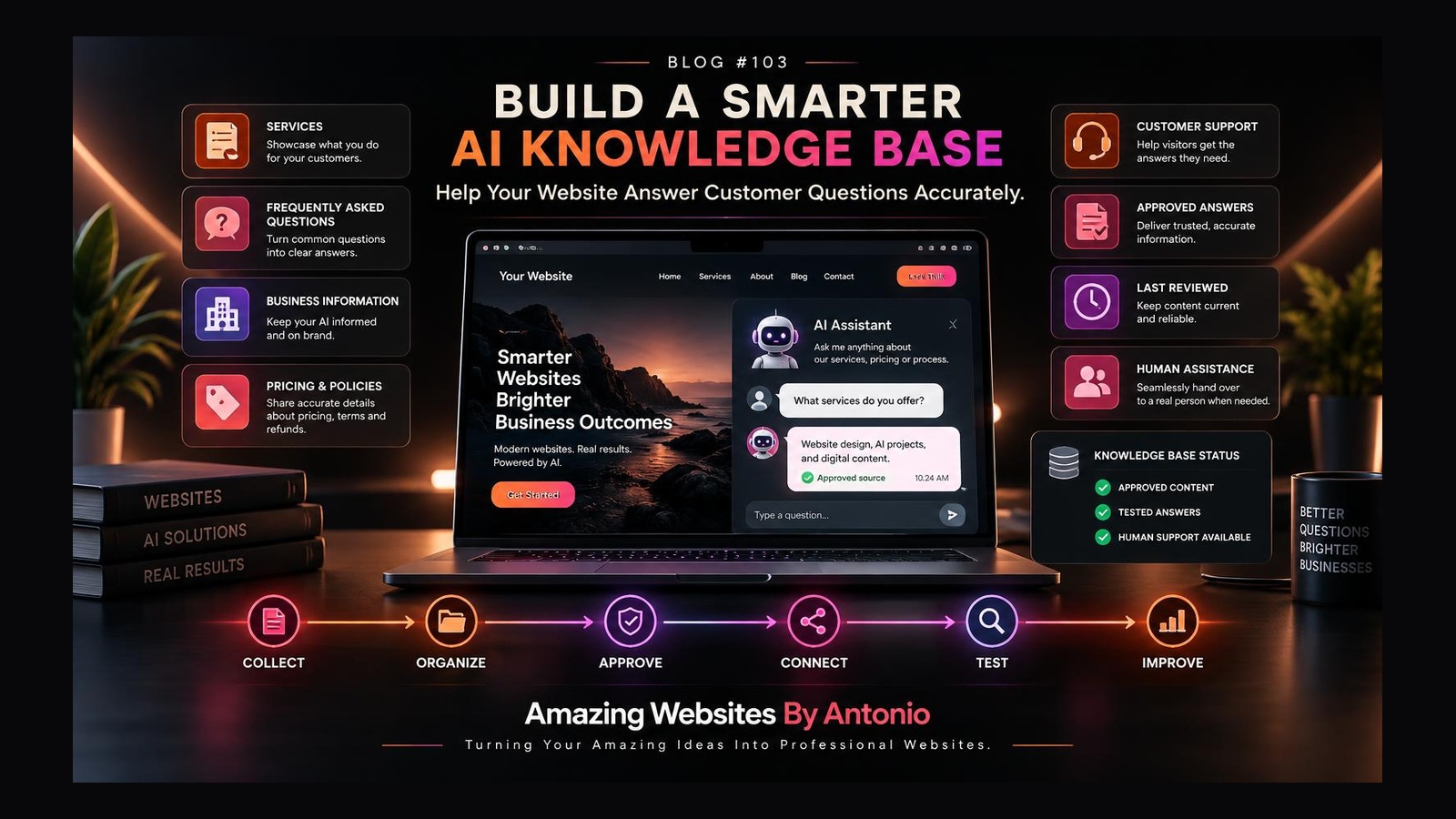
THE AI KNOWLEDGE BASE SUCCESS FRAMEWORK
COLLECT
Gather reliable business information.
↓
ORGANIZE
Create categories and focused articles.
↓
APPROVE
Verify accuracy and publication status.
↓
CONNECT
Make approved information available to appropriate tools.
↓
TEST
Evaluate answers and failure cases.
↓
MONITOR
Identify unanswered questions and mistakes.
↓
UPDATE
Keep information current.
↓
IMPROVE
Refine the customer experience.
FINAL THOUGHTS
An AI assistant can be impressive.
But impressive technology isn't enough.
The information behind it needs to be reliable.
Organized.
Accurate.
Current.
Appropriate.
And useful.
A strong AI knowledge base helps create that foundation.
You don't need hundreds of documents to begin.
Start with your most important customer questions.
Write clear answers.
Verify the information.
Test the results.
And keep improving.
BETTER INFORMATION → BETTER ANSWERS → BETTER CUSTOMER EXPERIENCES
Remember:
Artificial intelligence should help your business communicate more effectively.
It should never replace the importance of accuracy, trust, and human connection.
ORGANIZE YOUR KNOWLEDGE.
BUILD WITH PURPOSE.
ANSWER WITH ACCURACY.
GROW WITH CONFIDENCE.
Amazing Websites By Antonio
Turning Your Amazing Ideas Into Professional Websites