Your potential customers have questions.
- How much does it cost?
- How long will it take?
- What exactly do I receive?
- What happens after I place an order?
- Can you customize the service for my business?
- Do you offer support afterward?
The question is: Does your website answer those questions?
A strong Frequently Asked Questions page can become one of the most useful parts of a business website.
It doesn't simply answer questions.
It can reduce uncertainty, build trust, save you time, and help customers feel more confident about taking the next step.
Here are some ways to build an FAQ page that actually helps your business.
1. START WITH REAL CUSTOMER QUESTIONS
Don't fill your FAQ page with questions simply because they sound professional.
Think about what customers actually ask.
Look at:
- Emails
- Contact-form submissions
- Phone conversations
- Social media messages
- Sales conversations
- Customer feedback
If you hear the same question repeatedly, it probably belongs on your website.
Your FAQ page should reflect the customer's needs—not just what your business wants to talk about.
2. ANSWER THE MOST IMPORTANT QUESTIONS FIRST
Not every question has the same importance.
Start with questions that could prevent someone from moving forward.
For example:
- How much do your services cost?
- How do I get started?
- How long does a project take?
- What information do you need from me?
- Can I request a custom service?
- Do you work with new businesses?
- What happens after my website launches?
Putting important questions near the top makes the page more useful immediately.
3. KEEP ANSWERS CLEAR AND SIMPLE
An FAQ answer shouldn't feel like another blog article.
Give customers enough information to understand the answer without overwhelming them.
Instead of:
“Our project development methodology consists of several phases involving discovery, strategy, implementation and optimization.”
Try:
“Every project begins with learning about your business and goals. From there, we'll determine what needs to be created and guide you through the next steps.”
Simple language creates a better customer experience.
4. ORGANIZE QUESTIONS INTO CATEGORIES
As your FAQ grows, organization becomes important.
You could create sections such as:
- Getting Started
- Website Design
- Branding
- AI Solutions
- Automation
- Pricing & Payments
- Project Timelines
- Support
- Custom Services
Customers can quickly find the information that applies to them.
5. USE AN ACCORDION DESIGN
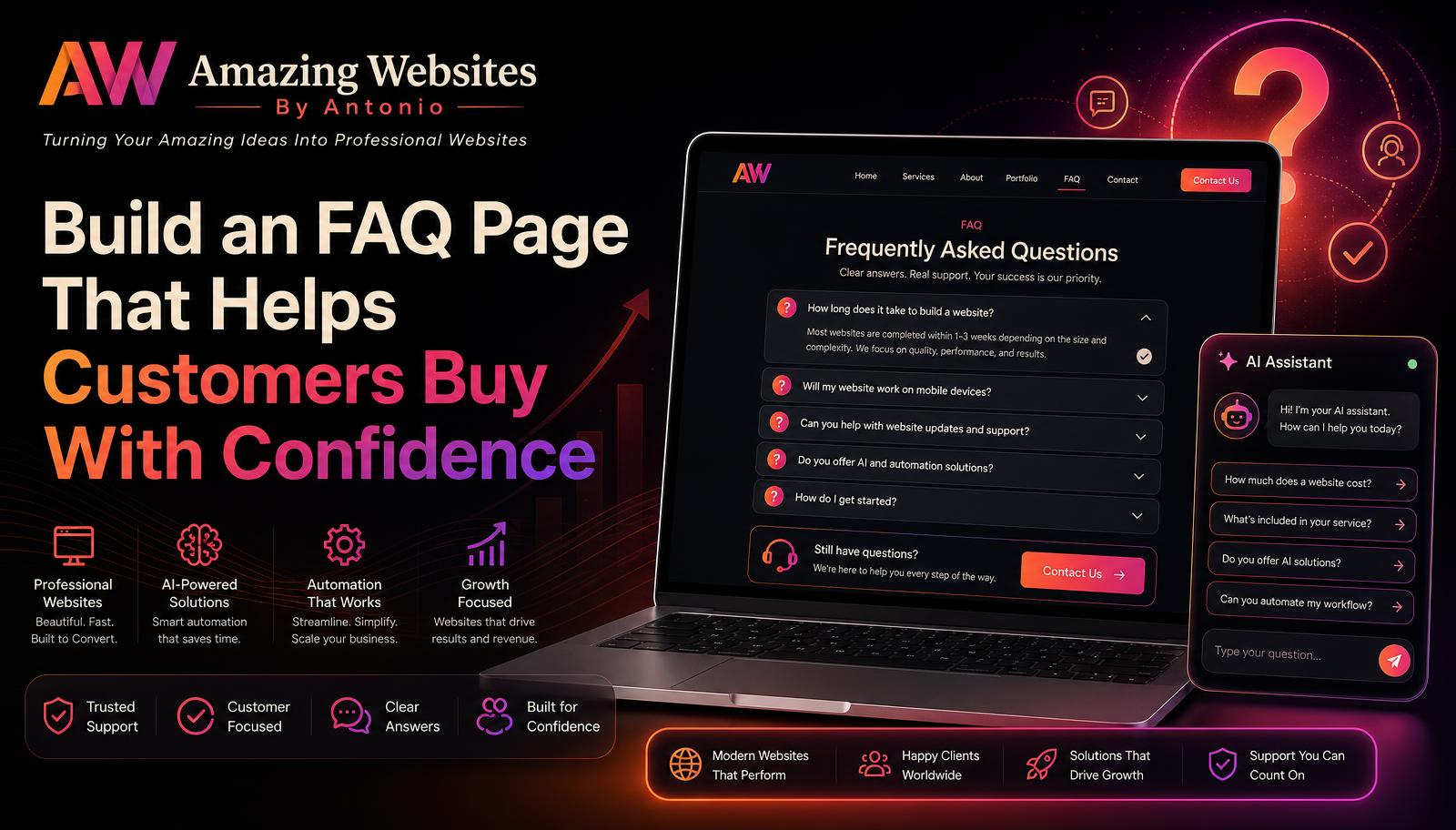
An accordion FAQ allows visitors to click a question and expand the answer.
For example:
- + How do I get started?
- + How much does a website cost?
- + Can you help with branding?
- + Do you provide AI solutions?
This keeps the page clean and prevents visitors from seeing a giant wall of text.
On mobile devices, this can be especially helpful.
6. ANSWER PRICING QUESTIONS
Many businesses avoid pricing questions completely.
Even if you don't publish exact prices, you can still explain your pricing process.
For example:
How much do your services cost?
“Pricing depends on the type of project, features, complexity, and services required. After learning about your goals, we'll recommend the appropriate solution and provide pricing for your project.”
That is much more helpful than avoiding the question.
7. EXPLAIN WHAT HAPPENS AFTER SOMEONE CONTACTS YOU
Customers often hesitate because they don't know what will happen next.
Your FAQ can remove that uncertainty.
For example:
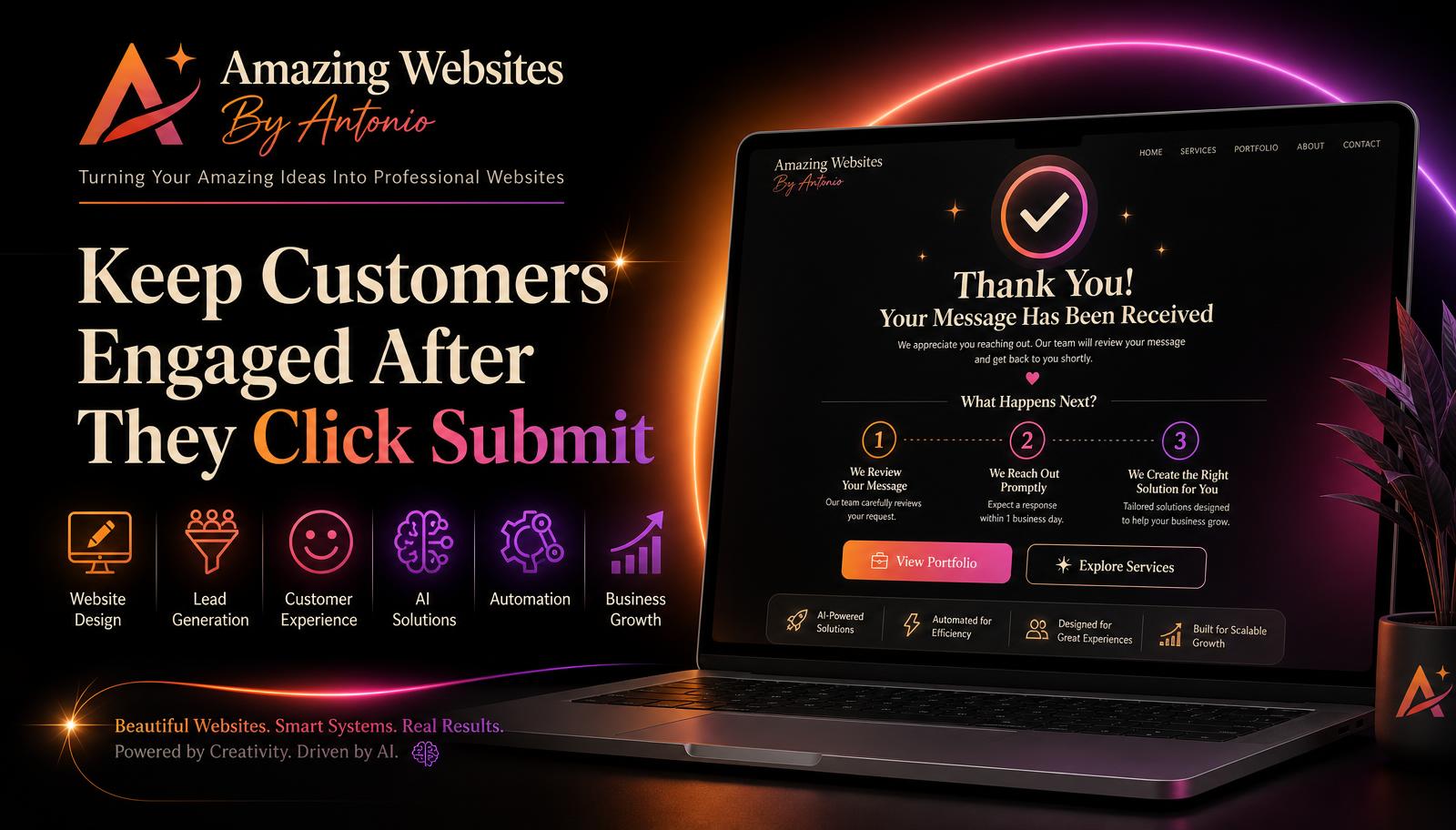
What happens after I submit the contact form?
“After you submit your information, Amazing Websites By Antonio will review your project details and follow up with you about the next steps.”
Now the customer knows what to expect.
8. ADDRESS CUSTOMER CONCERNS BEFORE THEY BECOME OBJECTIONS
Customers may have concerns they haven't asked you about yet.
For example:
- I already have a website. Can you improve it?
- I don't know anything about AI. Can you still help me?
- I don't have a logo yet. Is that a problem?
- I'm not sure which service I need.
- Can I add features later?
Your FAQ gives you an opportunity to reassure customers before those concerns cause them to leave.
9. INCLUDE A “NOT SURE WHAT YOU NEED?” QUESTION
This can be particularly valuable for a business offering multiple services.
For example:
What if I don't know which service I need?
“That's okay. Tell us about your business, what you're trying to accomplish, and where you're currently having challenges. We'll help you identify the service or solution that makes the most sense for your goals.”
That makes your website feel helpful rather than complicated.
10. CONNECT ANSWERS TO THE NEXT STEP
Some FAQ answers should naturally lead somewhere else on your website.
For example:
- Interested in website design? View Website Services
- Want to see previous work? View Portfolio
- Ready to discuss your project? Contact Amazing Websites By Antonio
Your FAQ shouldn't become a dead end.
Use it to continue the customer journey.
11. ADD AI-POWERED FAQ SUPPORT
A traditional FAQ page requires customers to browse through questions.
AI can make that experience even more interactive.
Imagine a visitor typing:
- “How much would it cost to redesign my website?”
- “Can you help me create a logo too?”
- “I need a website and automation. What service should I choose?”
An AI-powered website assistant could provide helpful information and guide the visitor toward the appropriate page, service, or contact option.
The FAQ page provides information.
AI can help visitors find that information conversationally.
12. KEEP YOUR FAQ UPDATED
Your FAQ page shouldn't be created once and forgotten.
As your business grows, new questions will appear.
You may:
- Add new services.
- Change your packages.
- Introduce AI tools.
- Add merchandise.
- Update payment options.
- Change your process.
When something important changes, review your FAQ.
An outdated FAQ can create more confusion than having no FAQ at all.
13. DON'T MAKE PROMISES YOU CAN'T GUARANTEE
Be careful with absolute statements.
Instead of:
“Every website will be finished within seven days.”
Consider:
“Project timelines vary depending on the size, features, content, and complexity of the website. Your expected timeline will be discussed before the project begins.”
Your FAQ should create confidence while remaining accurate.
14. INCLUDE A FINAL QUESTION THAT INVITES CONTACT
No FAQ can answer everything.
End with something like:
Still have a question?
Didn't find what you were looking for?
Contact Amazing Websites By Antonio and tell us how we can help.
THE BEST FAQ PAGES REMOVE UNCERTAINTY
Think about the questions running through a potential customer's mind:
- Can this business help me?
- Can I afford this?
- How does the process work?
- What happens next?
- Can I trust them?
- What if I don't know exactly what I need?
A strong FAQ page helps answer those questions before uncertainty becomes a reason to leave.
When customers understand your business, they can make decisions with greater confidence.
PRO TIP
Write down the 10 questions customers ask you most often.
Then visit your website and see how many of those questions are already answered.
If customers repeatedly have to contact you for basic information, that's a sign your website could be doing more of the work for you.
Your website should educate.
Your website should guide.
Your website should answer questions.
And ultimately, your website should make it easier for the right customer to take the next step.
Amazing Websites By Antonio
Turning Your Amazing Ideas Into Professional Websites