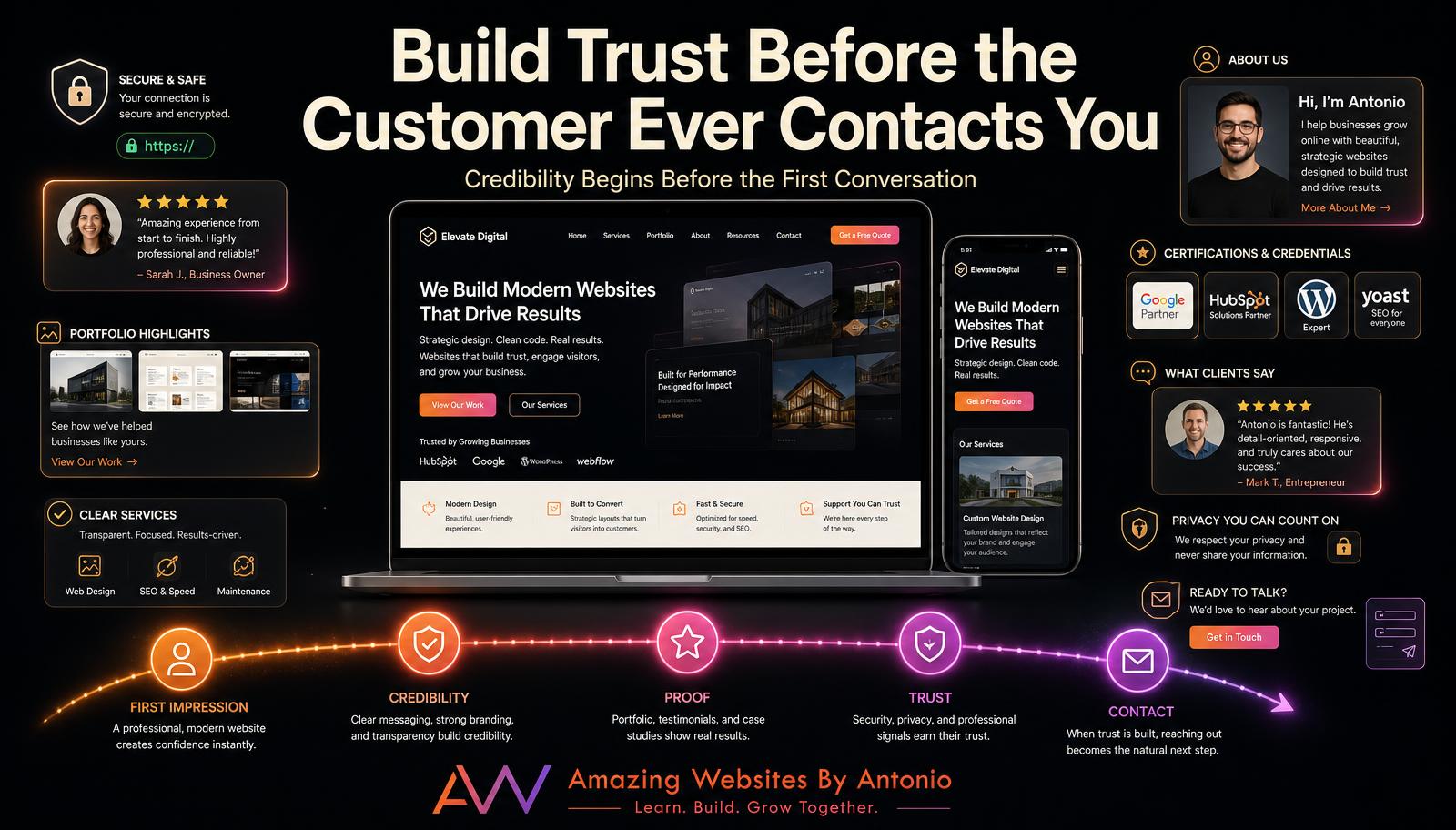
Before a potential customer ever sends you an email...
Before they fill out your contact form...
Before they schedule a consultation...
They are already deciding whether they trust your business.
Your website plays a major role in that decision.
Visitors notice:
- How your website looks.
- How clearly you communicate.
- Whether your information feels current.
- Whether your work looks genuine.
- Whether other people have shared real experiences.
- Whether your website feels secure.
- Whether your business seems easy to contact.
Trust begins long before the first conversation.
Let's look at how your website can help build it.
First Impressions Matter
People make quick judgments online.
A visitor may decide within seconds whether your website feels:
- Professional or Unfinished
- Clear or Confusing
- Trustworthy or Questionable
That doesn't mean your website needs expensive animations or complicated technology.
It means the basics need to feel intentional.
Make sure your website has:
- Clean design
- Clear navigation
- Readable text
- Consistent branding
- Working links
- Mobile-friendly pages
- Current information
Professionalism begins with attention to detail.
Make It Immediately Clear Who You Are
Visitors shouldn't need to search through your website to understand what business they're visiting.
Your homepage should clearly communicate:
- Your business name
- What you do
- Who you help
- What makes your services valuable
For example:
Instead of: Welcome to My Website
Try: Professional Websites and AI-Powered Digital Solutions Designed to Help Businesses Stand Out Online
Clarity builds confidence.
Use a Professional Domain Name
A professional domain can strengthen credibility.
For example, yourbusiness.com typically creates a stronger impression than a long or unrelated web address.
Your domain should be:
- Easy to remember
- Easy to type
- Connected to your brand
- Consistent with your business identity
It's a small detail that can make a large difference.
Use Consistent Branding
Imagine your homepage uses one logo. Your social media uses another. Your colors change from page to page. Your fonts constantly change.
Visitors may wonder whether they're even interacting with the same business.
Consistency communicates professionalism.
Use a recognizable:
- Logo
- Color palette
- Typography system
- Photography style
- Tone of voice
Your brand should feel connected everywhere customers encounter it.
Tell People Who Is Behind the Business
People often trust businesses more when they understand who is behind them.
Your About page can explain:
- Who you are
- Why you started the business
- What you believe
- Your experience
- Your approach
- What matters to you
You don't need to share your entire life story. Give visitors enough information to feel like there is a real person behind the website.
Use Real Photos When Appropriate
Stock photography can be useful. But authentic photographs can create a stronger connection.
Consider showing:
- The business owner
- Team members
- Workspace
- Products
- Projects
- Behind-the-scenes moments
Real images can help turn an anonymous website into a recognizable business.
Show Real Work
If you provide a service, your portfolio is one of your strongest trust-building tools.
Don't simply say, “We create professional websites.” Show examples.
Include:
- Project images
- Screenshots
- Before-and-after examples
- Project goals
- Services provided
- Results when available
Evidence is often more persuasive than claims.
Use Authentic Testimonials
Testimonials can help potential customers understand what working with your business is actually like.
The key word is: Authentic.
Only display genuine feedback submitted by real people.
Strong testimonials may describe:
- Communication
- Quality
- Creativity
- Professionalism
- Results
- Customer experience
When appropriate, identify whether feedback came from a paying client or a general website visitor. Transparency makes testimonials more credible.
Don't Hide Your Contact Information
A trustworthy business should be easy to reach.
Make contact information easy to find. Depending on your business, provide:
- Contact form
- Email address
- Phone number
- Business social media
- Scheduling option
Don't force visitors to hunt for a way to communicate with you. Accessibility creates confidence.
Explain What Happens After Someone Contacts You
People may hesitate because they don't know what will happen next. Remove the uncertainty.
For example:
- Step 1: Submit your project inquiry.
- Step 2: We review your goals.
- Step 3: We schedule a conversation.
- Step 4: You receive recommended next steps.
A clear process makes contacting your business feel safer and easier.
Be Clear About Your Services
Avoid vague descriptions. Instead of “Digital Solutions,” explain what that means.
For example:
- Website Design
- Website Redesign
- Branding
- AI Automation
- AI Chatbots
- Digital Content
Clear descriptions help visitors understand whether you're the right fit. Confusion weakens trust.
Explain Pricing When Appropriate
You don't always need to publish exact pricing. Some projects require custom quotes. But total mystery can create uncertainty.
Consider sharing:
- Starting prices
- Pricing ranges
- Package examples
- What affects pricing
- How estimates are created
Transparency helps potential customers decide whether to continue the conversation.
Make Sure Your Website Is Secure
Visitors notice security warnings. Your website should use HTTPS. The browser should not display messages suggesting the website is unsafe.
If your site collects contact information, email addresses, payment information, or account information, security becomes even more important.
A professional experience includes protecting visitor data.
Include a Privacy Policy
If you're collecting personal information, explain how it is handled.
Your privacy policy should accurately describe:
- What information you collect
- Why you collect it
- How it may be used
- Which third-party services may process it
- How visitors can contact you with questions
Transparency builds confidence.
Keep Your Website Updated
Outdated websites can create doubt. Look for:
- Old copyright dates
- Broken links
- Services you no longer offer
- Outdated team information
- Old pricing
- Missing images
- Empty pages
- Events that ended years ago
A maintained website tells visitors: This business is active.
Check Your Links
Broken links damage credibility. Imagine clicking “View Our Portfolio” and receiving an error. Or “Contact Us” and nothing happens.
Small technical problems can create large trust problems.
Regularly test:
- Navigation
- Buttons
- Forms
- Social links
- Downloads
- External resources
Your website should feel dependable.
Make Forms Work Properly
Contact forms are especially important. Test them yourself. Submit a sample inquiry.
Make sure:
- It sends successfully
- The message reaches you
- The user receives confirmation
- Error messages make sense
- Required fields are clear
A broken form can cost you a customer without you ever knowing.
Use Helpful Content to Demonstrate Knowledge
Educational content is one of the strongest ways to establish credibility.
Your blog can show that you understand:
- Customer problems
- Industry topics
- Technology
- Business strategy
- Website design
- AI
- Branding
You aren't simply telling people, “I know what I'm doing.” You're demonstrating it.
Answer Common Questions
FAQs can remove doubt before someone contacts you.
Questions might include:
- How long does a website project take?
- Do you redesign existing websites?
- Do you work with small businesses?
- Can you help with AI?
- What happens after I submit an inquiry?
Every answered question removes one small piece of uncertainty.
Show Credentials Carefully
Credentials can strengthen trust when they are relevant. You may display:
- Certifications
- Training
- Awards
- Professional memberships
- Education
- Specialized experience
But don't overcrowd the website with badges simply for decoration. Explain why the credential matters when possible.
Avoid Exaggerated Claims
Statements such as “Guaranteed to make you rich!” or “The #1 business in the entire world!” can weaken trust when there's no evidence supporting them.
Strong businesses don't need unrealistic promises. Focus on what you can genuinely provide. Specific, believable claims are stronger.
Use Social Proof Without Manipulation
Social proof might include:
- Testimonials
- Customer stories
- Reviews
- Project examples
- Community engagement
- Media mentions
Use real information. Avoid fake countdown timers, fabricated reviews, fake customer numbers, invented urgency, and made-up scarcity. Short-term manipulation can damage long-term credibility.
Make Your Policies Easy to Find
Depending on your business, customers may want information about:
- Refunds
- Returns
- Shipping
- Cancellations
- Project terms
- Privacy
- Accessibility
Policies don't have to dominate your homepage. But they should be reasonably easy to locate. Clear expectations create trust.
Make Your Website Accessible
Accessibility is part of professionalism. Consider:
- Readable contrast
- Alt text for images
- Keyboard navigation
- Proper headings
- Descriptive links
- Accessible forms
A website that welcomes more people creates a stronger customer experience.
Don't Forget Mobile Visitors
Someone may discover you from a phone while sitting in a coffee shop, waiting for an appointment, browsing social media, or searching Google.
If your mobile website is difficult to use, that person may leave. Test:
- Navigation
- Buttons
- Text size
- Forms
- Images
- Page speed
Your professionalism needs to follow the customer to every device.
Make Your Website Feel Human
Technology is powerful. AI is powerful. Automation is powerful. But people still want to know there are real humans involved.
Use technology to improve speed, organization, availability, and customer support. But preserve personality, empathy, authenticity, and human connection.
The strongest digital brands use technology without losing their humanity.
Trust Is Built Through Consistency
One trust signal isn't enough.
A testimonial alone won't fix a confusing website. A beautiful logo won't fix broken links. A certification won't fix poor communication.
Trust comes from everything working together.
Professional design + Clear messaging + Real proof + Helpful information + Reliable technology + Transparent communication = Credibility
Think Like a New Visitor
You know your business. Your visitor doesn't.
Open your website and imagine you've never seen it before. Ask:
- Who runs this business?
- What do they provide?
- Can I see examples?
- Can I find genuine feedback?
- How do I contact them?
- What happens next?
- Does this website feel active?
- Do I feel comfortable sharing my information here?
Every unclear answer is an opportunity to strengthen trust.
Final Thoughts
People rarely begin trusting a business at the moment they click “Contact.”
Trust usually begins earlier. It starts with the first impression. Then visitors look for evidence.
They read your content. They explore your portfolio. They review your services. They learn about you. They read other people's experiences. They notice whether everything works.
And eventually they decide: “I feel comfortable reaching out.”
Your website doesn't need to be perfect. It needs to be:
- Professional.
- Clear.
- Authentic.
- Useful.
- Reliable.
Trust isn't something you demand from customers. It's something your business earns.
Antonio's Pro Tip
Ask someone who has never used your website to explore it for five minutes. Then ask them one question:
“What made this business feel trustworthy—or untrustworthy?”
Don't explain the website first. Listen to their first impression. They may notice something you've stopped seeing because you're too familiar with your own site. Fresh eyes can reveal powerful opportunities for improvement.
Credibility Begins Before the First Conversation
At Amazing Websites By Antonio, I believe professional websites should help businesses create confidence before a customer ever sends the first message.
Through professional website design, AI-powered branding, educational content, authentic customer experiences, thoughtful automation, and creative digital solutions, businesses can create online experiences that feel both modern and human.
The goal isn't simply to look trustworthy. The goal is to be trustworthy—and let your website show it.
Let's build something amazing together.
Turning Your Amazing Ideas Into Professional Websites
Amazing Websites By Antonio
Creating Professional Websites, AI Solutions, and Digital Experiences That Help Businesses Thrive.