Your website visitor did exactly what you wanted them to do.
They filled out your contact form.
They requested information.
They asked for a quote.
They scheduled a consultation.
Or they signed up to hear more from your business.
Then they clicked Submit.
What happens next?
Too many websites simply display:
“Thank you. Your form has been submitted.”
Technically, that works.
But you've just missed an opportunity.
A well-designed thank-you page can reassure your potential customer, explain what happens next, continue building trust, and keep that person connected with your business.
Let's look at how to create a thank-you page that does more than simply say “Thank You.”
1. Confirm That the Action Worked
The first job of your thank-you page is simple:
Let the customer know everything went through successfully.
A visitor shouldn't be wondering:
- “Did they get my message?”
- “Should I submit it again?”
- “Did something go wrong?”
Use a clear confirmation such as:
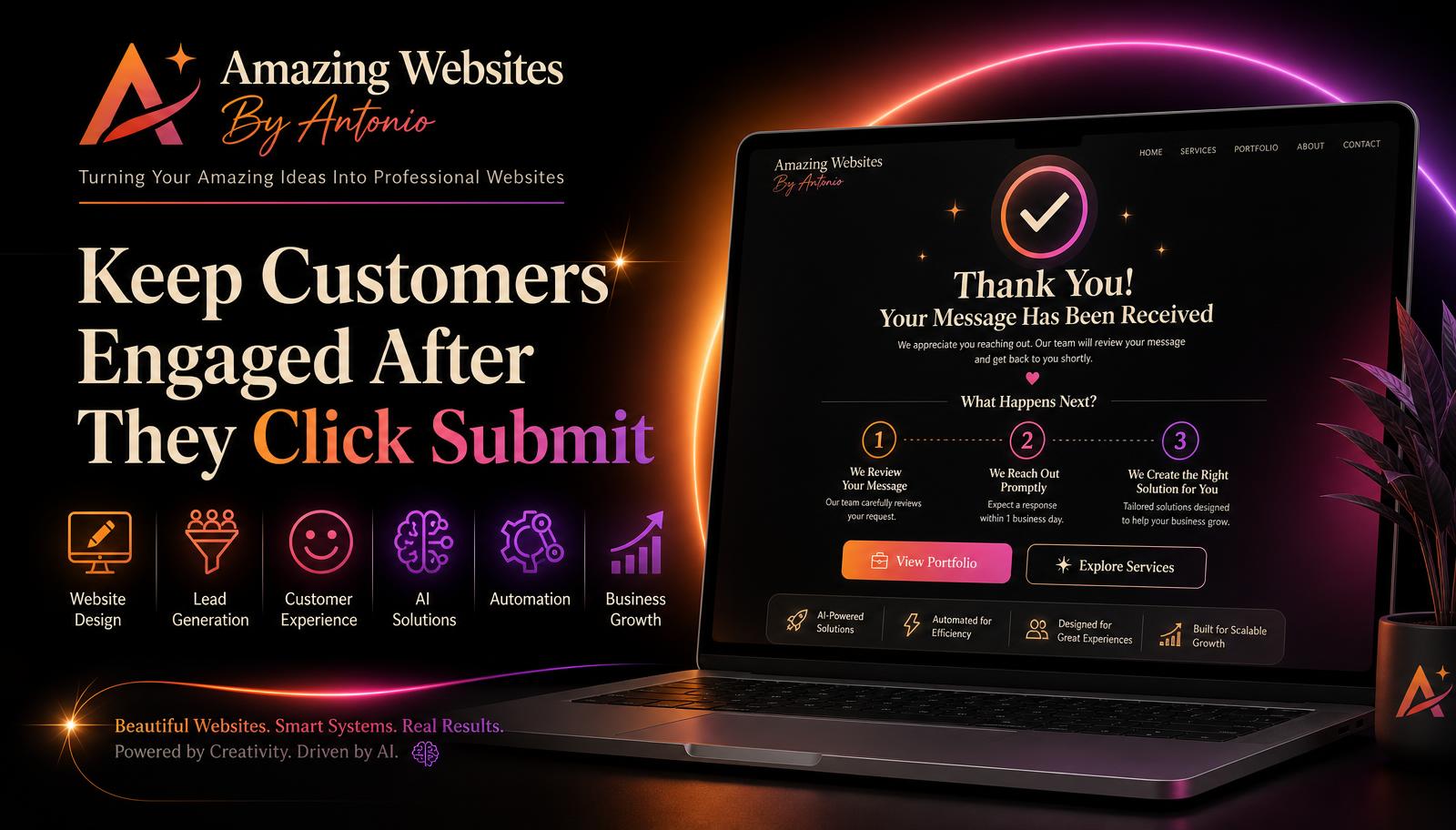
THANK YOU FOR CONTACTING AMAZING WEBSITES BY ANTONIO!
Your information has been received.
We'll review what you submitted and follow up regarding the next steps.
Simple. Clear. Reassuring.
2. Tell Them What Happens Next
Customers feel more confident when they know what to expect.
You could include:
WHAT HAPPENS NEXT?
STEP 1: We've received your information.
STEP 2: We'll review your business needs and project details.
STEP 3: We'll follow up to discuss your project and the appropriate next steps.
Now the customer isn't left wondering what happens behind the scenes.
3. Give a Realistic Response Expectation
If you have a standard response timeframe, communicate it.
For example:
“We typically respond within one to two business days.”
Only publish a timeframe you can realistically maintain.
If your schedule varies, you can simply say:
“We'll review your request and respond as soon as possible.”
Never make a promise your business may not be able to keep.
4. Keep Your Brand Visible
Your thank-you page is still part of your wdditional information about your project, contact Amazing Websites By Antonio.
This gives them another way to communicate without submitting the entire form again.
10. Use a Thank-You Page for Different Actions
You don't necessarily need one thank-you message for everything.
Different actions can have different confirmation pages.
For example:
- CONTACT FORM: “Thank you! We've received your project inquiry.”
- TESTIMONIAL SUBMISSION: “Thank you for sharing your experience. Your testimonial has been submitted for review.”
- NEWSLETTER SIGN-UP: “Welcome! You're now subscribed.”
- QUOTE REQUEST: “Your quote request has been received.”
- PURCHASE: “Thank you for your order.”
Different messages create a more personalized experience.
11. Connect the Thank-You Page to Automation
This is where things can become powerful.
When someone submits a form, your website could automatically:
- Send a confirmation email
- Notify you about the new lead
- Add the customer to your lead-management system
- Create a follow-up task
- Categorize the inquiry by service
- Trigger an appropriate workflow
The customer sees a simple thank-you page.
But behind the scenes, your business can already be preparing for the next step.
12. Use AI to Personalize the Next Step
AI could eventually make thank-you pages more personalized.
Imagine a customer contacting you about:
WEBSITE DESIGN
Their thank-you page could recommend:
“While you wait, take a look at our website portfolio.”
Another customer contacts you about:
AI AUTOMATION
Their page could recommend:
“Explore how AI and automation can help businesses save time.”
The next step becomes relevant to what the customer actually asked about.
13. Track Thank-You Page Visits
Thank-you pages can also help with website analytics.
If a visitor can only reach the page after completing a form, visits to that page can help you measure successful form submissions.
You can begin answering questions such as:
- How many website visitors become leads?
- Which pages generate the most inquiries?
- Which marketing campaigns generate contact submissions?
- Which services attract the most interest?
Your thank-you page can become part of measuring whether your website is actually working.
14. Test the Complete Experience
Don't test only the contact form.
Test everything that happens afterward.
Submit the form yourself.
Then check:
- Did the thank-you page appear?
- Was the message correct?
- Did you receive the lead notification?
- Did the customer confirmation work?
- Did the next-step buttons work?
- Did everything display correctly on mobile?
Your customer experience doesn't end when the Submit button is pressed.
15. End With a Positive Message
Finish the page with something that feels warm and professional.
For example:
THANK YOU FOR REACHING OUT.
We're excited to learn more about your idea and explore how we may be able to help bring it to life.
Amazing Websites By Antonio
Turning Your Amazing Ideas Into Professional Websites
From Submission to Relationship
A website form submission isn't the end of the customer journey.
It could be the beginning of a business relationship.
Think about the sequence:
- Visitor discovers your website.
- Visitor explores your services.
- Visitor develops trust.
- Visitor contacts you.
- Visitor receives confirmation.
- You follow up.
- A conversation begins.
That conversation could become a customer.
Your thank-you page may seem like a small piece of your website.
But small details can create a much more professional customer experience.
Pro Tip
Submit every important form on your website today.
Look carefully at what happens afterward.
If all you see is:
“Thank you.”
Ask yourself:
What else would be useful to the customer right now?
- Confirmation?
- A response expectation?
- A portfolio link?
- An FAQ?
- A helpful resource?
- A clear next step?
Turn that empty space into an opportunity to continue helping your customer.
Because a great website doesn't stop working after someone clicks Submit.
It keeps guiding them forward.
Amazing Websites By Antonio
Turning Your Amazing Ideas Into Professional Websites
Use your:
- Logo
- Brand colors
- Typography
- Business name
- Tagline
- Consistent visual style
For Amazing Websites By Antonio, the page should still feel modern, creative, professional, and connected to the rest of the website.
The experience shouldn't suddenly feel like the visitor was sent somewhere else.
5. Give Them Something Useful to Do
The visitor has already shown interest in your business.
Don't automatically send them to a dead end.
You could invite them to:
- View Our Portfolio
- Read Our Latest Blog
- Explore Our Services
- Learn About AI Solutions
- View Customer Testimonials
- Visit Our FAQ
The goal isn't to overwhelm them with ten buttons.
Choose one or two helpful next steps.
6. Show Them Your Work
After someone contacts you, they may continue researching your business while waiting for your response.
Your thank-you page is a great place to feature:
- A recent website
- A branding project
- A customer success story
- A portfolio link
- A testimonial
This can reinforce the decision they just made to contact you.
7. Build Additional Trust
The customer just shared information with your business.
Use the thank-you page to reinforce professionalism.
You could include a short message such as:
“Thank you for considering Amazing Websites By Antonio. We appreciate the opportunity to learn about your business and what you're looking to create.”
That feels much more personal than:
“Submission received.”
8. Don't Immediately Try to Sell Them Everything
A thank-you page should continue the relationship—not turn into a giant sales pitch.
Avoid immediately showing:
- BUY THIS!
- UPGRADE NOW!
- ADD FIVE MORE SERVICES!
Instead, focus on reassurance and useful next steps.
The customer has already taken action.
Respect that.
9. Include Your Contact Information When Appropriate
Sometimes customers realize after submitting a form that they forgot something.
You could include:
NEED TO ADD SOMETHING?
If you need to provide a