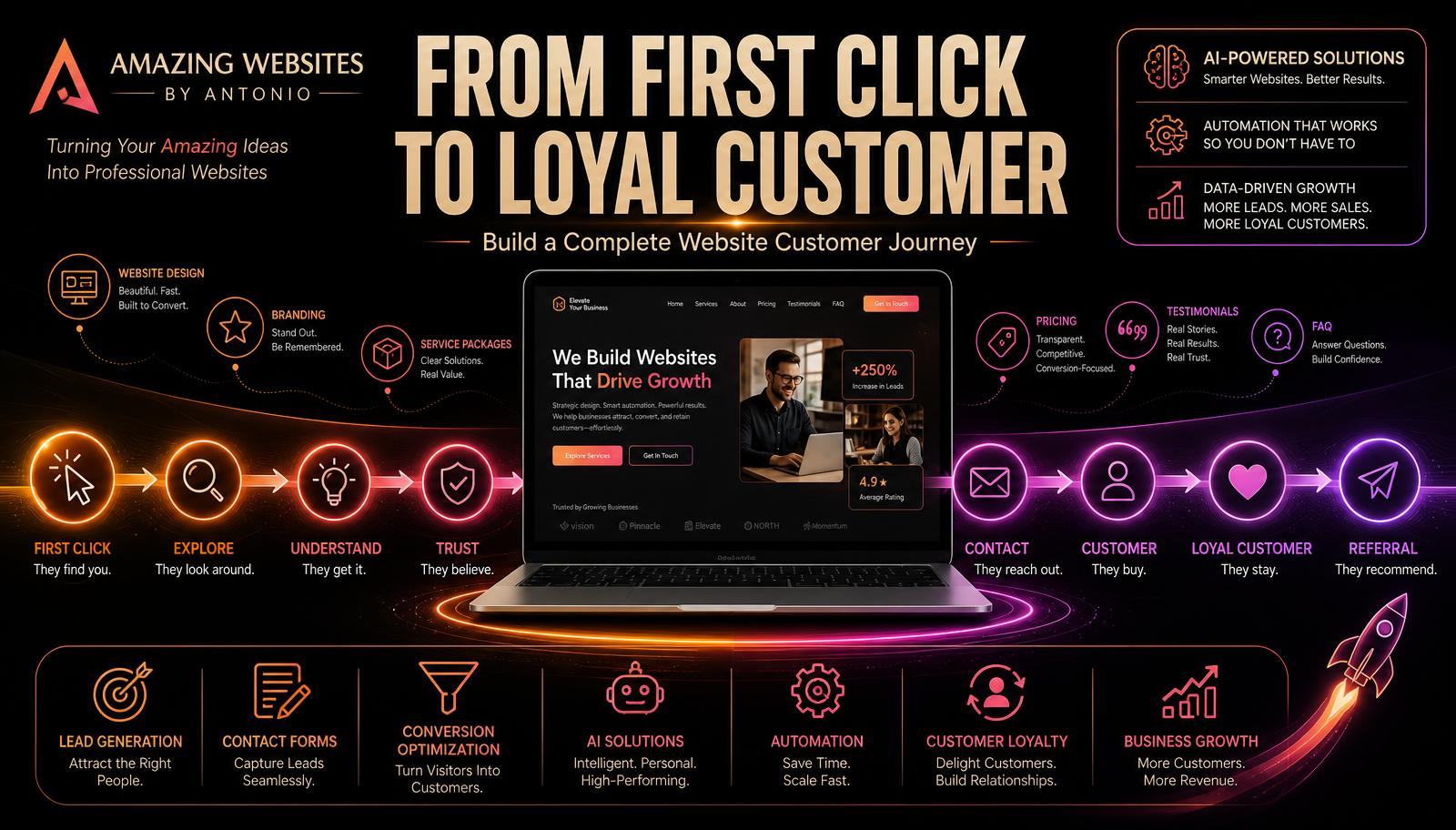
A great business website isn't simply a collection of pages.
It's a journey.
Someone may discover your business for the first time through Google, social media, a referral, an advertisement, or a link.
They click.
They arrive on your website.
And from that moment forward, every page, headline, button, image, service description, testimonial, FAQ, and contact form can influence what happens next.
Will they leave?
Will they explore?
Will they trust you?
Will they contact you?
Will they become a customer?
And eventually, will they come back?
Let's look at how your entire website can work together to guide someone from their very first click to becoming a loyal customer.
1. Stage One: Discovery
Every customer journey has a beginning.
Someone discovers your business.
Maybe they searched:
- “Website designer for my business.”
- “Help creating a professional website.”
- “AI solutions for small businesses.”
- “Business branding services.”
Or perhaps they saw your work on social media.
At this stage, your website has one important job:
Help the visitor immediately understand where they've landed.
Your homepage should quickly communicate:
- Who you are.
- What you do.
- Who you help.
- Why it matters.
- What they should do next.
Don't make new visitors solve a puzzle.
Clarity is the beginning of a strong customer journey.
2. Stage Two: First Impression
People form opinions quickly.
Your website's design can influence whether someone feels confident continuing.
Look at:
- Professional design
- Consistent branding
- Easy-to-read typography
- Clear navigation
- Mobile responsiveness
- Quality visuals
- Fast loading
- Working links
Your website doesn't have to be overloaded with effects.
It needs to feel intentional, professional, and trustworthy.
3. Stage Three: Exploration
Now the visitor wants to learn more.
They may visit:
- About
- Services
- Portfolio
- Blog
- Testimonials
- Pricing
- FAQ
Your navigation should make those areas easy to find.
Think of your website like a building.
Visitors shouldn't need a map just to locate the front desk.
Guide them naturally.
4. Stage Four: Understanding the Services
Visitors need to understand what you're actually offering.
Each service should answer:
- What is this?
- Who is it for?
- What problem does it solve?
- What are the benefits?
- What happens next?
For Amazing Websites By Antonio, that could mean clearly explaining services involving:
- Professional websites
- Branding
- AI solutions
- Automation
- Digital tools
- Creative services
- Business growth solutions
Don't assume customers understand industry terminology.
Explain services through the customer's goals.
5. Stage Five: Helping Them Choose
Understanding your services doesn't automatically mean knowing which one to buy.
This is where service packages, comparison tools, guided questions, and clear recommendations can help.
You might offer:
- Starter
- Growth
- Premium
- Custom Solution
Then explain who each option is best for.
Make choosing easier—not harder.
6. Stage Six: Building Trust
Before contacting you, potential customers may ask themselves:
- Can I trust this business?
- Have they done this before?
- Will they understand what I need?
Trust can be strengthened through:
- Portfolio projects
- Customer testimonials
- Professional branding
- Clear processes
- Helpful educational content
- Accurate information
- Transparent communication
Don't simply tell visitors you're trustworthy.
Give them reasons to believe it.
7. Stage Seven: Answering Questions
Questions create hesitation when they remain unanswered.
Your FAQ can address things such as:
- How does the process work?
- What does a service include?
- How much could it cost?
- How long could it take?
- Can services be customized?
- What happens after I contact you?
- Can you help if I don't know what I need?
Every useful answer removes a little uncertainty.
8. Stage Eight: Creating Pricing Clarity
Customers may not need an exact price immediately, but they usually want some understanding of the investment.
Depending on your business, you could use:
- Fixed pricing
- Starting-at pricing
- Service packages
- Custom quotes
- Consultation-based pricing
Explain what's included and what could affect the final cost.
Pricing clarity can help build trust.
9. Stage Nine: Making Contact Easy
Eventually, an interested visitor needs a way to become a lead.
Your Contact page should be easy to find and easy to use.
Ask only for information you actually need.
For example:
- Name
- Business
- Service of Interest
- Project Goals
- Message
Then give them a clear button:
- Start Your Project
- Request a Quote
- Let's Talk
- Get Started
Don't make a ready customer work hard to contact you.
10. Stage Ten: Confirming Their Action
They press Submit.
The journey isn't over.
Show a professional thank-you page that confirms:
- Their message was received.
- What happens next.
- When they can reasonably expect a response.
- Where they can continue exploring your business.
That small detail creates reassurance.
11. Stage Eleven: Following Up
Your website generated a lead.
Now your business needs to continue the experience.
Follow up professionally.
Review what the customer submitted.
Respond to their questions.
Explain the next steps.
Don't make customers repeat information they've already given you unnecessarily.
A strong website experience followed by poor communication can still lose the customer.
12. Stage Twelve: Turning the Lead Into a Customer
Once you've spoken with the potential customer, make moving forward easy.
They should understand:
- What you're providing.
- The price.
- Payment expectations.
- Timeline.
- What you need from them.
- What happens next.
Clarity shouldn't disappear once the customer leaves your website.
13. Stage Thirteen: Delivering a Great Experience
Getting the sale isn't the finish line.
Now you need to deliver.
Keep customers informed.
Communicate clearly.
Set expectations.
Ask questions when needed.
Make it easy for customers to provide the materials you need.
A good customer experience can create more than one transaction.
It can create trust.
14. Stage Fourteen: After the Project
What happens after the work is finished?
This stage is often forgotten.
You could:
- Thank the customer
- Provide useful instructions
- Offer appropriate support
- Ask for feedback
- Invite them to submit a testimonial
- Recommend relevant future services
Don't disappear immediately after delivery.
The relationship may have additional value for both sides.
15. Stage Fifteen: Turning Customers Into Returning Customers
A customer who already knows and trusts your business can be extremely valuable.
Their needs may grow.
A website customer may later need:
- Branding
- Automation
- AI tools
- Website updates
- Additional digital products
- Business growth solutions
The goal isn't to pressure customers into purchasing more.
It's to remain useful as their needs evolve.
16. Stage Sixteen: Turning Customers Into Advocates
A happy customer may tell someone else about you.
They may:
- Leave a testimonial
- Recommend your business
- Share your work
- Tag you on social media
- Return for another service
Word-of-mouth can become part of the customer journey too.
Give customers an experience worth talking about.
17. Use Content to Keep the Relationship Going
Your blog isn't only for new visitors.
Existing customers can benefit from your content too.
Helpful articles can keep your business connected to your audience long after someone's first website visit.
That's one reason consistent content can become such an important part of your digital presence.
18. Use AI Throughout the Customer Journey
AI can support different stages of the experience.
AI could help:
- Answer common questions
- Guide visitors toward services
- Recommend packages
- Assist with lead qualification
- Personalize website experiences
- Support follow-up workflows
- Analyze customer behavior
- Identify common questions
The purpose of AI shouldn't be to remove the human relationship.
It should help make the customer experience more useful and efficient.
19. Use Automation Behind the Scenes
Automation can help your business respond consistently.
For example:
Form Submitted → Confirmation sent → Lead organized → Business notified → Follow-up task created → Customer contacted
The customer experiences a smooth process.
Behind the scenes, automation helps make that process possible.
20. Measure the Entire Journey
Don't measure website success only by traffic.
Ask:
- How are visitors finding us?
- Which pages are they viewing?
- Which services receive the most interest?
- Where are visitors leaving?
- How many people contact us?
- How many leads become customers?
- How many customers return?
- How many customers refer others?
Those questions tell you much more than:
“How many website visits did I get?”
21. Find the Weak Link
A customer journey is only as strong as the experience connecting each stage.
You could have:
- A beautiful homepage but confusing services.
- Great services but no testimonials.
- Great testimonials but unclear pricing.
- Clear pricing but a difficult contact form.
- A great contact form but poor follow-up.
Look at the entire journey.
Sometimes one weak point can prevent everything else from working.
22. Think Like Your Customer
One of the best ways to improve your website is to stop looking at it like the person who built it.
Pretend you've never seen it.
Ask:
- Where am I?
- What does this business do?
- Is this for me?
- Why should I trust them?
- What should I choose?
- How much might it cost?
- What if I have questions?
- How do I contact them?
- What happens afterward?
If your website answers those questions naturally, you're creating a much stronger experience.
From First Click to Loyal Customer
A website isn't finished simply because every page has been published.
The real question is:
Does everything work together?
Discovery leads to understanding.
Understanding leads to trust.
Trust leads to action.
Action leads to communication.
Communication can lead to a customer.
A great experience can lead to loyalty.
And loyalty can lead to referrals.
That's the complete customer journey.
Pro Tip
Take your own customer journey today.
Start at your homepage.
Then pretend you're a brand-new visitor.
Navigate through your:
- Homepage
- Services
- Portfolio
- Testimonials
- Pricing
- FAQ
- Contact page
- Thank-you experience
At every stage, ask:
“What would I naturally want to do next?”
Then make sure your website provides that next step.
Your website shouldn't simply exist online.
It should guide.
It should communicate.
It should build trust.
It should create opportunities.
And it should help turn the right visitors into lasting customers.
Amazing Websites By Antonio
Turning Your Amazing Ideas Into Professional Websites