The moment has finally arrived.
Your website is LIVE! 🎉
After all the planning... designing... writing... developing... reviewing... revising... testing... and approving...
Your website is officially available to the world.
That's a major accomplishment.
But launch day isn't the end of your website journey.
It's the beginning of a new stage.
Now you can see how the website performs in the real world.
- Real visitors begin clicking.
- Real customers begin exploring.
- Real forms begin receiving submissions.
- Real data begins becoming available.
And your website can begin growing alongside your business.
Here are some of the most important things to do after your website goes live.
1. Visit the Live Website Yourself
Once the website is published, open the actual live domain.
Don't assume everything works simply because it worked before launch.
Visit the website as if you were a customer seeing it for the first time.
Ask:
- Does the website load?
- Does it look right?
- Is the correct website showing?
- Does anything immediately seem broken?
Your first post-launch check should begin with the actual live experience.
2. Check Every Important Page Again
Yes—you checked the pages before launch.
Check them again.
Review:
- Home
- About
- Services
- Portfolio
- Testimonials
- Blog
- FAQ
- Contact
- Shop
- Booking
- Resources
- Legal pages
- Any custom pages
Publishing can sometimes reveal issues that weren't visible in a preview or development environment.
3. Test the Navigation
Click through the main menu.
Test:
- Desktop navigation
- Dropdown menus
- Mobile menu
- Logo/home link
- Footer navigation
- Important internal links
Make sure visitors can move around the live website without getting lost.
4. Test Every Important Call to Action
Check buttons such as:
- START YOUR PROJECT
- CONTACT US
- VIEW SERVICES
- VIEW PORTFOLIO
- BOOK NOW
- SHOP NOW
- LEARN MORE
- READ MORE
Every important button should take visitors where you intended.
5. Submit the Contact Form
One of your first live tests should be a real contact-form submission.
Enter test information.
Submit it.
Then verify:
- Did the form submit successfully?
- Did the confirmation appear?
- Did the message arrive?
- Did it go to the correct email or system?
- Did any notification work correctly?
Never assume a form works until you've tested the full live process.
6. Test Other Important Forms
Depending on the website, also test:
- Newsletter signup
- Project intake
- Quote request
- Testimonial submission
- Appointment request
- Registration
- Feedback forms
A form isn't fully tested until you know what happens after someone presses the button.
7. Test the Website on Your Phone
Open the live website on a real smartphone.
Don't rely only on a desktop mobile preview.
Check:
- Navigation
- Text
- Images
- Buttons
- Forms
- Videos
- Popups
- Footer
- Scrolling
- Calls to action
A real device can sometimes reveal issues that previews don't.
8. Check Tablet and Desktop Experiences
When possible, review the live site across different screen sizes.
The goal is a consistent experience—not an identical layout.
Each screen size should feel intentional and easy to use.
9. Check Important Browsers
If practical, review the website in major browsers used by your audience.
Pay special attention to:
- Navigation
- Forms
- Animations
- Custom features
- Video
- Layout
Browser differences can occasionally affect how something behaves.
10. Verify the Domain and HTTPS
Check the address bar.
Make sure visitors are reaching the intended domain.
Verify that the website loads securely over HTTPS.
Also test important domain variations or redirects if they were configured.
11. Look for Broken Links
Test internal and external links again.
Look for:
- 404 pages
- Old URLs
- Incorrect destinations
- Broken social links
- Missing blog posts
- Broken buttons
Fix broken links quickly.
12. Review Your 404 Page
What happens when someone visits a page that doesn't exist?
A useful 404 page can include:
- A friendly explanation
- Link to Home
- Link to Services
- Search when available
- Contact option
- Helpful navigation
A wrong turn doesn't have to become a dead end.
13. Check Search-Engine Visibility
If the website is intended to appear in search engines, confirm that important public pages aren't accidentally set to remain hidden from indexing.
Review your website platform's search visibility settings and other applicable SEO controls.
Remember that publishing a website does not mean it will instantly appear prominently in search results.
Discovery and ranking can take time.
14. Review Page Titles and Meta Descriptions
Check how important pages are labeled.
Review:
- Homepage title
- Service-page titles
- About-page title
- Contact-page title
- Blog titles
- Meta descriptions where supported
Make sure the information accurately represents the page.
15. Check Social Sharing Previews
When someone shares your website or a blog article, the link may generate a preview.
Check whether important pages have appropriate:
- Title
- Description
- Featured image
A polished link preview can make shared content look more professional.
16. Verify Analytics
If you're using analytics, make sure it is collecting the intended information.
Don't simply install analytics and forget about it.
Verify that the setup is functioning.
Depending on your goals, useful measurements may include:
- Website visits
- Popular pages
- Traffic sources
- Form submissions
- Purchases
- Bookings
- Important calls to action
Collect data that helps you make decisions.
17. Establish a Baseline
Early website data can become useful later.
Record initial measurements when appropriate.
Then you can compare:
- First month.
- Third month.
- Sixth month.
- One year.
Growth becomes easier to understand when you have something to compare it with.
18. Monitor Website Performance
Keep an eye on how quickly important pages load.
Watch for:
- Oversized images
- Heavy video
- Unnecessary scripts
- Slow third-party integrations
- Large animations
Website performance can change as new content and features are added.
19. Check for Technical Errors
Watch for problems such as:
- Missing images
- Broken layouts
- Form failures
- Server errors
- Failed integrations
- Unexpected redirects
- Pages that don't load
Address important problems quickly.
20. Test E-Commerce After Launch
If the website sells products, carefully verify the live shopping experience using safe testing methods appropriate for the platform.
Review:
- Product pages
- Prices
- Variants
- Cart
- Checkout
- Payment configuration
- Shipping
- Taxes where applicable
- Order notifications
- Confirmation emails
A store needs ongoing attention after launch.
21. Test Booking Systems
If the website accepts appointments, verify:
- Available dates
- Available times
- Time zones
- Confirmation
- Calendar integration
- Reminders
- Rescheduling
- Cancellation
Make sure the customer experience matches the business's actual availability.
22. Review Security
Security doesn't end at launch.
Continue reviewing appropriate protections such as:
- Strong passwords
- Multi-factor authentication where available
- Platform updates
- Plugin or integration updates where applicable
- User access
- Backups
- Security notifications
Remove access that is no longer needed.
23. Confirm Your Backup or Recovery Process
Know how your website can be restored if something goes wrong.
Depending on your platform, this may involve:
- Automatic backups
- Manual backups
- Version history
- Restore points
- Platform recovery tools
Don't wait for a problem to learn how recovery works.
24. Announce the Website Launch
Your website is live.
Tell people!
You might announce it through:
- Newsletter
- Business community
- Existing customers
- Networking groups
Give people a reason to visit.
25. Show People What's New
Instead of simply saying:
"Our new website is live!"
Explain what visitors can find.
For example:
OUR NEW WEBSITE IS LIVE!
Explore:
- ✓ Our services
- ✓ Our latest work
- ✓ Helpful resources
- ✓ Customer testimonials
- ✓ Our blog
- ✓ Ways to contact us
Make the announcement useful.
26. Ask Trusted People to Test It
Fresh eyes can catch things you've stopped noticing.
Ask a few trusted people to explore the website.
You can ask:
- Was anything confusing?
- Could you find the services?
- Was contacting the business easy?
- Did anything look broken?
- What stood out?
You don't have to make every suggested change.
But patterns in feedback can reveal useful opportunities.
27. Watch How Visitors Use the Website
Analytics and privacy-appropriate user-experience tools can sometimes reveal patterns.
- Maybe visitors frequently view one service.
- Maybe a page receives traffic but few people continue.
- Maybe a call to action gets little engagement.
Use evidence to identify questions worth investigating.
28. Don't Panic Over Early Data
A brand-new website may not have enough traffic to support strong conclusions.
Ten visitors aren't the same as ten thousand.
Give your website time to collect useful information.
Look for meaningful patterns rather than reacting to every number.
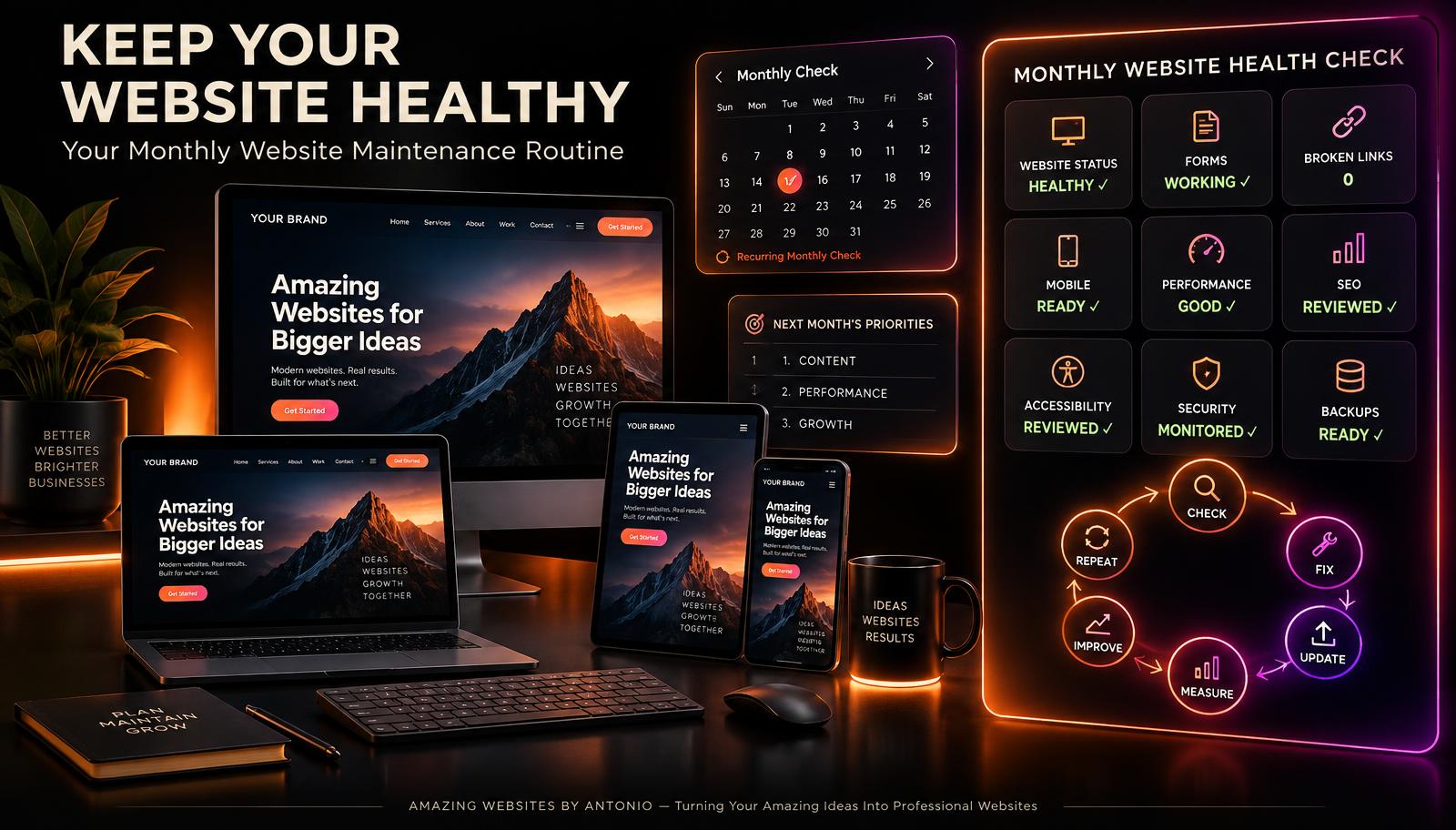
29. Create a Website Maintenance Routine
Decide how often you'll review the website.
For example:
WEEKLY
- Check important forms
- Review urgent issues
MONTHLY
- Check broken links
- Review analytics
- Update important content
- Review performance
QUARTERLY
- Review services
- Update portfolio
- Review testimonials
- Check SEO opportunities
- Review accessibility
- Review security and access
The exact schedule depends on the website.
The important part is having a routine.
30. Keep Business Information Current
Businesses change.
Update the website when:
- Phone numbers change
- Email addresses change
- Hours change
- Services change
- Team members change
- Prices change
- Locations change
- Policies change
An outdated website can create confusion.
31. Continue Publishing Helpful Content
Launch isn't the end of your content strategy.
Continue adding useful content such as:
- Blog posts
- Case studies
- Portfolio projects
- Testimonials
- FAQs
- Resources
- Business updates
A growing website can continue providing new reasons for people to return.
32. Keep Your Portfolio Current
Your newest work may eventually become your strongest work.
- Add new projects.
- Improve project descriptions.
- Create case studies.
- Remove outdated examples when appropriate.
Your portfolio should evolve with your skills and business.
33. Continue Collecting Testimonials
New customer experiences can become new proof.
Create an organized process for requesting, reviewing, and publishing testimonials with appropriate permission.
Keep testimonials authentic.
Don't invent reviews.
34. Review Your Calls to Action
As data and customer feedback become available, ask:
- Are people contacting us?
- Are visitors finding the services?
- Are calls to action clear?
- Are important buttons visible?
- Do visitors know what to do next?
Improve the customer journey based on evidence.
35. Continue Improving Accessibility
Accessibility isn't a one-time checkbox.
New:
- Pages
- Images
- Forms
- Videos
- Blog posts
- Features
can introduce new accessibility considerations.
Include accessibility in your ongoing website process.
36. Keep Learning From the Website
Your website can teach you about your audience.
Over time, you may discover:
- Which services attract attention.
- Which blog topics perform well.
- Which pages lead to inquiries.
- Which questions customers ask repeatedly.
- Which content needs improvement.
Use those lessons to make smarter decisions.
37. Don't Redesign Everything Too Quickly
After launch, you may immediately notice things you want to change.
That's normal.
But don't rebuild the entire website every week.
- Give the design time.
- Collect feedback.
- Gather data.
- Fix genuine problems quickly.
- Test larger ideas thoughtfully.
Constant unnecessary changes can make it difficult to understand what is actually working.
38. Create a Website Improvement List
Instead of immediately implementing every new idea, maintain a list.
For example:
FUTURE WEBSITE IMPROVEMENTS
- □ Add new case study
- □ Improve FAQ
- □ Add customer video testimonials
- □ Create new resource
- □ Improve service comparison
- □ Add new automation
- □ Update portfolio
Then prioritize changes based on business value.
39. Celebrate the Launch
Don't become so focused on the next task that you forget what you accomplished.
A website launch represents:
- An idea.
- A plan.
- A design.
- A build.
- A review.
- A revision process.
- Testing.
- Collaboration.
And finally:
A real website available to the world.
Celebrate that milestone.
40. Remember That a Website Is Never Really "Finished"
A professional website isn't a poster hanging on a digital wall.
It's a living part of your business.
It can:
- Grow.
- Change.
- Teach.
- Connect.
- Generate opportunities.
- Share your story.
- Show your work.
- Support your customers.
And evolve as your business evolves.
Final Thoughts
Your website is live.
Now help it grow.
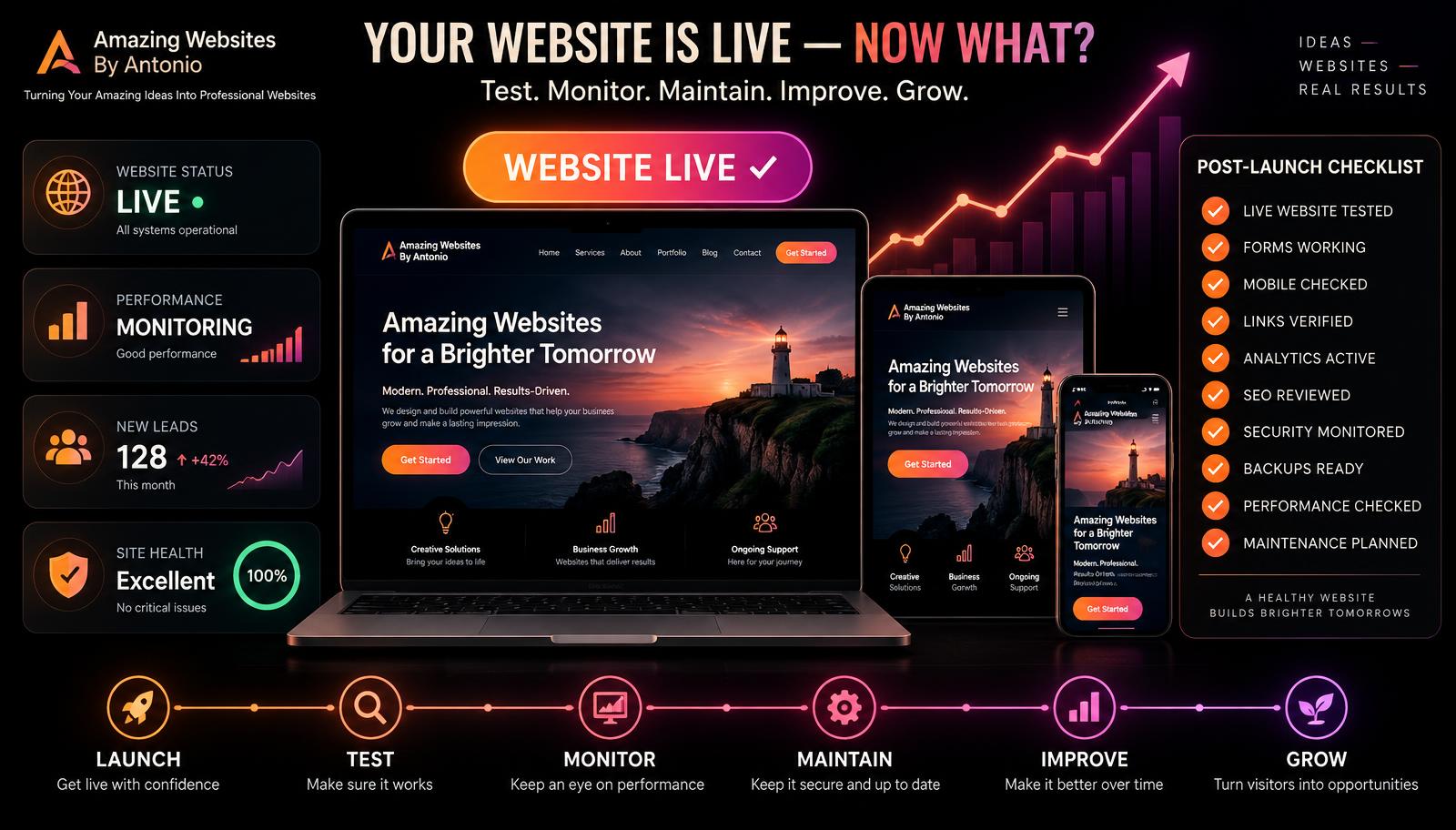
Test it. Monitor it. Maintain it. Protect it. Update it. Measure it. Learn from it. Improve it.
And keep giving people reasons to come back.
Launch day isn't:
THE END.
It's:
THE BEGINNING.
Because the goal isn't simply to launch a professional website.
The goal is to build a website that continues working for your business long after launch day.
Amazing Websites By Antonio
Turning Your Amazing Ideas Into Professional Websites