Amazing Websites By Antonio LogoAmazing Websites By Antonio
Home💌 Letter From Founder✨ Success Center📚 Smart Resource Center🚀 Business Growth Suite🤝 Community🌐 Ecosystem🔬 Innovation Lab🌍 Global Network🌟 V3.1🎯 Command Center🎓 Academy✨ Complete Vision🔭 Master Vision 2040📜 Charter✍️ Signature Line🛍️ Marketplace🎙️ Media Center🌈 Brand Experience🏆 Hall of Success🏛️ Legacy Center📖 Constitution📊 Impact Report🧭 Journey Center🏅 Excellence BlueprintDashboardSearchOur Mission🌟 Our VisionStart Here🎓 Learning JourneysWhere Should I Start?Resource FinderWebsite Health CheckVersion 2.0 Roadmap🗺️ 2030 RoadmapServices🎨 Brand Identity📢 ManifestoPortfolioSuccess StoriesTestimonialsCredentialsBlog🎨 Comic StudioFree ResourcesResource CenterAI Learning HubPrompt LibraryNewsletterContact
All articles
🧭 Website Strategy & User Experience

How to Use Internal Links to Keep Visitors Exploring Your Website Longer

Your website is made up of individual pages — but they shouldn't feel like separate islands. Internal links connect your homepage, services, portfolio, blog, and contact page into one connected journey that keeps visitors exploring.

Antonio Humann Sep 21, 2026 7 min read Share on LinkedInShare on YouTube
How to Use Internal Links to Keep Visitors Exploring Your Website Longer

Your website is made up of individual pages.

But those pages shouldn''t feel like separate islands.

Your homepage, services, portfolio, testimonials, blog, FAQ, About page, and contact page should work together.

One of the simplest ways to connect them is through internal links.

An internal link is a link that takes a visitor from one page of your website to another page on the same website.

For example:

  • A blog post might link to a service.
  • A service might link to a portfolio project.
  • A portfolio project might link to a case study.
  • A case study might link to your contact page.

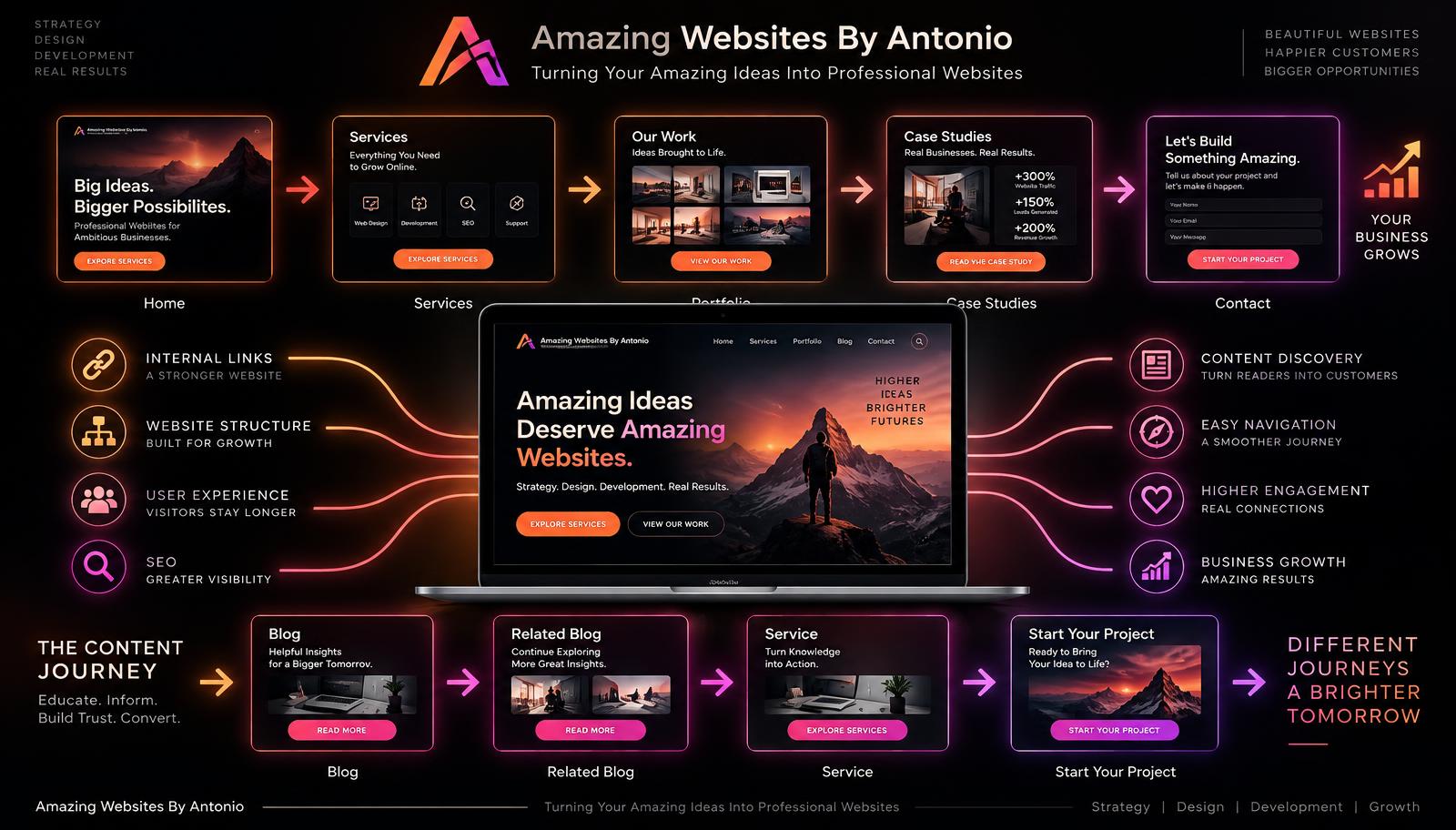
These connections help create a journey.

Instead of visitors reaching the end of a page and leaving, internal links give them another useful place to go.

Here are some ways to use internal links more effectively.

1. Think About the Customer Journey

Before adding links everywhere, think about what your visitor might want to do next.

Someone reading about Website Design may want to:

  • View website projects
  • Read a case study
  • Understand your process
  • Review testimonials
  • Explore pricing
  • Contact you

Your internal links can guide them toward those next steps.

The goal isn''t simply to create more clicks.

The goal is to create useful clicks.

2. Link Related Content

Internal links are most useful when the destination is relevant to what someone is already reading.

For example:

  • If you''re discussing website testimonials, link to your Testimonials page.
  • If you''re writing about branding, link to your Branding service.
  • If you''re explaining case studies, link to your Case Studies or Portfolio section.
  • If you''re talking about getting started, link to your Contact or Project Intake page.

The connection should make sense.

3. Connect Your Blog to Your Services

Your blog can educate visitors.

Your services can show them how your business can help.

Connect the two.

For example, a blog about improving website design could include:

“Need help creating a professional website? Explore our Website Design services.”

This creates a natural path from education to service discovery.

4. Connect Your Services to Your Portfolio

If you describe a service, show visitors examples.

For example:

WEBSITE DESIGN

Learn about the service.

Then:

VIEW WEBSITE PROJECTS →

BRANDING

Learn about the service.

Then:

EXPLORE BRANDING WORK →

This allows visitors to move from:

“What do you offer?”

to:

“Show me what you''ve done.”

5. Connect Your Portfolio to Case Studies

A portfolio gives visitors a visual example.

A case study gives them the story behind it.

When possible, connect the two.

For example:

VIEW PROJECT →

READ THE FULL CASE STUDY →

This lets interested visitors explore the project more deeply.

6. Connect Case Studies to Your Contact Page

After someone sees a successful project, that may be the perfect moment to invite them to take action.

For example:

“Have an idea you''d like to bring to life?”

START YOUR PROJECT →

This creates a natural customer journey:

SERVICE → PORTFOLIO → CASE STUDY → CONTACT

7. Link Between Related Blog Posts

Your blog library becomes more valuable when articles connect to each other.

If one article discusses website navigation and another discusses website footers, those topics are related.

Link them.

You might say:

“Want to improve another important part of your navigation? Read our guide to creating a website footer that works harder for your business.”

This helps visitors discover more of your content.

8. Use Descriptive Link Text

Avoid using “click here” every time.

The words inside a link can help visitors understand where it leads.

Instead of:

CLICK HERE

Try:

  • EXPLORE OUR WEBSITE DESIGN SERVICES
  • READ OUR WEBSITE NAVIGATION GUIDE
  • VIEW OUR PORTFOLIO
  • LEARN ABOUT OUR PROCESS

Descriptive links create clearer expectations.

9. Don''t Overload Every Paragraph With Links

Internal links are helpful.

Too many can become distracting.

If nearly every sentence contains a link, visitors may not know which ones matter.

Use links where they genuinely improve the experience.

Quality matters more than quantity.

10. Link Important Pages More Often

Some pages are especially important to your business.

These might include:

  • Services
  • Portfolio
  • Contact
  • Testimonials
  • FAQ
  • Project Intake
  • Important cornerstone blog posts

Look for natural opportunities to connect relevant content to these pages.

11. Use Call-to-Action Links

Internal links don''t always have to appear inside paragraphs.

Buttons can also guide visitors.

For example:

  • EXPLORE SERVICES →
  • VIEW OUR WORK →
  • READ THE CASE STUDY →
  • LEARN MORE →
  • START YOUR PROJECT →
  • CONTACT US →

A strong button can make an important next step easier to notice.

12. Don''t Forget Your Homepage

Your homepage can serve as one of the main hubs of your website.

It can link visitors to:

  • Services
  • Portfolio
  • Testimonials
  • About
  • Blog
  • FAQ
  • Contact

The homepage shouldn''t explain everything in full.

It should introduce important areas and help visitors decide where to explore next.

13. Use Your Footer to Connect Important Pages

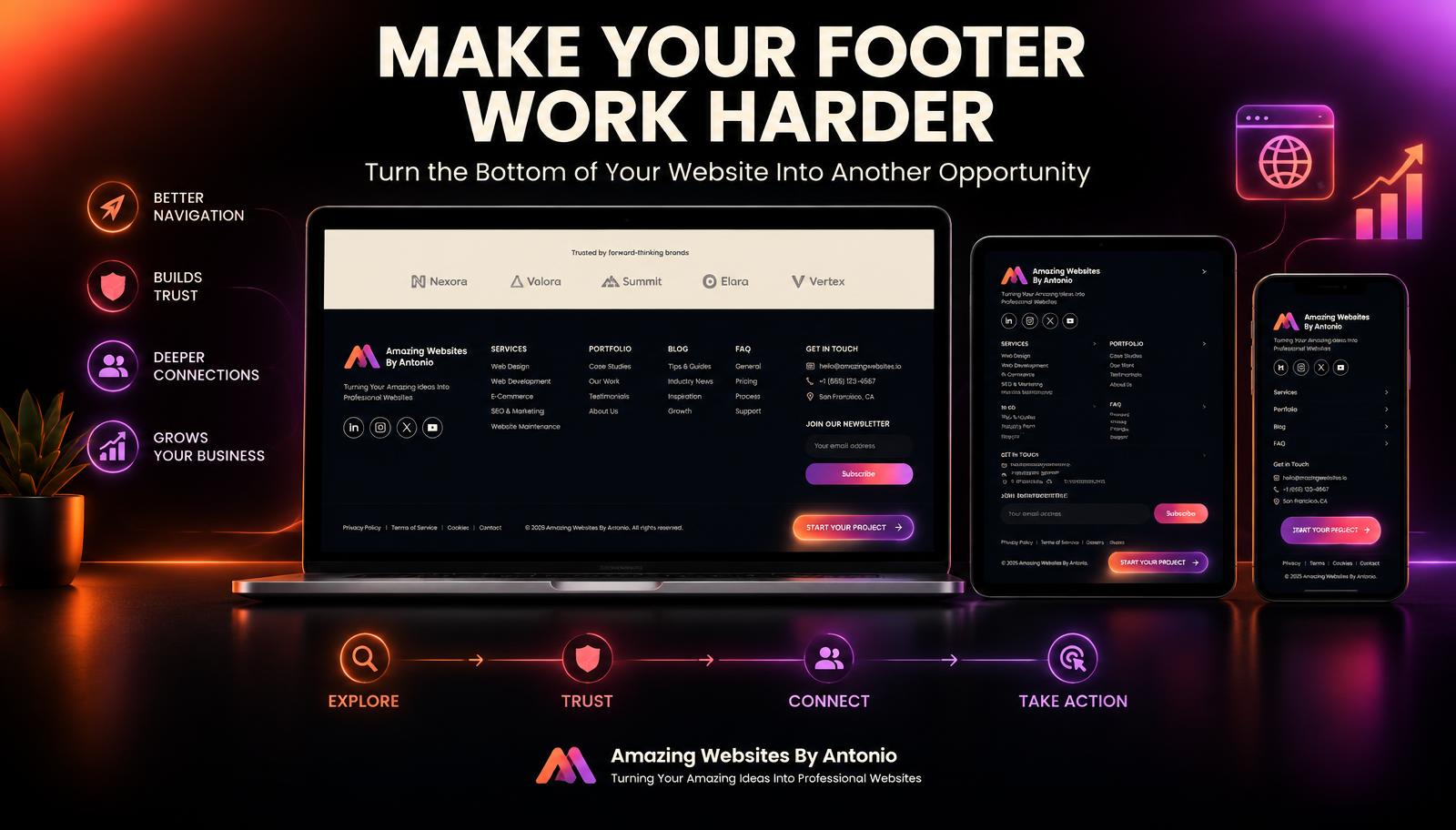
Your footer is another place for internal links.

Visitors who reach the bottom of a page may be ready to explore somewhere else.

Include useful destinations such as:

  • Services
  • Portfolio
  • Blog
  • FAQ
  • About
  • Contact

This creates another path forward.

14. Check for Broken Internal Links

Websites change.

Pages get renamed.

URLs change.

Old content gets removed.

That means internal links can eventually break.

Regularly check your website for links that lead to:

  • Missing pages
  • 404 errors
  • Old URLs
  • Deleted content
  • Incorrect destinations

Broken links interrupt the customer journey.

15. Update Old Blog Posts

Older content can still provide value.

When you publish a new article, look at previous posts that discuss related topics.

Could an older post link to the new one?

Could the new article link back to an older resource?

This gradually builds a connected library of useful content.

16. Create Topic Clusters

As your blog grows, you may have several articles about one larger topic.

For example:

WEBSITE DESIGN

  • Homepage design
  • Navigation
  • Services pages
  • Footers
  • Calls to action
  • Mobile design
  • Website accessibility

These related articles can link to one another.

That makes it easier for visitors to continue learning about a subject.

17. Use Internal Links to Answer Questions

Sometimes visitors need more information but you don''t want to repeat an entire explanation on every page.

That''s where internal links help.

For example:

“Have questions about the process? Visit our FAQ.”

“Want to see examples? Explore our Portfolio.”

“Want to learn more about us? Read our Founder''s Letter.”

You provide the answer without overcrowding the current page.

18. Make Sure Links Work on Mobile

Internal links need to be easy to use on smartphones and tablets.

Make sure:

  • Text links are easy to tap
  • Buttons are large enough
  • Links aren''t too close together
  • Hover-dependent features have mobile alternatives
  • The destination page is mobile-friendly too

The entire journey needs to work across devices.

19. Don''t Link Just for Search Engines

Internal linking can support SEO by helping search engines understand relationships between pages.

But your visitors should come first.

Don''t force awkward links into content just because you think they might help search rankings.

Create links because they are useful.

A better visitor experience and good website organization can support a stronger website overall.

20. Create a Website That Feels Connected

A great website isn''t simply a collection of pages.

It is a connected experience.

Each page can answer one question and lead naturally to another.

Your homepage introduces the business.

Your services explain how you help.

Your portfolio shows your work.

Your case studies demonstrate your process.

Your testimonials build confidence.

Your FAQ answers questions.

Your contact page provides the next step.

Internal links connect those pieces.

Final Thoughts

Every page on your website should have a purpose.

But it should also have a relationship with the rest of your website.

Ask yourself:

  • Where did this visitor probably come from?
  • What are they learning here?
  • What might they need next?
  • Where should I guide them?

Those questions can help you create better internal links.

Don''t leave your pages standing alone.

Connect them.

Build pathways.

Guide visitors toward useful information.

And create a website where every page helps lead naturally to the next.

Because sometimes one helpful link is all it takes to turn:

“I found this website.”

into:

“I want to keep exploring.”

Amazing Websites By Antonio

Turning Your Amazing Ideas Into Professional Websites
Share this article
Facebook Twitter LinkedInYouTube
Previous
How to Create a Website Footer That Works Harder for Your Business
Next
How to Create a Website Contact Form That People Actually Want to Fill Out
Continue your learning

Recommended for you

Smart picks based on this article's category, related topics, and what's trending on Amazing Websites By Antonio.

How to Create a Website Footer That Works Harder for Your Business
🧭 Website Strategy & User Experience

How to Create a Website Footer That Works Harder for Your Business

Your website footer may be the last section of a page, but it shouldn't be an afterthought. Learn 20 practical ways to design a footer that improves navigation, builds trust, and gives visitors one final clear call to action.

Sep 20, 2026 6 min read
Continue reading
How to Create Website Navigation That Helps Visitors Find What They Need Faster
🧭 Website Strategy & User Experience

How to Create Website Navigation That Helps Visitors Find What They Need Faster

Your website navigation acts like a map. It helps visitors understand where they are, where they can go, and how to find what they need. Here are 20 ways to create navigation that guides visitors faster.

Sep 19, 2026 6 min read
Continue reading
How to Keep Website Visitors Engaged Longer Without Overwhelming Them
🧭 Website Strategy & User Experience

How to Keep Website Visitors Engaged Longer Without Overwhelming Them

Discover how to keep website visitors engaged longer without overwhelming them. Learn practical strategies for clearer messaging, better navigation, interactive tools, and purposeful calls to action.

Aug 31, 2026 10 min read
Continue reading

Suggested learning path

A guided sequence through Website Strategy & User Experience.

  1. 1Step 1
    How to Keep Website Visitors Engaged Longer Without Overwhelming Them
  2. 2Step 2
    How to Create Website Navigation That Helps Visitors Find What They Need Faster
  3. 3Step 3
    How to Create a Website Footer That Works Harder for Your Business

Popular this week

Most read
The Future of Business Websites: What Every Entrepreneur Should Prepare For
Oct 10, 2026 · 10 min read
Recently updated
100 Ways to Make Your Business Website More Amazing
Oct 9, 2026 · 10 min read
Editor's pick
How to Turn Website Feedback Into a Customer Experience Improvement Plan
Oct 8, 2026 · 9 min read

Explore more categories

🤖AI for Business

AI, ChatGPT, automation, agents, prompts, and productivity for small businesses.

🧠Artificial Intelligence & Business Growth

How AI helps small businesses save time, reduce costs, improve productivity, and grow smarter.

🌐Website Design

Planning, homepages, landing pages, responsive design, UX, and best practices.

🧭Website Design & User Experience

Website design, user experience, accessibility, and creating websites that are intuitive and easy to use.

🎯Website Design & Conversion Strategy

Calls to action, landing pages, conversion optimization, and turning website visitors into customers.

⚡Website Performance & Business Growth

Website speed, performance optimization, conversions, and how a faster site drives business growth.

🌐Website Design & Business Growth

Website design, contact pages, landing pages, and business-focused web strategies that turn visitors into customers.

📊Website Strategy & Business Growth

Website analytics, strategy, planning, and data-informed decisions that help businesses grow online.

🚀Website Innovation & Business Growth

Future-ready websites, digital innovation, thoughtful AI, automation, and technology that supports business growth.

🎨Website Strategy & Branding

How website strategy, brand identity, and messaging work together to create a consistent customer experience.

🏆Website Strategy & Personal Branding

Building trust and credibility by showcasing expertise, experience, authentic stories, and professional value online.

🤝Website Strategy & Customer Experience

Building website trust, credibility, and customer confidence through strategic design, clear messaging, and thoughtful user experiences.

🤝Website Strategy & Client Experience

Client intake, onboarding, communication, and project processes that create a smooth, confident experience from first contact to launch.

🚀Client Experience & Business Growth

Client onboarding, welcome experiences, and building strong customer relationships that help businesses grow.

📋Client Experience & Project Management

Client communication, project updates, feedback, approvals, and keeping website projects organized from kickoff to launch.

🗂️Website Strategy & Project Management

Project planning, launch checklists, testing, approvals, and organizing website builds from start to launch.

🧰Website Strategy & Maintenance

Post-launch care, monitoring, backups, security, updates, and keeping a live website healthy and growing.

🧰Website Maintenance & Business Growth

Monthly maintenance routines, health checks, updates, monitoring, and ongoing care that keeps a website working for the business.

🧭Website Strategy & User Experience

Website engagement, user experience, navigation, and creating websites that guide visitors naturally without overwhelming them.

🎯Website Strategy & Lead Generation

Contact pages, lead capture, inquiry forms, and turning website visitors into qualified business leads.

🔍SEO & Digital Marketing

Search engine optimization, keyword strategy, and digital marketing foundations that help businesses get found online.

📊Website Analytics & Business Growth

Website metrics, analytics, conversions, and using data to make smarter business decisions and grow online.

🎨Branding

Brand identity, logos, colors, typography, strategy, and consistency.

🎨Branding & Business

Brand building, business identity, growth strategy, and customer experience for small businesses.

💎Branding & Business Growth

Brand messaging, value propositions, positioning, and differentiation that help businesses stand out and grow.

🎨Branding & Website Strategy

How brand storytelling, identity, and website strategy work together to create a memorable customer experience.

🤝Branding & Customer Connection

Founder stories, authentic messaging, and human-centered branding that help businesses build meaningful customer relationships.

📈Digital Marketing

Marketing, social, email, content, ads, and lead generation.

📈Digital Marketing & Business Growth

Digital marketing, social media, SEO, content strategy, and growth tactics that help businesses attract and convert customers.

🧲Lead Generation & Business Growth

Lead magnets, email capture, conversion strategy, and turning website visitors into loyal customers.

🤝Lead Generation & Customer Relationships

Lead follow-up, nurturing, communication, and building lasting customer relationships.

🚀Small Business Growth

Entrepreneurship, productivity, customer experience, and success stories.

🤝Customer Experience & Business Growth

Customer relationships, loyalty, communication, community building, and experiences that drive business growth.

🤝Customer Experience & Website Strategy

Customer feedback, usability, testing, and purposeful website improvements guided by customer needs and business goals.

🔒Website Security & Business Technology

Website security best practices, cybersecurity tips, technology safety, and protecting your business online.

📝Content Marketing & Business Growth

Content marketing strategy, blog writing, website copy, and valuable content that attracts, engages, and converts customers.

✍️Writing & Digital Content

Website copy, blog writing, content strategy, messaging, and storytelling that connects with your audience.

🛠️Resources & Guides

Tutorials, how-to's, checklists, beginner guides, and FAQs.

📚 Resource Center

Guides, templates, checklists, and tutorials for every stage.

Search another article

Looking for something specific? Search across every blog post and resource.

Get new articles by email

Subscribe for new blogs, AI resources, website tips, and platform updates.

Turning Your Amazing Ideas Into Professional Websites.

Keep exploring

Continue Your Learning

Learning doesn't stop with one article. Explore more resources, practical tools, and educational guides designed to help you build your skills, strengthen your business, and grow with confidence.

🤖 AI Learning Hub

Continue building your AI knowledge with beginner-friendly lessons, practical examples, and structured learning paths.

Explore the AI Learning Hub

💬 Prompt Library

Browse our growing collection of AI prompts for websites, marketing, branding, business, productivity, and content creation.

Open the Prompt Library

📚 Resource Center

Discover guides, templates, checklists, tutorials, and practical resources to support your digital journey.

Browse Resources

📝 Read Another Blog

  • How to Create a Website Footer That Works Harder for Your Business
    Sep 20, 2026 · 6 min read
  • How to Create Website Navigation That Helps Visitors Find What They Need Faster
    Sep 19, 2026 · 6 min read
  • How to Keep Website Visitors Engaged Longer Without Overwhelming Them
    Aug 31, 2026 · 10 min read
View All Blog Articles

🛠️ Interactive Tools

Continue learning with hands-on tools: Website Health Check, Where Should I Start? Quiz, and the Interactive Resource Finder.

Try the Interactive Tools

🌐 Professional Services

Need personalized support? Learn how Amazing Websites By Antonio can help with website design, branding, AI guidance, SEO, and digital strategy.

View Services

Every Step Forward Matters

Whether you're learning about AI, improving your website, strengthening your brand, or exploring new digital tools, every article you read brings you one step closer to achieving your goals. Our mission is to make learning practical, approachable, and valuable for everyone.

Stay Connected

Receive updates whenever we publish new educational articles, learning resources, and platform improvements.

Thank you for learning with Amazing Websites By Antonio. We're committed to helping entrepreneurs, nonprofits, creators, and small businesses continue learning, building, and growing with confidence.

Turning Your Amazing Ideas Into Professional Websites.

Amazing Websites By Antonio Logo

Amazing Websites By Antonio

Creating Professional Websites, AI Solutions, and Digital Experiences That Help Businesses Thrive.

Turning Your Amazing Ideas Into Professional Websites
Amazing Websites By Antonio exists to empower entrepreneurs, creators, educators, students, nonprofits, and small business owners through practical education, innovative technology, professional website solutions, and a supportive learning community.

Our mission is to help people transform ideas into opportunities by providing the knowledge, tools, resources, and confidence they need to succeed in today’s digital world.

Whether you’re building your first website, exploring artificial intelligence, strengthening your brand, growing your business, or learning new digital skills, we’re here to support every step of your journey.

Together, we’re creating a future where learning is accessible, innovation serves people, and success is built through curiosity, creativity, collaboration, and continuous growth.

Explore

  • Academy
  • AI Learning Hub
  • Learning Journeys
  • Educational Blog
  • Prompt Library
  • Smart Resource Center
  • Business Growth Suite
  • Community Platform
  • Marketplace & Creator Hub
  • Innovation Lab

Professional Services

  • Website Design
  • Website Audits
  • Branding Strategy
  • SEO Guidance
  • AI Consulting
  • Prompt Engineering
  • Digital Content Creation
  • Business Growth Planning

Connect With Us

Follow our journey as we continue building new educational resources, innovative tools, and opportunities that empower people to learn, create, build, grow, and succeed.

antonio.humann@gmail.com605-212-7171Listen to "Your Vision Starts Here"
Send a Message
© 2026 Amazing Websites By Antonio. All Rights Reserved.Helping People Build Brighter Digital Futures.