Amazing Websites By Antonio LogoAmazing Websites By Antonio
Home💌 Letter From Founder✨ Success Center📚 Smart Resource Center🚀 Business Growth Suite🤝 Community🌐 Ecosystem🔬 Innovation Lab🌍 Global Network🌟 V3.1🎯 Command Center🎓 Academy✨ Complete Vision🔭 Master Vision 2040📜 Charter✍️ Signature Line🛍️ Marketplace🎙️ Media Center🌈 Brand Experience🏆 Hall of Success🏛️ Legacy Center📖 Constitution📊 Impact Report🧭 Journey Center🏅 Excellence BlueprintDashboardSearchOur Mission🌟 Our VisionStart Here🎓 Learning JourneysWhere Should I Start?Resource FinderWebsite Health CheckVersion 2.0 Roadmap🗺️ 2030 RoadmapServices🎨 Brand Identity📢 ManifestoPortfolioSuccess StoriesTestimonialsCredentialsBlog🎨 Comic StudioFree ResourcesResource CenterAI Learning HubPrompt LibraryNewsletterContact
All articles
🤝 Website Strategy & Client Experience

How to Create a Website Project Intake Form That Helps You Understand Your Customer Before the First Meeting

A great project starts with understanding. Learn how to build a project intake form that helps you understand your customer's business, goals, audience, and vision before the first meeting.

Antonio Humann Sep 23, 2026 8 min read Share on LinkedInShare on YouTube
How to Create a Website Project Intake Form That Helps You Understand Your Customer Before the First Meeting

A potential customer has contacted your business.

They''re interested.

They have an idea.

And now it''s time to learn more about what they want to create.

This is where a project intake form can become incredibly useful.

A project intake form collects important information about a customer''s business, goals, audience, project needs, and expectations before the project moves forward.

It doesn''t replace a real conversation.

It makes that conversation more productive.

Instead of spending the entire first meeting gathering basic information, you can already understand the foundation of the project and use the meeting to explore the customer''s vision more deeply.

Here are some ways to create a project intake form that helps both you and your customer start the project with greater clarity.

1. Explain Why You''re Asking Questions

Don''t simply send someone a long form without context.

Start with a welcoming introduction.

For example:

“TELL US ABOUT YOUR AMAZING IDEA”

“We''d love to learn more about your business, goals, and vision. This form helps us understand your project before we begin so we can have a more productive conversation about bringing your idea to life.”

When customers understand why you''re requesting information, the form feels more purposeful.

2. Start With Basic Contact Information

Begin with easy questions.

For example:

  • Full Name
  • Business or Organization Name
  • Email Address
  • Phone Number — Optional
  • Current Website — If Applicable
  • Preferred Method of Contact

These questions establish who the customer is before moving into the project itself.

3. Ask About the Business

Before designing a website, you need to understand the business behind it.

Consider asking:

  • “What does your business or organization do?”
  • “What products or services do you offer?”
  • “How long have you been in business?”
  • “What makes your business different?”
  • “What is your mission?”

These answers can influence everything from website messaging to design decisions.

4. Understand the Project Goal

One of the most important questions is:

“What would you like this project to accomplish?”

A customer might want to:

  • Launch a new business
  • Create their first professional website
  • Redesign an existing website
  • Generate more leads
  • Sell products
  • Accept bookings
  • Build credibility
  • Promote services
  • Showcase a portfolio
  • Automate part of their business
  • Strengthen their brand

Understanding the goal helps you think beyond simply creating pages.

5. Ask Who the Target Audience Is

A website shouldn''t only reflect the business owner.

It also needs to serve the people who will use it.

Ask questions such as:

  • “Who are your ideal customers?”
  • “What type of people do you want your website to reach?”
  • “What problems are those customers trying to solve?”
  • “What do you want visitors to do when they reach your website?”

These answers can help shape the customer journey.

6. Ask What Type of Project They Need

Give customers a simple way to identify the services they''re interested in.

For example:

SELECT ALL THAT APPLY:

  • New Website
  • Website Redesign
  • Branding
  • Logo Design
  • AI Solutions
  • Automation
  • Digital Tools
  • Website Updates
  • Other

This gives you an early picture of the project''s scope.

7. Ask About Website Pages

If the project involves a website, ask what pages they think they need.

Examples might include:

  • Home
  • About
  • Services
  • Portfolio
  • Testimonials
  • Shop
  • Blog
  • FAQ
  • Contact
  • Booking
  • Resources
  • Other

Customers may not know exactly what they need yet.

That''s okay.

The form should start the conversation, not require them to design the website themselves.

8. Ask About Features

Different businesses need different functionality.

Ask whether they may need features such as:

  • Contact forms
  • Online payments
  • E-commerce
  • Appointment booking
  • Customer testimonials
  • Video
  • Audio
  • Newsletter signup
  • Social media integration
  • Blog
  • Search
  • Member accounts
  • AI-powered features
  • Automation
  • Downloadable resources

This can help identify technical requirements earlier.

9. Learn About Their Brand

Ask whether the customer already has:

  • A logo
  • Brand colors
  • Fonts
  • Brand guidelines
  • Professional photos
  • Written website content
  • Videos
  • Product images
  • Social media accounts

This helps you understand what already exists and what may still need to be created.

10. Ask About Design Preferences

Design is subjective.

Ask customers what they like.

For example:

“How would you describe the style you want?”

Possible choices might include:

  • Modern
  • Professional
  • Bold
  • Minimal
  • Elegant
  • Colorful
  • Creative
  • Corporate
  • Playful
  • Luxury

You can also ask:

“Are there websites you like? What do you like about them?”

This provides direction without copying someone else''s website.

11. Ask About Colors

If the customer already has established brand colors, you need to know.

Ask:

“Do you have existing brand colors?”

If yes:

“Please provide the colors or upload your brand guidelines.”

If not:

“Are there colors you''d like us to explore?”

Color choices should support the brand and audience rather than simply reflect personal preference.

12. Ask About Content

A website needs content.

Find out what the customer already has.

Ask:

  • “Do you already have written website content?”
  • “Do you have professional photographs?”
  • “Do you have product images?”
  • “Do you have testimonials?”
  • “Will you provide the content, or do you need help developing it?”

This can prevent delays later.

13. Ask About an Existing Website

If the customer already has a website, ask for the address.

Then ask:

  • “What do you like about your current website?”
  • “What would you like to improve?”
  • “What isn''t working?”
  • “Is there anything you definitely want to keep?”

This helps you understand the reason behind the redesign.

14. Ask About Competitors

Understanding the market can provide useful context.

You might ask:

“Who are some businesses or organizations you consider competitors or alternatives?”

You can also ask:

“What would you like your business to do differently?”

The goal isn''t to copy competitors.

It''s to better understand the environment in which the customer''s website will exist.

15. Ask About the Desired Customer Action

Every website should have a purpose.

Ask:

“What is the most important action you want visitors to take?”

Examples:

  • Contact the business
  • Request a quote
  • Book an appointment
  • Purchase a product
  • Donate
  • Subscribe
  • Download something
  • Visit a location
  • Learn about services

This helps determine calls to action throughout the website.

16. Ask About Timeline

Ask whether there is an important deadline.

For example:

“Is there a specific date when you need this project completed?”

If there is, ask why.

Maybe the customer has:

  • A business launch
  • An event
  • A product release
  • A conference
  • A campaign
  • A seasonal deadline

Knowing this early can help determine whether the timeline is realistic.

17. Ask About Budget Appropriately

Budget can affect project scope.

If you choose to ask about it, consider using ranges rather than demanding an exact number.

For example:

WHAT BUDGET RANGE HAVE YOU SET ASIDE FOR THIS PROJECT?

Then provide ranges appropriate for your business.

You can also include:

“I''m not sure yet.”

The purpose is to understand expectations, not make the customer uncomfortable.

18. Allow File Uploads When Useful

Your intake form may allow customers to upload materials such as:

  • Logo files
  • Brand guidelines
  • Photos
  • Existing graphics
  • Documents
  • Product information
  • Content drafts

Only request files you genuinely need, and make sure your system handles uploaded information appropriately and securely.

19. Include an Open-Ended Question

One of the best questions can simply be:

“Is there anything else you''d like us to know about your project or vision?”

Sometimes the most valuable information doesn''t fit neatly into a checkbox.

Give the customer space to explain.

20. Don''t Make the Form Exhausting

A project intake form can be more detailed than a contact form.

But it still shouldn''t feel like an exam.

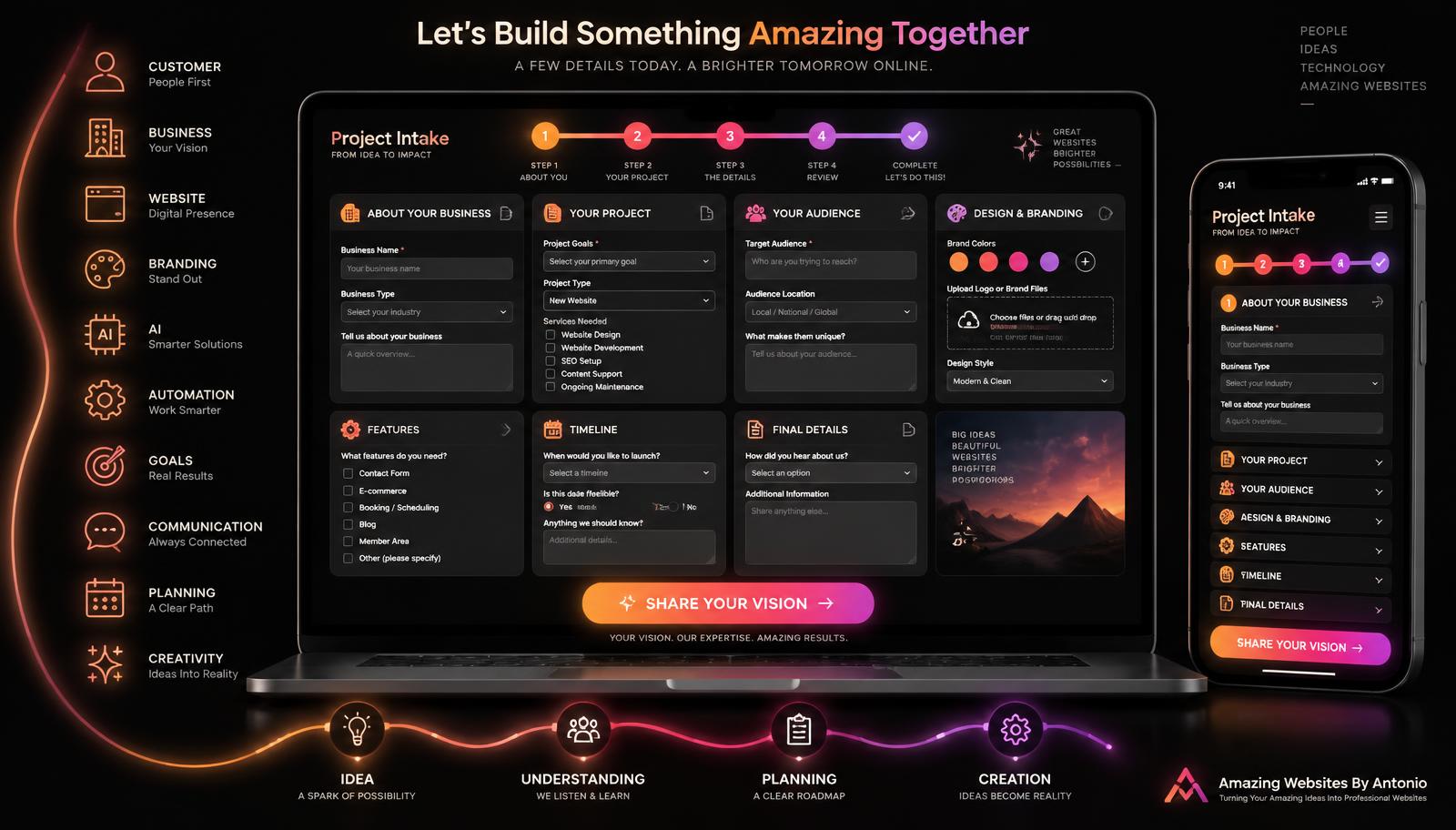
Organize questions into sections such as:

  • About You
  • About Your Business
  • Your Project
  • Your Audience
  • Design & Branding
  • Website Features
  • Content
  • Timeline
  • Final Details

This makes a longer form feel easier to complete.

21. Consider a Progress Indicator

For multi-step forms, show customers where they are.

For example:

STEP 1 OF 5 — ABOUT YOUR BUSINESS

Then:

STEP 2 OF 5 — YOUR PROJECT

A progress indicator can make the form feel more manageable.

22. Save Progress When Possible

If your intake form is lengthy, consider allowing customers to save their progress and return later if your website platform supports it.

Someone may need to locate a logo, find a website example, or ask a business partner a question.

Don''t make them lose everything because they needed more time.

23. Make It Mobile-Friendly

Some customers may complete the entire intake form from a phone.

Test:

  • Text fields
  • Checkboxes
  • Dropdowns
  • Upload buttons
  • Multi-step navigation
  • Progress indicators
  • Submit button
  • Confirmation screen

Make sure the experience remains easy on smaller screens.

24. Confirm the Form Was Received

After submission, clearly tell the customer what happened.

For example:

THANK YOU FOR SHARING YOUR VISION!

We''ve received your project information.

We''ll review the details you''ve provided so we can better understand your goals and prepare for the next step.

This gives customers confidence that their information went through successfully.

25. Review the Form Before the Meeting

The intake form only becomes valuable if you actually use the information.

Before meeting with the customer:

  • Read their answers.
  • Review their website.
  • Look at the materials they provided.
  • Identify important questions.
  • Note anything that needs clarification.

Then enter the meeting prepared.

26. Use the Form as a Starting Point — Not a Script

The intake form gives you information.

The conversation gives you understanding.

A customer''s answer may lead to a question you never thought to include on the form.

Stay curious.

Listen.

Ask follow-up questions.

Explore the vision.

The goal isn''t simply to complete a checklist.

The goal is to understand the person and business behind the project.

Final Thoughts

A great project doesn''t begin with design.

It begins with understanding.

Before choosing colors...

Before creating pages...

Before writing code...

Before adding AI...

Before building automation...

Learn about the customer.

Understand their business.

Discover their goals.

Identify their audience.

Explore their vision.

Then you can begin creating something that actually fits what they need.

A project intake form doesn''t replace the human conversation.

It helps make that conversation better.

Because before you can turn someone''s amazing idea into a professional website, you first need to understand the amazing idea.

Amazing Websites By Antonio

Turning Your Amazing Ideas Into Professional Websites
Share this article
Facebook Twitter LinkedInYouTube
Previous
How to Create a Website Contact Form That People Actually Want to Fill Out
Next
How to Create a Client Onboarding Experience That Makes a Great First Impression
Continue your learning

Recommended for you

Smart picks based on this article's category, related topics, and what's trending on Amazing Websites By Antonio.

How to Turn Your Entire Website Into a Complete Customer Journey — From First Click to Loyal Customer
🎨 Website Strategy & Branding

How to Turn Your Entire Website Into a Complete Customer Journey — From First Click to Loyal Customer

A great business website is not just a collection of pages—it is a journey. Learn how to guide visitors from their very first click to becoming loyal customers.

Sep 8, 2026 8 min read
Continue reading
How to Use Customer Feedback to Improve Your Website Without Letting Every Opinion Control the Design
🤝 Customer Experience & Website Strategy

How to Use Customer Feedback to Improve Your Website Without Letting Every Opinion Control the Design

Customer feedback is powerful, but not every opinion should control your design. Learn to identify patterns, investigate problems, protect your brand, and test purposeful website improvements.

Oct 6, 2026 12 min read
Continue reading
How to Build Trust on Your Website Before a Customer Ever Contacts You
🤝 Website Strategy & Customer Experience

How to Build Trust on Your Website Before a Customer Ever Contacts You

Trust begins long before the first conversation. Learn how your website can build credibility through professional design, clear messaging, real proof, and reliable experiences.

Aug 30, 2026 9 min read
Continue reading

Popular this week

Most read
The Future of Business Websites: What Every Entrepreneur Should Prepare For
Oct 10, 2026 · 10 min read
Recently updated
100 Ways to Make Your Business Website More Amazing
Oct 9, 2026 · 10 min read
Editor's pick
How to Turn Website Feedback Into a Customer Experience Improvement Plan
Oct 8, 2026 · 9 min read

Explore more categories

🤖AI for Business

AI, ChatGPT, automation, agents, prompts, and productivity for small businesses.

🧠Artificial Intelligence & Business Growth

How AI helps small businesses save time, reduce costs, improve productivity, and grow smarter.

🌐Website Design

Planning, homepages, landing pages, responsive design, UX, and best practices.

🧭Website Design & User Experience

Website design, user experience, accessibility, and creating websites that are intuitive and easy to use.

🎯Website Design & Conversion Strategy

Calls to action, landing pages, conversion optimization, and turning website visitors into customers.

⚡Website Performance & Business Growth

Website speed, performance optimization, conversions, and how a faster site drives business growth.

🌐Website Design & Business Growth

Website design, contact pages, landing pages, and business-focused web strategies that turn visitors into customers.

📊Website Strategy & Business Growth

Website analytics, strategy, planning, and data-informed decisions that help businesses grow online.

🚀Website Innovation & Business Growth

Future-ready websites, digital innovation, thoughtful AI, automation, and technology that supports business growth.

🎨Website Strategy & Branding

How website strategy, brand identity, and messaging work together to create a consistent customer experience.

🏆Website Strategy & Personal Branding

Building trust and credibility by showcasing expertise, experience, authentic stories, and professional value online.

🤝Website Strategy & Customer Experience

Building website trust, credibility, and customer confidence through strategic design, clear messaging, and thoughtful user experiences.

🤝Website Strategy & Client Experience

Client intake, onboarding, communication, and project processes that create a smooth, confident experience from first contact to launch.

🚀Client Experience & Business Growth

Client onboarding, welcome experiences, and building strong customer relationships that help businesses grow.

📋Client Experience & Project Management

Client communication, project updates, feedback, approvals, and keeping website projects organized from kickoff to launch.

🗂️Website Strategy & Project Management

Project planning, launch checklists, testing, approvals, and organizing website builds from start to launch.

🧰Website Strategy & Maintenance

Post-launch care, monitoring, backups, security, updates, and keeping a live website healthy and growing.

🧰Website Maintenance & Business Growth

Monthly maintenance routines, health checks, updates, monitoring, and ongoing care that keeps a website working for the business.

🧭Website Strategy & User Experience

Website engagement, user experience, navigation, and creating websites that guide visitors naturally without overwhelming them.

🎯Website Strategy & Lead Generation

Contact pages, lead capture, inquiry forms, and turning website visitors into qualified business leads.

🔍SEO & Digital Marketing

Search engine optimization, keyword strategy, and digital marketing foundations that help businesses get found online.

📊Website Analytics & Business Growth

Website metrics, analytics, conversions, and using data to make smarter business decisions and grow online.

🎨Branding

Brand identity, logos, colors, typography, strategy, and consistency.

🎨Branding & Business

Brand building, business identity, growth strategy, and customer experience for small businesses.

💎Branding & Business Growth

Brand messaging, value propositions, positioning, and differentiation that help businesses stand out and grow.

🎨Branding & Website Strategy

How brand storytelling, identity, and website strategy work together to create a memorable customer experience.

🤝Branding & Customer Connection

Founder stories, authentic messaging, and human-centered branding that help businesses build meaningful customer relationships.

📈Digital Marketing

Marketing, social, email, content, ads, and lead generation.

📈Digital Marketing & Business Growth

Digital marketing, social media, SEO, content strategy, and growth tactics that help businesses attract and convert customers.

🧲Lead Generation & Business Growth

Lead magnets, email capture, conversion strategy, and turning website visitors into loyal customers.

🤝Lead Generation & Customer Relationships

Lead follow-up, nurturing, communication, and building lasting customer relationships.

🚀Small Business Growth

Entrepreneurship, productivity, customer experience, and success stories.

🤝Customer Experience & Business Growth

Customer relationships, loyalty, communication, community building, and experiences that drive business growth.

🤝Customer Experience & Website Strategy

Customer feedback, usability, testing, and purposeful website improvements guided by customer needs and business goals.

🔒Website Security & Business Technology

Website security best practices, cybersecurity tips, technology safety, and protecting your business online.

📝Content Marketing & Business Growth

Content marketing strategy, blog writing, website copy, and valuable content that attracts, engages, and converts customers.

✍️Writing & Digital Content

Website copy, blog writing, content strategy, messaging, and storytelling that connects with your audience.

🛠️Resources & Guides

Tutorials, how-to's, checklists, beginner guides, and FAQs.

📚 Resource Center

Guides, templates, checklists, and tutorials for every stage.

Search another article

Looking for something specific? Search across every blog post and resource.

Get new articles by email

Subscribe for new blogs, AI resources, website tips, and platform updates.

Turning Your Amazing Ideas Into Professional Websites.

Keep exploring

Continue Your Learning

Learning doesn't stop with one article. Explore more resources, practical tools, and educational guides designed to help you build your skills, strengthen your business, and grow with confidence.

🤖 AI Learning Hub

Continue building your AI knowledge with beginner-friendly lessons, practical examples, and structured learning paths.

Explore the AI Learning Hub

💬 Prompt Library

Browse our growing collection of AI prompts for websites, marketing, branding, business, productivity, and content creation.

Open the Prompt Library

📚 Resource Center

Discover guides, templates, checklists, tutorials, and practical resources to support your digital journey.

Browse Resources

📝 Read Another Blog

Discover related, popular, and newest articles across every category.

View All Blog Articles

🛠️ Interactive Tools

Continue learning with hands-on tools: Website Health Check, Where Should I Start? Quiz, and the Interactive Resource Finder.

Try the Interactive Tools

🌐 Professional Services

Need personalized support? Learn how Amazing Websites By Antonio can help with website design, branding, AI guidance, SEO, and digital strategy.

View Services

Every Step Forward Matters

Whether you're learning about AI, improving your website, strengthening your brand, or exploring new digital tools, every article you read brings you one step closer to achieving your goals. Our mission is to make learning practical, approachable, and valuable for everyone.

Stay Connected

Receive updates whenever we publish new educational articles, learning resources, and platform improvements.

Thank you for learning with Amazing Websites By Antonio. We're committed to helping entrepreneurs, nonprofits, creators, and small businesses continue learning, building, and growing with confidence.

Turning Your Amazing Ideas Into Professional Websites.

Amazing Websites By Antonio Logo

Amazing Websites By Antonio

Creating Professional Websites, AI Solutions, and Digital Experiences That Help Businesses Thrive.

Turning Your Amazing Ideas Into Professional Websites
Amazing Websites By Antonio exists to empower entrepreneurs, creators, educators, students, nonprofits, and small business owners through practical education, innovative technology, professional website solutions, and a supportive learning community.

Our mission is to help people transform ideas into opportunities by providing the knowledge, tools, resources, and confidence they need to succeed in today’s digital world.

Whether you’re building your first website, exploring artificial intelligence, strengthening your brand, growing your business, or learning new digital skills, we’re here to support every step of your journey.

Together, we’re creating a future where learning is accessible, innovation serves people, and success is built through curiosity, creativity, collaboration, and continuous growth.

Explore

  • Academy
  • AI Learning Hub
  • Learning Journeys
  • Educational Blog
  • Prompt Library
  • Smart Resource Center
  • Business Growth Suite
  • Community Platform
  • Marketplace & Creator Hub
  • Innovation Lab

Professional Services

  • Website Design
  • Website Audits
  • Branding Strategy
  • SEO Guidance
  • AI Consulting
  • Prompt Engineering
  • Digital Content Creation
  • Business Growth Planning

Connect With Us

Follow our journey as we continue building new educational resources, innovative tools, and opportunities that empower people to learn, create, build, grow, and succeed.

antonio.humann@gmail.com605-212-7171Listen to "Your Vision Starts Here"
Send a Message
© 2026 Amazing Websites By Antonio. All Rights Reserved.Helping People Build Brighter Digital Futures.