A Practical Guide to Evaluating Website Improvement Results, Reviewing Ongoing Costs, Making Better Technology Decisions, and Investing in the Features That Matter Most
Imagine you've spent several months improving your professional business website.
You've redesigned your homepage.
Updated your services.
Improved your Contact form.
Added an AI assistant.
Created new automations.
Enhanced your mobile navigation.
And introduced new features to make your website more helpful.
You've carefully planned these improvements.
Tested the changes.
Published everything.
Verified the results.
And tracked the benefits over time.
But now you're facing an important business question:
WHICH WEBSITE IMPROVEMENTS ARE ACTUALLY WORTH CONTINUING?
Maybe your AI assistant is answering customer questions accurately.
Your Contact form is helping customers reach your business.
Your automations are saving valuable time.
And your website navigation is making information easier to find.
Those are encouraging outcomes.
But perhaps another feature requires expensive maintenance.
An integration is creating more work than expected.
An automation is rarely used.
Or an improvement hasn't produced the benefits you originally hoped for.
What should you do?
Should you continue investing in the feature?
Make adjustments?
Collect more information?
Replace it?
Or discontinue it?
That's where an AI website benefits realization review becomes valuable.
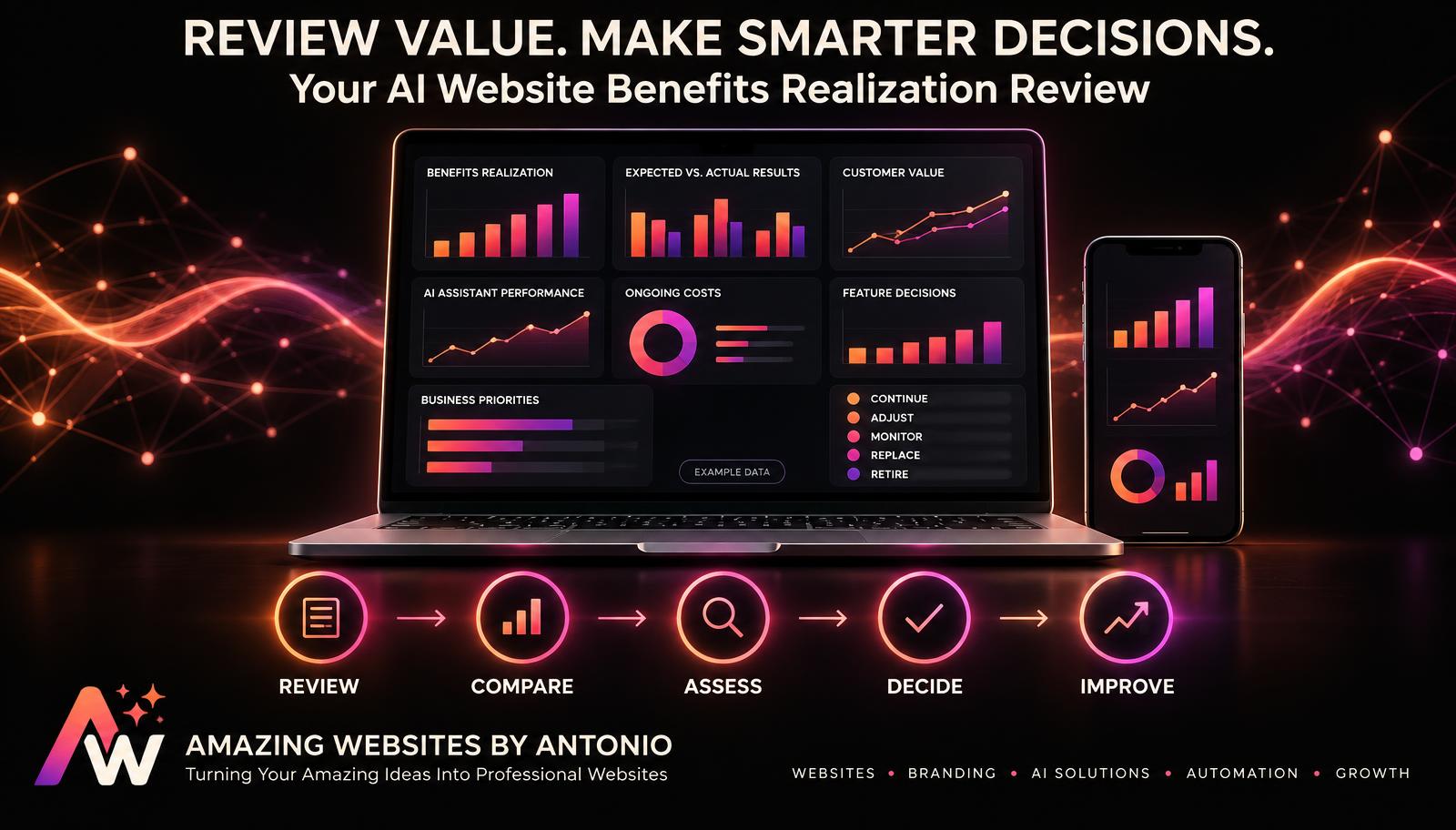
AN AI WEBSITE BENEFITS REALIZATION REVIEW IS A STRUCTURED EVALUATION THAT COMPARES THE EXPECTED BENEFITS OF WEBSITE IMPROVEMENTS WITH THEIR ACTUAL RESULTS, ONGOING COSTS, RISKS, AND BUSINESS VALUE TO SUPPORT FUTURE DECISIONS.
It helps you understand whether your website investments are delivering meaningful outcomes.
Instead of continuing every feature simply because you created it, you evaluate its value.
Instead of removing features based only on personal preference, you consider evidence.
And instead of focusing exclusively on financial returns, you also evaluate customer experience, accessibility, reliability, and operational efficiency.
For AI-powered websites, this review can cover:
- Customer engagement
- Contact form effectiveness
- AI assistant accuracy
- Automation reliability
- Operational efficiency
- Website usability
- Accessibility
- Performance
- Maintenance costs
- Subscription expenses
- Security and privacy risks
- Revenue opportunities
- Long-term business priorities
The good news?
YOU DON'T NEED A LARGE BUSINESS STRATEGY TEAM TO CONDUCT A PROFESSIONAL BENEFITS REALIZATION REVIEW.
Even a solo entrepreneur can evaluate website improvements using a practical checklist, spreadsheet, or structured report.
In Blog #135, we're exploring 50 strategies to help you decide which improvements deserve continued investment.
PART 1: UNDERSTAND BENEFITS REALIZATION
1. Know What Benefits Realization Means
Benefits realization is the process of determining whether an improvement is producing the positive outcomes it was intended to create.
2. Understand Why Benefits Reviews Matter
A completed website feature isn't automatically a valuable business investment.
3. Separate Verification From Benefits Realization
Verification checks whether a change meets defined requirements.
Benefits realization evaluates whether the change produces meaningful value over time.
4. Consider Financial and Nonfinancial Benefits
Customer trust, accessibility, and reliability can matter even when their financial value is difficult to calculate.
5. Establish a Regular Review Process
Schedule appropriate reviews for significant website investments.
PART 2: REVIEW ORIGINAL BUSINESS EXPECTATIONS
6. Locate the Original Improvement Plan
Review the reason the feature was introduced.
7. Identify Expected Benefits
Document the customer or business outcomes the improvement was intended to support.
8. Review Original Success Measures
Identify the metrics or acceptance criteria established during planning.
9. Confirm the Intended Audience
Determine who was expected to benefit from the improvement.
10. Review Changes in Business Priorities
Consider whether the original need remains relevant.
PART 3: EVALUATE ACTUAL RESULTS
11. Gather Benefits Tracking Records
Review available results from the improvement's observation period.
12. Compare Actual Outcomes With Targets
Determine whether expected benefits were achieved.
13. Review Trends Over Time
Look for sustained results rather than relying on one measurement.
14. Identify Unexpected Benefits
Document useful outcomes that were not originally anticipated.
15. Identify Benefits That Have Not Materialized
Recognize when evidence does not support the expected value.
PART 4: EVALUATE CUSTOMER EXPERIENCE VALUE
16. Review Customer Workflow Outcomes
Determine whether the improvement helps visitors complete important tasks.
17. Evaluate Contact Form Effectiveness
Review relevant inquiry workflow measurements and feedback.
18. Consider Mobile Usability
Determine whether the feature supports a useful mobile experience.
19. Review Accessibility Benefits
Evaluate whether the improvement reduces barriers for visitors.
20. Consider Customer Feedback
Use relevant feedback alongside other evidence.
PART 5: EVALUATE AI ASSISTANT VALUE
21. Review AI Response Accuracy
Determine whether the assistant continues providing reliable information.
22. Evaluate Customer Question Coverage
Review whether the assistant addresses relevant customer needs.
23. Examine Human Handoff
Confirm that customers can reach the business when necessary.
24. Consider AI Maintenance Requirements
Include knowledge updates, testing, monitoring, and oversight.
25. Evaluate Whether the AI Feature Remains Useful
Compare the assistant's benefits with its costs, limitations, and business purpose.
PART 6: REVIEW OPERATIONAL AND FINANCIAL COSTS
26. Identify Ongoing Subscription Costs
Document recurring expenses associated with the feature.
27. Estimate Maintenance Time
Consider the effort required to keep the improvement functioning.
28. Review Integration Costs
Include relevant external services and technical dependencies.
29. Evaluate Operational Efficiency
Determine whether the improvement reduces or increases repetitive work.
30. Compare Financial Benefits With Costs
Use reliable financial information when available, without confusing estimated time value with actual cash savings.
PART 7: ASSESS RISKS AND LONG-TERM SUSTAINABILITY
31. Review Reliability Concerns
Consider recurring failures or unexpected interruptions.
32. Evaluate Security and Privacy Risks
Identify issues that could affect customer information or website safety.
33. Review External Dependencies
Consider reliance on third-party platforms and integrations.
34. Evaluate Future Maintenance Requirements
Determine whether the feature can be supported over time.
35. Consider the Risks of Removing the Feature
Review how discontinuation could affect customers, accessibility, or important business workflows.
PART 8: MAKE CONTINUE, ADJUST, OR RETIRE DECISIONS
36. Define Decision Criteria
Establish how benefits, costs, risks, and business priorities will influence the decision.
37. Continue High-Value Improvements
Maintain features that deliver meaningful benefits and meet important requirements.
38. Adjust Underperforming Improvements
Identify changes that could improve results.
39. Extend Measurement When Evidence Is Insufficient
Collect additional information before making an irreversible decision.
40. Retire Features Carefully
Use an approved transition plan when a feature is no longer justified or needed.
PART 9: DOCUMENT THE BENEFITS REALIZATION REVIEW
41. Create a Review Summary
Describe the improvement and its original purpose.
42. Record Actual Benefits
Document verified results and relevant limitations.
43. Summarize Costs and Risks
Include ongoing expenses, maintenance needs, and important concerns.
44. Record the Recommended Decision
Explain whether to continue, adjust, monitor, replace, or retire the feature.
45. Assign Follow-Up Responsibilities
Identify who will carry out the approved decision.
PART 10: USE FINDINGS TO IMPROVE BUSINESS STRATEGY
46. Compare Similar Website Investments
Look for patterns across different improvements.
47. Identify High-Value Website Capabilities
Recognize features that consistently support important business needs.
48. Reallocate Resources Thoughtfully
Consider shifting time or budget toward more valuable opportunities.
49. Update Future Improvement Planning
Use lessons from benefits reviews to strengthen investment decisions.
50. Build a Sustainable Website Improvement Strategy
Continue evaluating whether your website features serve customers and support business goals.
REVIEW → COMPARE → EVALUATE → DECIDE → ACT → MONITOR → IMPROVE
BENEFITS TRACKING VS. BENEFITS REALIZATION REVIEW
These activities are connected, but they serve different purposes.
| Benefits Tracking | Benefits Realization Review |
|---|---|
| Collects results over time | Interprets those results |
| Measures selected indicators | Evaluates overall business value |
| Identifies trends | Determines what the trends mean |
| Tracks expected benefits | Assesses whether benefits justify continued investment |
| Supports ongoing monitoring | Supports strategic decisions |
IMPORTANT:
A benefits realization review should use reliable tracking information whenever available.
If important evidence is missing, document the uncertainty.
THE FIVE QUESTIONS EVERY BENEFITS REVIEW SHOULD ANSWER
QUESTION 1: DID THE IMPROVEMENT DELIVER ITS EXPECTED BENEFITS?
Compare actual outcomes with original goals.
QUESTION 2: ARE THE BENEFITS STILL CONTINUING?
Review results across an appropriate period.
QUESTION 3: WHAT DOES THE IMPROVEMENT COST TO MAINTAIN?
Consider subscriptions, maintenance, monitoring, and operational effort.
QUESTION 4: DOES THE IMPROVEMENT STILL SUPPORT BUSINESS AND CUSTOMER NEEDS?
Evaluate relevance, accessibility, reliability, and customer impact.
QUESTION 5: WHAT SHOULD HAPPEN NEXT?
Choose an evidence-supported action.
CONTINUE. ADJUST. MONITOR. REPLACE. OR RETIRE.
YOUR AI WEBSITE BENEFITS REALIZATION SCORECARD
A simple scorecard can help organize your findings.
For each applicable category, use:
- 2 points: Strong evidence that requirements are met
- 1 point: Partial evidence or additional review needed
- 0 points: Requirements not met or required evidence missing
| Evaluation Category | Maximum Points |
|---|---|
| Expected Benefits Achieved | 2 |
| Customer Experience Value | 2 |
| AI or Functional Reliability | 2 |
| Operational Efficiency | 2 |
| Cost Sustainability | 2 |
| Business Relevance | 2 |
| Maintenance Sustainability | 2 |
| Risk Management | 2 |
| Long-Term Performance | 2 |
| Evidence Quality | 2 |
| Total | 20 |
Illustrative Interpretation
| Score | Suggested Interpretation |
|---|---|
| 18–20 | Strong case for continued investment |
| 14–17 | Generally positive, with review opportunities |
| 10–13 | Meaningful adjustments may be needed |
| 0–9 | Reassess the improvement's future |
IMPORTANT:
This scorecard is an illustrative decision aid, not a universal standard.
Exclude nonapplicable categories and report the adjusted maximum.
A high score must never override an unresolved critical security, privacy, accessibility, or customer workflow issue.
A low score also does not automatically justify removing a feature that serves an essential legal, accessibility, or operational requirement.
YOUR BENEFITS REALIZATION DASHBOARD
A dashboard can summarize the status of important website investments.
Consider tracking:
- Improvements under review
- Improvements meeting expected benefits
- Improvements below target
- Improvements requiring adjustment
- Improvements awaiting additional evidence
- Improvements recommended for retirement
- Total ongoing costs
- Documented operational savings
- Customer experience findings
- Outstanding risks
FICTIONAL DASHBOARD EXAMPLE
| Metric | Example |
|---|---|
| Improvements Reviewed | 15 |
| Continue | 7 |
| Adjust | 4 |
| Extend Measurement | 2 |
| Replace | 1 |
| Retire | 1 |
| Monthly Ongoing Costs | $180 |
| Benefits With Reliable Measurements | 11 |
These figures are fictional and do not represent actual Amazing Websites By Antonio website results.
The dashboard should help guide decisions rather than simply display positive numbers.
FICTIONAL BENEFITS COMPARISON EXAMPLE
| Website Improvement | Expected Benefit | Observed Result | Suggested Action |
|---|---|---|---|
| Contact Form Update | More reliable inquiries | Defined tests continue passing | Continue |
| AI Knowledge Update | More accurate answers | Accuracy improved but some errors remain | Adjust |
| Mobile Navigation Update | Easier navigation | Usability tests meet target | Continue |
| Automation Update | Less manual work | Maintenance effort exceeds time saved | Reassess |
| New Interactive Feature | Greater engagement | Insufficient usage data | Extend Measurement |
This example demonstrates how different outcomes can lead to different decisions.
YOUR CONTINUE, ADJUST, MONITOR, REPLACE, OR RETIRE DECISION MATRIX
| Decision | When It May Be Appropriate |
|---|---|
| Continue | Benefits are demonstrated, costs are sustainable, and important requirements are met |
| Adjust | The feature remains useful but needs improvements |
| Monitor | Evidence is insufficient or the observation period is too short |
| Replace | Another supported approach could better meet the same requirements |
| Retire | The feature is no longer needed or its ongoing costs and risks outweigh its value |
Before replacing or retiring a feature, consider customer dependencies, data retention, accessibility, contractual obligations, and continuity.
HOW TO REVIEW THE TOTAL COST OF A WEBSITE FEATURE
A website feature's ongoing cost can involve more than a monthly subscription.
Consider:
TOTAL REVIEW-PERIOD COST = SUBSCRIPTIONS + MAINTENANCE + MONITORING + SUPPORT + OTHER RELEVANT COSTS
FICTIONAL EXAMPLE
Suppose an automation has these monthly costs:
- Subscription: $30
- Maintenance labor: $40
- Monitoring and review: $20
- Other related expenses: $10
Total estimated monthly cost: $100
If the automation saves an estimated $120 worth of time each month, the difference is $20 in estimated net time value.
But that is not necessarily $20 in additional profit.
You still need to consider implementation costs, measurement uncertainty, and whether saved time produces actual financial value.
INTERACTIVE WEBSITE FEATURE VALUE CALCULATOR
Use this calculator to explore a fictional or hypothetical website feature's ongoing financial value.
Open the interactive Website Feature Value Calculator →
Enter a measured monthly financial benefit plus subscription, maintenance, monitoring, and other ongoing costs to see your monthly ongoing costs, monthly net benefit estimate, and financial benefit relative to ongoing cost. With the example figures ($150 benefit; $30 + $40 + $20 + $10 costs), monthly ongoing costs are $100, the monthly net benefit estimate is $50, and the benefit equals 150% of ongoing cost.
Illustrative only. Enter measured financial benefits, not unverified revenue or time-value assumptions. This calculation excludes initial investment, taxes, and other unlisted costs. A positive estimate does not automatically mean a feature should be retained.
COMPLETE AI WEBSITE BENEFITS REALIZATION REVIEW CHECKLIST
SECTION 1 — ORIGINAL EXPECTATIONS
- Improvement purpose is documented.
- Expected benefits are identified.
- Original targets are available.
- Intended customer needs are reviewed.
- Current business relevance is considered.
SECTION 2 — ACTUAL RESULTS
- Benefits tracking records are reviewed.
- Actual outcomes are compared with targets.
- Trends are evaluated.
- Unexpected benefits are identified.
- Missing evidence is documented.
SECTION 3 — CUSTOMER VALUE
- Important customer workflows are evaluated.
- Contact Form outcomes are reviewed where applicable.
- Mobile usability is considered.
- Accessibility requirements are reviewed.
- Relevant customer feedback is examined.
SECTION 4 — AI AND AUTOMATIONS
- AI assistant accuracy is reviewed.
- Customer question coverage is evaluated.
- Human handoff is considered.
- Automation reliability is assessed.
- AI maintenance requirements are documented.
SECTION 5 — COSTS AND RISKS
- Subscription costs are recorded.
- Maintenance effort is estimated.
- Integration costs are considered.
- Security and privacy risks are reviewed.
- Retirement or replacement risks are identified.
SECTION 6 — DECISION MAKING
- Decision criteria are documented.
- Continue, Adjust, Monitor, Replace, or Retire is considered.
- Important uncertainties are identified.
- Business impact is evaluated.
- Final recommendation is explained.
SECTION 7 — FOLLOW-UP
- Decision owner is assigned.
- Required actions are documented.
- Target dates are established.
- Relevant stakeholders are informed.
- Next review date is scheduled.
COPY-READY AI WEBSITE BENEFITS REALIZATION REVIEW TEMPLATE
BUSINESS NAME:
[Enter Business Name]
WEBSITE:
[Enter Website Address]
REVIEW ID:
[Enter Identifier]
RELATED IMPROVEMENT ID:
[Enter Identifier]
REVIEW DATE:
[Enter Date]
PREPARED BY:
[Enter Name]
SECTION 1 — IMPROVEMENT OVERVIEW
IMPROVEMENT TITLE:
[Enter Title]
DESCRIPTION:
[Describe Feature or Improvement]
IMPLEMENTATION DATE:
[Enter Date]
ORIGINAL BUSINESS PURPOSE:
[Describe Purpose]
CURRENT BUSINESS RELEVANCE:
[Describe Relevance]
SECTION 2 — EXPECTED BENEFITS
PRIMARY EXPECTED BENEFIT:
[Describe Benefit]
SECONDARY BENEFITS:
[List Benefits]
ORIGINAL TARGETS:
[List Targets]
INTENDED USERS:
[Describe Audience]
SECTION 3 — ACTUAL RESULTS
REVIEW PERIOD:
[Enter Period]
MEASURED RESULTS:
[List Results]
COMPARISON WITH TARGETS:
[Describe Comparison]
SUSTAINED BENEFITS:
[List Benefits]
UNREALIZED BENEFITS:
[List Missing Benefits]
EVIDENCE LIMITATIONS:
[List Limitations]
SECTION 4 — CUSTOMER EXPERIENCE
CUSTOMER WORKFLOW FINDINGS:
[Enter Findings]
CONTACT FORM FINDINGS:
[Enter Findings]
MOBILE EXPERIENCE:
[Enter Findings]
ACCESSIBILITY:
[Enter Findings]
CUSTOMER FEEDBACK:
[Summarize Feedback]
SECTION 5 — AI ASSISTANT AND AUTOMATIONS
AI FEATURE INVOLVED:
Yes / No
AI ACCURACY FINDINGS:
[Enter Findings]
HUMAN HANDOFF FINDINGS:
[Enter Findings]
AUTOMATION RELIABILITY:
[Enter Findings]
MAINTENANCE REQUIREMENTS:
[Describe Requirements]
SECTION 6 — FINANCIAL AND OPERATIONAL REVIEW
MONTHLY SUBSCRIPTION COSTS:
[Enter Amount]
MONTHLY MAINTENANCE COSTS:
[Enter Amount]
OTHER ONGOING COSTS:
[Enter Amount]
DOCUMENTED FINANCIAL BENEFITS:
[Enter Amount or Not Established]
OPERATIONAL TIME SAVINGS:
[Enter Amount or Not Measured]
COST-BENEFIT FINDINGS:
[Summarize Findings]
SECTION 7 — RISKS AND SUSTAINABILITY
RELIABILITY RISKS:
[List Risks]
SECURITY AND PRIVACY RISKS:
[List Risks]
EXTERNAL DEPENDENCIES:
[List Dependencies]
LONG-TERM SUPPORT NEEDS:
[List Needs]
RISKS OF REMOVAL:
[List Risks]
SECTION 8 — FINAL DECISION
RECOMMENDATION:
Continue / Adjust / Monitor / Replace / Retire
DECISION REASON:
[Explain Decision]
IMPORTANT UNCERTAINTIES:
[List Uncertainties]
APPROVED BY:
[Enter Name]
DECISION DATE:
[Enter Date]
SECTION 9 — FOLLOW-UP ACTIONS
ACTION 1:
[Describe Action]
ACTION 2:
[Describe Action]
ACTION OWNER:
[Enter Name]
TARGET DATE:
[Enter Date]
NEXT REVIEW DATE:
[Enter Date]
SECTION 10 — FINAL SUMMARY
MOST VALUABLE BENEFIT:
[Enter Finding]
BIGGEST CHALLENGE:
[Enter Finding]
KEY LESSON LEARNED:
[Enter Lesson]
NEXT BUSINESS PRIORITY:
[Enter Priority]
EXAMPLE AI WEBSITE BENEFITS REALIZATION SCENARIO
The following scenario is fictional.
Situation: A Business Owner Reviews an AI Assistant and Automation Investment
A business owner has been using an AI assistant and an automated inquiry notification workflow for several months.
Both features were successfully implemented and verified.
Now the owner wants to determine whether continued investment makes sense.
Step 1 — Review Original Expectations
The AI assistant was intended to provide accurate answers to common customer questions.
The automation was intended to reduce manual inquiry handling.
Step 2 — Gather Results
The owner reviews representative AI tests, automation records, maintenance time, and available customer feedback.
Step 3 — Evaluate the AI Assistant
The assistant continues answering important questions accurately, but requires occasional knowledge updates.
Step 4 — Evaluate the Automation
The automation works reliably, but its maintenance requirements have increased.
Step 5 — Review Ongoing Costs
The owner documents subscription expenses, maintenance effort, and other relevant costs.
Step 6 — Compare Benefits With Expectations
The AI assistant continues supporting customer information needs.
The automation saves some manual work but less than originally expected.
Step 7 — Assess Risks
The owner reviews privacy, reliability, and integration dependencies.
Step 8 — Make a Recommendation
The owner recommends continuing the AI assistant while adjusting the automation workflow to reduce maintenance effort.
Step 9 — Assign Improvement Actions
Specific tasks are created to simplify the automation and review its future results.
Step 10 — Schedule Another Review
The owner plans another benefits review after the changes have been implemented and observed.
LESSON:
A benefits realization review doesn't always lead to a simple keep-or-remove decision.
Sometimes the best choice is to improve an existing feature so it delivers more meaningful value.
YOUR 30-DAY AI WEBSITE BENEFITS REALIZATION REVIEW PLAN
WEEK 1 — SELECT IMPROVEMENTS FOR REVIEW
- Identify significant website investments.
- Review original improvement goals.
- Gather available benefits tracking information.
- Identify important customer outcomes.
- Establish review criteria.
GOAL: Understand which improvements need a formal value review.
WEEK 2 — EVALUATE RESULTS AND COSTS
- Compare actual results with original targets.
- Review customer experience outcomes.
- Evaluate AI assistant performance.
- Document ongoing costs.
- Identify important risks and limitations.
GOAL: Build a reliable picture of each improvement's value.
WEEK 3 — MAKE EVIDENCE-BASED DECISIONS
- Evaluate the benefits realization scorecard.
- Identify high-value features.
- Review underperforming improvements.
- Consider Continue, Adjust, Monitor, Replace, or Retire decisions.
- Document recommendations.
GOAL: Decide how each improvement should be managed going forward.
WEEK 4 — IMPLEMENT AND REVIEW
- Approve appropriate next steps.
- Assign action owners.
- Establish target dates.
- Begin improvement or transition work.
- Schedule future benefits reviews.
GOAL: Turn review findings into better website investment decisions.
THE AI WEBSITE BENEFITS REALIZATION FRAMEWORK
REVIEW
Understand the improvement's original purpose.
↓
COMPARE
Evaluate actual results against expected benefits.
↓
ASSESS
Consider costs, customer value, reliability, and risks.
↓
DECIDE
Choose to continue, adjust, monitor, replace, or retire.
↓
ACT
Implement the approved decision.
↓
MONITOR
Review the results of that decision.
↓
IMPROVE
Use what you've learned to guide future investments.
FINAL THOUGHTS
Creating a professional business website is an exciting accomplishment.
It represents your creativity.
Your services.
Your brand.
And your commitment to helping customers.
But as your business grows, you'll continue investing in new website features.
Some improvements will become essential parts of your operations.
Others may need adjustments.
Some may require additional monitoring.
And a few may eventually become unnecessary.
That's a normal part of managing a growing digital business.
The important thing is making thoughtful decisions.
Decisions based on customer needs.
Reliable evidence.
Operational requirements.
Long-term costs.
And meaningful business value.
That's why an AI website benefits realization review matters.
It helps you understand which improvements are delivering results.
Which features deserve continued investment.
Which systems need attention.
And where your time and resources may create the greatest value.
A SUCCESSFUL WEBSITE STRATEGY ISN'T ABOUT KEEPING EVERY FEATURE YOU'VE EVER CREATED.
IT'S ABOUT MAINTAINING THE FEATURES THAT CONTINUE TO SERVE YOUR CUSTOMERS AND SUPPORT YOUR BUSINESS.
Review your investments.
Measure their benefits.
Understand their costs.
Consider their risks.
And make informed decisions.
Because professional website management isn't just about adding more technology.
IT'S ABOUT USING TECHNOLOGY IN WAYS THAT CONTINUE TO CREATE MEANINGFUL VALUE.
REVIEW YOUR BENEFITS.
EVALUATE YOUR INVESTMENTS.
MAKE BETTER DECISIONS.
KEEP BUILDING BETTER WEBSITES.
Amazing Websites By Antonio
Turning Your Amazing Ideas Into Professional Websites