A Practical Guide to Tracking Website Improvements, Measuring Customer Experience, Evaluating Operational Efficiency, and Understanding the Ongoing Value of Your Digital Investments
Imagine you've just completed another important improvement to your professional business website.
You've redesigned your homepage.
Improved your Contact form.
Updated your services.
Made your AI assistant more helpful.
Optimized your mobile navigation.
Or connected a new automation.
You carefully planned the improvement.
Completed the work.
Published the changes.
Tested the results.
And verified that the improvement met its original requirements.
What an exciting accomplishment!
But here's another important question:
IS YOUR WEBSITE IMPROVEMENT STILL DELIVERING VALUE WEEKS OR MONTHS AFTER YOU COMPLETE IT?
Maybe your improved Contact form is helping more customers send inquiries.
Your AI assistant is answering common questions more accurately.
Your website is saving you time by organizing information more effectively.
Or your new automation is reducing repetitive administrative work.
Those benefits may continue long after the original project ends.
But how do you measure them?
How do you know whether the improvement is still useful?
And how do you determine whether the time and resources invested were worthwhile?
That's where an AI website improvement benefits tracker becomes valuable.
AN AI WEBSITE IMPROVEMENT BENEFITS TRACKER IS AN ORGANIZED SYSTEM FOR MONITORING THE EXPECTED AND ACTUAL BENEFITS OF WEBSITE IMPROVEMENTS OVER TIME.
It helps you understand the value your improvements are creating.
Instead of focusing only on completed tasks, you track meaningful outcomes.
Instead of measuring success once, you review whether the benefits continue.
And instead of assuming every improvement automatically creates business value, you evaluate the evidence.
For AI-powered websites, those benefits can appear in many areas:
- Customer satisfaction
- Contact form engagement
- Website usability
- AI assistant accuracy
- Operational efficiency
- Automation reliability
- Accessibility
- Website performance
- Customer support
- Business inquiries
- Cost savings
- Revenue opportunities
- Website reliability
The good news?
YOU DON'T NEED A LARGE BUSINESS ANALYTICS TEAM TO CREATE A PRACTICAL WEBSITE IMPROVEMENT BENEFITS TRACKER.
Even a solo entrepreneur can use a spreadsheet, dashboard, or simple document to monitor important results.
In Blog #134, we're exploring 50 practical strategies to help you measure the long-term value of website improvements.
PART 1: UNDERSTAND WEBSITE IMPROVEMENT BENEFITS
1. Know What a Website Benefit Means
A benefit is a positive outcome that an improvement is expected to create or support.
2. Separate Outputs From Outcomes
An output is something you deliver, such as a redesigned Contact form.
An outcome is the result that follows, such as customers finding it easier to submit inquiries.
3. Understand Why Long-Term Tracking Matters
An improvement may work immediately after publishing but produce different results over time.
4. Recognize Financial and Nonfinancial Benefits
Not every valuable improvement directly increases revenue.
5. Make Benefits Tracking Part of Improvement Planning
Identify expected benefits before implementing significant changes.
PART 2: IDENTIFY EXPECTED BENEFITS
6. Review Original Improvement Goals
Look at what the improvement was intended to accomplish.
7. Identify Customer Experience Benefits
Consider how the improvement could help visitors complete important tasks.
8. Identify Operational Benefits
Determine whether the improvement could save time or reduce repetitive work.
9. Identify Reliability Benefits
Consider whether the change could reduce errors or service interruptions.
10. Create a Benefits Register
Document expected benefits in one organized location.
PART 3: DEFINE MEASURABLE BENEFIT INDICATORS
11. Choose Relevant Metrics
Select indicators that reflect the improvement's intended value.
12. Establish Baseline Measurements
Record relevant performance before the improvement.
13. Define Benefit Targets
Set realistic expectations for the results you want to achieve.
14. Identify Measurement Methods
Determine how the results will be collected.
15. Document Measurement Limitations
Recognize missing data, small sample sizes, and factors that may affect results.
PART 4: TRACK CUSTOMER EXPERIENCE BENEFITS
16. Monitor Important Customer Journeys
Review whether visitors can complete relevant actions.
17. Evaluate Contact Form Engagement
Track appropriate inquiry metrics where reliable data is available.
18. Review Navigation Improvements
Measure whether visitors can find important information more easily.
19. Consider Customer Feedback
Use relevant feedback to understand the customer experience.
20. Track Accessibility Improvements
Review whether important accessibility barriers have been reduced.
PART 5: TRACK AI ASSISTANT BENEFITS
21. Measure AI Response Accuracy
Use representative test questions to review answer quality.
22. Evaluate Common Question Coverage
Determine whether the assistant addresses important customer questions.
23. Review Human Handoff Effectiveness
Check whether customers can reach appropriate assistance when needed.
24. Track AI-Related Efficiency
Measure time savings only when reliable observations or estimates support them.
25. Monitor AI Limitations
Document incorrect answers, unresolved questions, and other issues that could reduce benefits.
PART 6: TRACK OPERATIONAL EFFICIENCY
26. Identify Repetitive Tasks
List activities that website improvements are intended to simplify.
27. Measure Time Before and After
Use comparable workflows to estimate time differences.
28. Evaluate Automation Reliability
Confirm that automated tasks continue producing expected outcomes.
29. Consider Maintenance Requirements
Include the time and resources required to maintain the improvement.
30. Calculate Net Operational Benefits
Consider both time saved and additional work created by the improvement.
PART 7: TRACK FINANCIAL AND BUSINESS BENEFITS
31. Identify Relevant Financial Outcomes
Consider cost savings, additional revenue, or reduced administrative expenses.
32. Record Implementation Costs
Include appropriate development, subscription, and setup expenses.
33. Track Ongoing Costs
Consider maintenance, monitoring, and service fees.
34. Calculate Financial Return Carefully
Compare measured financial benefits with relevant costs when the information is available.
35. Avoid Unsupported Revenue Claims
Do not assume that an increase in website traffic or inquiries automatically represents additional profit.
PART 8: CREATE YOUR BENEFITS TRACKING DASHBOARD
36. Organize Benefits by Improvement
Connect each expected benefit to the website change that supports it.
37. Assign Benefit Owners
Identify who is responsible for reviewing each benefit.
38. Establish Review Dates
Choose appropriate weekly, monthly, or quarterly review intervals.
39. Use Consistent Benefit Status Labels
Examples include On Track, Below Target, Exceeded Target, Needs Review, and Not Measured.
40. Display Important Trends
Use simple charts or tables to show how results change over time.
PART 9: EVALUATE WHETHER BENEFITS ARE SUSTAINED
41. Compare Results Across Multiple Periods
Look for patterns rather than relying on one measurement.
42. Investigate Declining Benefits
Identify whether performance changes, customer behavior, or other factors may explain the decline.
43. Review External Influences
Consider marketing activity, seasonality, traffic sources, and changes in customer demand.
44. Identify Benefits That Have Not Materialized
Document expected outcomes that have not been demonstrated.
45. Decide Whether Further Action Is Needed
Continue monitoring, improve the feature, revise expectations, or discontinue an ineffective approach.
PART 10: USE BENEFITS TRACKING TO GUIDE FUTURE DECISIONS
46. Review Your Most Valuable Improvements
Identify changes associated with meaningful positive outcomes.
47. Compare Benefits With Costs
Consider whether the value justifies ongoing resources.
48. Share Evidence-Based Results
Communicate findings clearly without overstating what the measurements prove.
49. Update Future Improvement Priorities
Use benefit trends to guide where you invest your time and resources.
50. Build a Long-Term Value Measurement Habit
Make benefits tracking part of responsible website management.
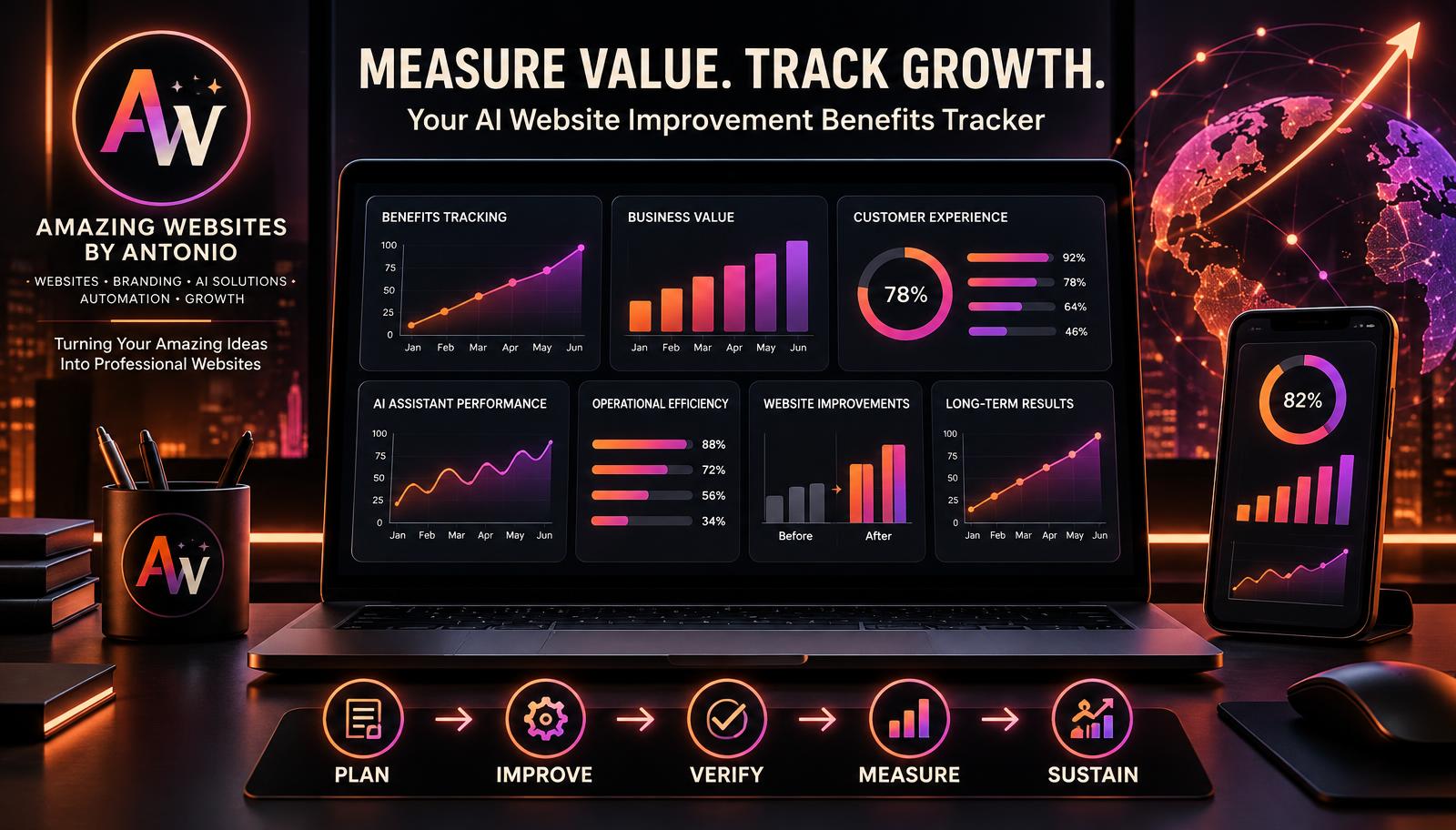
PLAN → IMPROVE → VERIFY → MEASURE → REVIEW → OPTIMIZE → SUSTAIN
WEBSITE IMPROVEMENT OUTPUTS VS. BUSINESS BENEFITS
Understanding the difference between completing a change and realizing a benefit is essential.
| Improvement Output | Potential Business Benefit |
|---|---|
| Redesigned Contact Form | Easier customer inquiries |
| Updated AI Assistant | More accurate customer information |
| Improved Mobile Navigation | Better mobile usability |
| New Automation | Less repetitive administrative work |
| Faster Website Pages | Improved browsing experience |
| Updated FAQ Page | Easier access to common answers |
| Improved Accessibility | Fewer barriers for visitors |
| Better Website Monitoring | Faster identification of important problems |
IMPORTANT:
These are potential benefits.
You should measure relevant outcomes before claiming that an improvement actually delivered them.
THE FIVE CATEGORIES OF WEBSITE IMPROVEMENT BENEFITS
1. CUSTOMER EXPERIENCE BENEFITS
These improvements help customers interact with your website.
Examples:
- Easier navigation
- Clearer information
- Better mobile usability
- More accessible content
2. OPERATIONAL BENEFITS
These improvements help the business operate more efficiently.
Examples:
- Reduced repetitive work
- Better inquiry organization
- More reliable notifications
- Easier website maintenance
3. AI ASSISTANT BENEFITS
These improvements help AI-powered features serve customers more effectively.
Examples:
- More accurate answers
- Better question coverage
- Clearer human handoff
- Reduced misinformation
4. FINANCIAL BENEFITS
These improvements may affect business costs or revenue.
Examples:
- Reduced administrative expenses
- Lower maintenance costs
- Improved qualified inquiry conversion
- Additional revenue where supported by records
5. RELIABILITY AND RISK BENEFITS
These improvements support dependable operations.
Examples:
- Fewer recurring errors
- Faster issue detection
- More reliable integrations
- Better documentation
- Reduced exposure to preventable operational problems
A useful benefits tracker should focus on the categories that matter most to your business.
YOUR AI WEBSITE IMPROVEMENT BENEFITS TRACKING MATRIX
| Improvement | Expected Benefit | Measurement | Review Frequency |
|---|---|---|---|
| Contact Form Update | Easier customer inquiries | Defined submission and inquiry metrics | Monthly |
| AI Knowledge Update | More accurate responses | Representative AI test results | Monthly |
| Mobile Menu Update | Better navigation | Usability test outcomes | Quarterly |
| Automation Update | Reduced manual work | Time per completed workflow | Monthly |
| Performance Update | Faster page experience | Comparable loading measurements | Monthly |
| Accessibility Update | Reduced usability barriers | Relevant accessibility test results | Quarterly |
These frequencies are examples.
Adjust your review schedule based on the importance of each benefit and the information available.
YOUR LONG-TERM BENEFITS DASHBOARD
A benefits dashboard helps you review whether improvements continue delivering useful outcomes.
Consider tracking:
- Total improvements under review
- Expected benefits
- Benefits with measurable baselines
- Benefits meeting targets
- Benefits below targets
- Benefits not yet measured
- Estimated operational time savings
- Documented cost savings
- Ongoing maintenance costs
- Benefits requiring additional action
FICTIONAL DASHBOARD EXAMPLE
| Metric | Example |
|---|---|
| Improvements Being Tracked | 12 |
| Expected Benefits | 18 |
| Benefits Meeting Targets | 9 |
| Benefits Below Targets | 4 |
| Benefits Not Yet Measured | 5 |
| Estimated Monthly Time Savings | 6 hours |
| Monthly Maintenance Costs | $45 |
These figures are fictional and do not represent actual Amazing Websites By Antonio business results.
HOW TO CALCULATE OPERATIONAL TIME SAVINGS
Time savings can be a useful measure when an improvement reduces repetitive work.
EXAMPLE
Before an automation:
A task takes 12 minutes.
After an automation:
The task takes 5 minutes, including the remaining manual review.
The task occurs 40 times per month.
Time saved per task:
12 − 5 = 7 minutes
Estimated monthly time savings:
7 × 40 = 280 minutes
280 ÷ 60 = approximately 4.67 hours per month.
If the estimated value of an hour of work is $25:
4.67 × $25 = approximately $116.67 in monthly time value.
IMPORTANT:
This is an illustrative estimate, not guaranteed financial savings.
Time value should not automatically be counted as actual cash savings unless the business can demonstrate that an expense was reduced or another financial benefit was realized.
Also account for maintenance and review time that the automation introduces.
INTERACTIVE BENEFITS CALCULATOR
Try the free interactive AI Website Benefits Calculator — enter your own numbers and copy your results.
Use this worked example to explore estimated time savings from a website improvement or automation.
Example inputs:
| Input | Value |
|---|---|
| Minutes before | 12 |
| Minutes after | 5 |
| Tasks per month | 40 |
| Hourly time value | $25 |
| Additional monthly maintenance cost | $20 |
Estimated results:
| Result | Value |
|---|---|
| Estimated hours saved/month | 4.67 |
| Time value/month | $116.67 |
| Time value minus maintenance cost/month | $96.67 |
Illustrative estimate only. This is not realized profit, cash savings, or a complete ROI calculation. It excludes setup costs, taxes, other ongoing expenses, and potential changes in task volume. When the task takes longer after the change, the estimate displays zero hours saved rather than a negative saving.
HOW TO EVALUATE WEBSITE IMPROVEMENT ROI
Return on investment, or ROI, can help evaluate financial benefits when reliable information is available.
A simplified formula is:
ROI (%) = [(Financial Benefits − Total Costs) ÷ Total Costs] × 100
FICTIONAL EXAMPLE
Suppose a website improvement produces $1,500 in attributable financial benefits over a defined period.
Total relevant costs are $1,000.
ROI = (($1,500 − $1,000) ÷ $1,000) × 100
ROI = 50%
This is a fictional calculation.
Actual ROI requires careful measurement of costs and financial benefits.
Don't automatically treat website visits, customer inquiries, or estimated time value as realized revenue.
If the financial benefits cannot be reliably measured, it may be more appropriate to report operational and customer experience outcomes separately.
HOW TO REVIEW BENEFITS OVER TIME
A useful tracker compares multiple review periods.
FICTIONAL EXAMPLE
| Benefit Indicator | Baseline | Month 1 | Month 2 | Month 3 |
|---|---|---|---|---|
| AI Test Accuracy | 75% | 90% | 95% | 95% |
| Contact Form Test Success | 80% | 100% | 100% | 100% |
| Monthly Manual Work | 12 hrs | 9 hrs | 8 hrs | 8 hrs |
| Median Page Load Measurement | 3.4 sec | 2.8 sec | 2.7 sec | 2.7 sec |
These figures are fictional.
They illustrate how a business owner might observe whether improvements are sustained.
A trend may be more informative than one isolated measurement.
However, changes should still be interpreted in context.
BENEFIT STATUS AND DECISION MATRIX
| Status | Meaning | Suggested Action |
|---|---|---|
| On Track | Results meet the defined target | Continue scheduled review |
| Exceeded Target | Results surpass the target | Evaluate whether the benefit is sustainable |
| Below Target | Results do not meet expectations | Investigate and plan corrective action |
| Needs Review | Evidence is mixed or unclear | Collect additional information |
| Not Measured | Required information is unavailable | Establish or improve measurement |
| No Longer Relevant | Original benefit is no longer needed | Document the decision and adjust tracking |
IMPORTANT:
An improvement should not be described as delivering a verified benefit when the supporting measurement is missing.
COMPLETE AI WEBSITE IMPROVEMENT BENEFITS TRACKING CHECKLIST
SECTION 1 — BENEFIT IDENTIFICATION
- Improvement action is identified.
- Expected benefits are documented.
- Customer and business outcomes are considered.
- Financial and nonfinancial benefits are distinguished.
- Benefit owner is assigned.
SECTION 2 — MEASUREMENT PLANNING
- Relevant indicators are selected.
- Baseline measurements are recorded where available.
- Targets are established.
- Measurement methods are documented.
- Data limitations are identified.
SECTION 3 — CUSTOMER EXPERIENCE
- Important customer journeys are reviewed.
- Contact Form engagement is evaluated where appropriate.
- Navigation outcomes are considered.
- Relevant feedback is reviewed.
- Accessibility improvements are assessed.
SECTION 4 — AI ASSISTANT BENEFITS
- Representative AI questions are tested.
- Response accuracy is evaluated.
- Human handoff is reviewed.
- Operational benefits are measured where possible.
- Important AI limitations are documented.
SECTION 5 — OPERATIONAL AND FINANCIAL VALUE
- Time savings are evaluated.
- Automation reliability is reviewed.
- Implementation costs are recorded.
- Ongoing maintenance costs are considered.
- Financial claims are supported by evidence.
SECTION 6 — LONG-TERM TRACKING
- Review schedule is established.
- Results are recorded consistently.
- Trends are evaluated.
- External influences are considered.
- Declining benefits are investigated.
SECTION 7 — REPORTING AND DECISIONS
- Benefits dashboard is updated.
- Actual results are compared with targets.
- Missing information is disclosed.
- Corrective actions are assigned.
- Future improvement priorities are reviewed.
COPY-READY AI WEBSITE IMPROVEMENT BENEFITS TRACKER TEMPLATE
BUSINESS NAME:
[Enter Business Name]
WEBSITE:
[Enter Website Address]
BENEFIT TRACKING ID:
[Enter Identifier]
RELATED IMPROVEMENT ACTION ID:
[Enter Identifier]
DATE CREATED:
[Enter Date]
BENEFIT OWNER:
[Enter Name]
SECTION 1 — IMPROVEMENT OVERVIEW
IMPROVEMENT TITLE:
[Enter Title]
IMPROVEMENT DESCRIPTION:
[Describe Change]
IMPLEMENTATION DATE:
[Enter Date]
VERIFICATION STATUS:
Verified / Needs Review / Not Verified
AFFECTED WEBSITE AREAS:
[List Pages or Features]
SECTION 2 — EXPECTED BENEFITS
PRIMARY BENEFIT:
[Describe Benefit]
SECONDARY BENEFITS:
[List Benefits]
BENEFIT CATEGORY:
Customer Experience / Operational Efficiency / AI Reliability / Financial / Risk Reduction / Other
EXPECTED BUSINESS VALUE:
[Describe Value]
SECTION 3 — MEASUREMENT PLAN
BENEFIT INDICATOR:
[Enter Metric]
BASELINE VALUE:
[Enter Value or Not Available]
TARGET VALUE:
[Enter Target]
MEASUREMENT METHOD:
[Describe Method]
DATA SOURCE:
[Enter Source]
MEASUREMENT LIMITATIONS:
[List Limitations]
SECTION 4 — REVIEW SCHEDULE
FIRST REVIEW DATE:
[Enter Date]
REVIEW FREQUENCY:
Weekly / Monthly / Quarterly / Other
NEXT REVIEW DATE:
[Enter Date]
PLANNED TRACKING END DATE:
[Enter Date or Ongoing]
SECTION 5 — ACTUAL RESULTS
REVIEW PERIOD:
[Enter Period]
ACTUAL MEASURED RESULT:
[Enter Result]
COMPARISON WITH BASELINE:
[Describe Change]
COMPARISON WITH TARGET:
[Describe Difference]
SUPPORTING EVIDENCE:
[List Safe References]
SECTION 6 — OPERATIONAL AND FINANCIAL VALUE
ESTIMATED TIME SAVINGS:
[Enter Amount or Not Measured]
DOCUMENTED COST SAVINGS:
[Enter Amount or Not Measured]
ADDITIONAL REVENUE ATTRIBUTABLE TO IMPROVEMENT:
[Enter Amount or Not Established]
IMPLEMENTATION COSTS:
[Enter Amount]
ONGOING COSTS:
[Enter Amount]
FINANCIAL ASSESSMENT:
[Describe Findings]
SECTION 7 — BENEFIT STATUS
CURRENT STATUS:
On Track / Exceeded Target / Below Target / Needs Review / Not Measured / No Longer Relevant
KEY FINDINGS:
[List Findings]
EXTERNAL FACTORS:
[List Relevant Factors]
OUTSTANDING CONCERNS:
[List Concerns]
SECTION 8 — NEXT ACTIONS
RECOMMENDED ACTION:
Continue Monitoring / Improve / Investigate / Revise Target / Close Tracking
ACTION OWNER:
[Enter Name]
TARGET DATE:
[Enter Date]
NEXT REVIEW DATE:
[Enter Date]
ADDITIONAL NOTES:
[Enter Notes]
EXAMPLE AI WEBSITE IMPROVEMENT BENEFITS SCENARIO
The following scenario is fictional.
Situation: A Business Owner Improves an AI Assistant and Contact Form
A business owner recently completed two website improvements.
The first updated the AI assistant's service information.
The second improved the Contact form workflow.
Both improvements passed their original verification checks.
Now the owner wants to determine whether the improvements continue providing value.
Step 1 — Identify Expected Benefits
The owner expects more accurate AI responses and more reliable customer inquiries.
Step 2 — Establish Baselines
The owner reviews available AI test results and previous Contact form testing records.
Step 3 — Choose Benefit Indicators
The owner selects representative AI answer accuracy and defined Contact form test success.
Step 4 — Establish Review Dates
The owner schedules monthly reviews for the next three months.
Step 5 — Collect Results
The owner performs consistent tests and records the results.
Step 6 — Review AI Assistant Accuracy
The assistant continues meeting the defined accuracy target during the selected tests.
Step 7 — Review Contact Form Reliability
The Contact form continues passing its required test submissions.
Step 8 — Consider Business Outcomes
The owner reviews relevant inquiry records and customer feedback, while recognizing that changes in inquiry volume may have multiple causes.
Step 9 — Document the Findings
The benefits tracker records the results, limitations, and outstanding concerns.
Step 10 — Decide What Happens Next
The owner continues monitoring important functions and uses the findings to guide future improvements.
LESSON:
Verifying that an improvement works is important.
Tracking whether it continues delivering meaningful benefits helps support better long-term business decisions.
YOUR 30-DAY AI WEBSITE IMPROVEMENT BENEFITS TRACKING PLAN
WEEK 1 — IDENTIFY IMPORTANT BENEFITS
- Review completed website improvements.
- Identify expected customer benefits.
- Identify operational benefits.
- Consider relevant financial outcomes.
- Create a benefits register.
GOAL: Understand which improvements are expected to create meaningful value.
WEEK 2 — ESTABLISH MEASUREMENT METHODS
- Select relevant indicators.
- Gather available baseline data.
- Define realistic targets.
- Document measurement methods.
- Establish review schedules.
GOAL: Create a consistent way to evaluate benefits.
WEEK 3 — BUILD YOUR BENEFITS DASHBOARD
- Organize improvements by benefit category.
- Record current measurements.
- Compare results with targets.
- Document data limitations.
- Identify benefits requiring attention.
GOAL: Make important outcomes easier to review.
WEEK 4 — REVIEW AND IMPROVE
- Evaluate early benefit results.
- Investigate unexpected findings.
- Review ongoing costs.
- Identify needed corrective actions.
- Schedule future reviews.
GOAL: Establish a repeatable long-term benefits tracking process.
THE AI WEBSITE IMPROVEMENT BENEFITS FRAMEWORK
PLAN
Identify the value an improvement is expected to create.
↓
IMPROVE
Implement the approved website change.
↓
VERIFY
Confirm that the improvement meets its requirements.
↓
MEASURE
Collect relevant benefit indicators.
↓
REVIEW
Compare actual results with expectations.
↓
OPTIMIZE
Address gaps and identify further opportunities.
↓
SUSTAIN
Continue monitoring benefits for an appropriate period.
FINAL THOUGHTS
Creating a professional business website is an exciting accomplishment.
It represents your creativity.
Your services.
Your brand.
And your commitment to helping customers.
But as your business grows, you'll continue investing time and resources into website improvements.
Some changes may make your website easier to navigate.
Others may improve your Contact form.
Make your AI assistant more helpful.
Reduce repetitive work.
Or improve website performance.
Those improvements can create meaningful value.
But it's important to understand whether that value is actually being realized.
That's why an AI website improvement benefits tracker matters.
It helps you move beyond completed tasks.
Evaluate meaningful outcomes.
Measure customer experience improvements.
Review operational efficiency.
Consider financial value.
And determine whether your improvements continue delivering benefits over time.
A WEBSITE IMPROVEMENT ISN'T VALUABLE SIMPLY BECAUSE IT WAS COMPLETED.
ITS LONG-TERM VALUE COMES FROM THE POSITIVE RESULTS IT HELPS CREATE AND SUSTAIN.
Start with one important improvement.
Identify its expected benefit.
Choose a meaningful measurement.
Review the results.
And keep improving.
Because professional website management isn't just about building more features.
IT'S ABOUT BUILDING A WEBSITE THAT CONTINUES TO CREATE VALUE FOR YOUR CUSTOMERS AND BUSINESS.
PLAN FOR VALUE.
MEASURE YOUR BENEFITS.
REVIEW YOUR RESULTS.
KEEP BUILDING BETTER WEBSITES.
Amazing Websites By Antonio
Turning Your Amazing Ideas Into Professional Websites