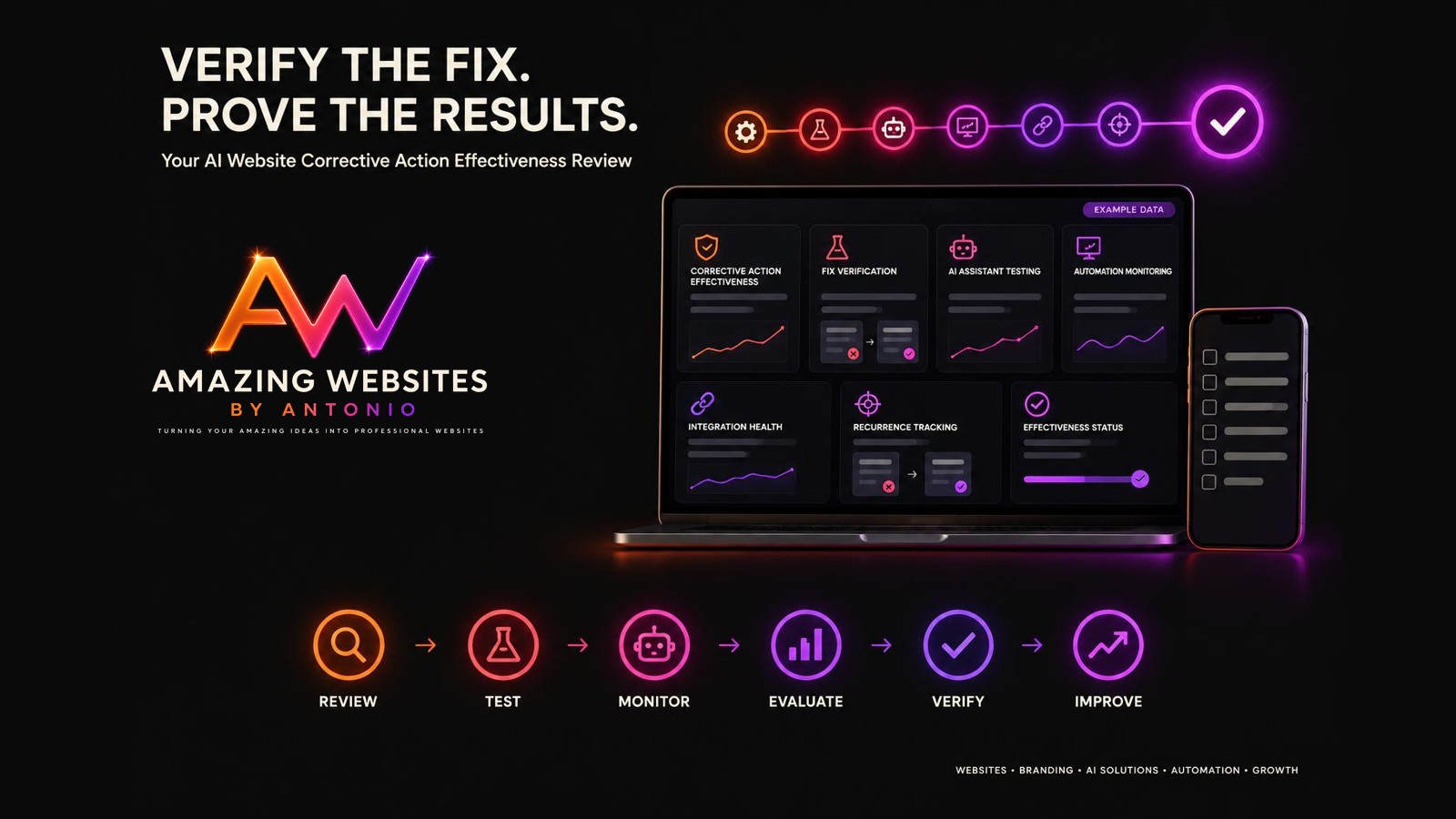
A Practical Guide to Verifying Website Fixes, Measuring Corrective Action Results, Monitoring Recurring Problems, and Improving Long-Term Website Reliability
Imagine you're managing your professional business website.
Your homepage looks beautiful.
Your Contact form is helping customers reach you.
Your AI assistant is answering questions.
And your automations are helping your business operate more efficiently.
Then something unexpected happens.
Your Contact form stops sending notifications.
You investigate the issue.
Review the automation.
Examine the integration.
And discover a configuration problem.
You make the appropriate correction.
Run a test.
And the notification arrives successfully.
Congratulations!
But here's an important question:
HOW DO YOU KNOW THE PROBLEM IS REALLY FIXED?
One successful test is encouraging.
But does the workflow continue working tomorrow?
Will it function correctly when several customers submit inquiries?
Could the same integration problem return?
Did the correction address the underlying cause?
And did the change accidentally affect another website feature?
These questions are important because restoring functionality and confirming long-term effectiveness are not exactly the same thing.
That's where an AI website corrective action effectiveness review becomes valuable.
AN AI WEBSITE CORRECTIVE ACTION EFFECTIVENESS REVIEW IS A STRUCTURED PROCESS FOR EVALUATING WHETHER AN IMPLEMENTED FIX ADDRESSED THE VERIFIED CAUSE OF A PROBLEM AND CONTINUES TO PRODUCE THE REQUIRED RESULTS.
It helps you move beyond simply marking an issue as resolved.
Instead of assuming a correction worked because one test passed, you collect appropriate evidence.
Instead of immediately closing a recurring problem, you monitor the affected system.
And instead of relying on guesswork, you establish clear criteria for determining whether corrective actions are effective.
For AI-powered websites, effectiveness reviews can help evaluate:
- Contact form corrections
- Email notification fixes
- AI assistant knowledge updates
- Automation repairs
- Integration changes
- Data synchronization corrections
- Website performance improvements
- Navigation repairs
- Mobile functionality fixes
- Security-related corrections
- Customer support improvements
- Recurring website incidents
The good news?
YOU DON'T NEED A LARGE TECHNICAL TEAM TO REVIEW WHETHER YOUR WEBSITE FIXES ARE WORKING.
Even a solo entrepreneur can create a practical effectiveness review using documented test results, monitoring records, and clear acceptance criteria.
In Blog #144, we're exploring 50 strategies to help you verify corrective actions and build more reliable website systems.
PART 1: UNDERSTAND CORRECTIVE ACTION EFFECTIVENESS
1. Know What an Effectiveness Review Means
An effectiveness review evaluates whether a completed corrective action produces the intended results and adequately addresses the identified problem.
2. Distinguish Implementation From Effectiveness
Implementation means the planned change was made.
Effectiveness means the change has been shown to address the problem under appropriate conditions.
3. Connect the Review to Root Cause Analysis
Use the findings from the original investigation to determine what needs to be verified.
4. Understand the Importance of Follow-Up
Some problems only recur after a particular event, workload, or amount of time.
5. Establish Clear Review Goals
Define what evidence would demonstrate that the corrective action is effective.
PART 2: REVIEW THE ORIGINAL WEBSITE PROBLEM
6. Revisit the Problem Statement
Review what failed and what should have happened.
7. Confirm the Root Cause Finding
Determine whether the underlying cause was verified or remains uncertain.
8. Review the Business Impact
Identify which customers, systems, or operations were affected.
9. Document the Corrective Action
Record exactly what was changed.
10. Identify Relevant Dependencies
Review other website systems that could be affected by the correction.
PART 3: ESTABLISH EFFECTIVENESS CRITERIA
11. Define Expected Results
Describe what successful operation should look like.
12. Choose Relevant Measurements
Select indicators that meaningfully reflect the problem.
13. Establish a Baseline
Use available historical results to understand performance before the correction.
14. Set Appropriate Observation Periods
Choose a review window based on the problem's recurrence pattern and business risk.
15. Define Failure Conditions
Identify what would indicate that the corrective action is ineffective.
PART 4: VERIFY CONTACT FORM AND CUSTOMER WORKFLOW FIXES
16. Test Contact Form Availability
Confirm that customers can access the form.
17. Verify Submission Completion
Use safe test data to confirm that submissions can be completed.
18. Check Inquiry Storage
Confirm that the submitted information reaches the intended destination.
19. Review Notification Delivery
Verify that expected notifications arrive through the approved workflow.
20. Monitor Real-World Results
Review appropriate operational evidence over the defined observation period.
PART 5: VERIFY AI ASSISTANT CORRECTIONS
21. Identify the Original AI Problem
Determine whether the correction addressed outdated knowledge, inaccurate answers, or another issue.
22. Review Approved Knowledge Updates
Confirm that the relevant information has been corrected.
23. Test Representative Questions
Evaluate whether the assistant meets approved response expectations.
24. Review Related AI Behaviors
Check whether the correction affected other important questions or workflows.
25. Monitor AI Response Quality
Use appropriate ongoing testing to identify possible recurrence.
PART 6: VERIFY AUTOMATION AND INTEGRATION FIXES
26. Confirm the Automation Trigger
Verify that the expected event activates the workflow.
27. Review Workflow Completion
Check whether required actions finish successfully.
28. Test Connected Services
Confirm that relevant integrations function as intended.
29. Review Error Logs
Look for repeated failures or new errors.
30. Test Important Exception Conditions
Where safe and appropriate, verify how the workflow handles expected exceptions.
PART 7: EVALUATE CORRECTIVE ACTION RESULTS
31. Compare Results With Acceptance Criteria
Determine whether the correction meets its documented requirements.
32. Review Recurrence Evidence
Check whether the original problem has returned.
33. Evaluate Related Systems
Confirm that the correction did not introduce significant new problems.
34. Document Remaining Risks
Identify issues that still require monitoring or additional work.
35. Determine the Effectiveness Status
Classify the corrective action as effective, partially effective, ineffective, or not yet verified.
PART 8: RESPOND TO INEFFECTIVE CORRECTIVE ACTIONS
36. Reopen the Investigation When Necessary
Review the original findings if the problem returns.
37. Reassess the Root Cause
Consider whether the original investigation missed important contributing factors.
38. Define Additional Corrective Actions
Create new actions based on updated evidence.
39. Establish New Verification Requirements
Determine how the revised solution will be tested.
40. Document the Updated Review
Preserve the findings and decisions for future reference.
PART 9: DOCUMENT THE EFFECTIVENESS REVIEW
41. Assign a Unique Review Identifier
Connect the effectiveness review to the original issue and corrective action.
42. Record Testing Evidence
Document what was tested and the observed results.
43. Summarize Monitoring Findings
Include relevant observations from the review period.
44. Record the Effectiveness Decision
Explain whether the evidence supports closure or additional work.
45. Obtain Appropriate Approval
Document the final review and responsible decision-maker.
PART 10: IMPROVE LONG-TERM WEBSITE RELIABILITY
46. Update Maintenance Procedures
Incorporate relevant new checks into routine website management.
47. Improve Monitoring
Identify opportunities to detect similar failures earlier.
48. Update the Knowledge Base
Document verified solutions and effectiveness findings.
49. Review Related Corrective Actions
Look for similar weaknesses elsewhere in the website.
50. Make Effectiveness Reviews Part of Continuous Improvement
Use corrective action results to strengthen future website maintenance and problem prevention.
REVIEW → DEFINE → TEST → MONITOR → EVALUATE → DECIDE → DOCUMENT → IMPROVE
CORRECTIVE ACTION IMPLEMENTATION VS. EFFECTIVENESS
These two activities answer different questions.
| Implementation Verification | Effectiveness Review |
|---|---|
| Was the planned change completed? | Did the change address the problem? |
| Were settings updated correctly? | Does the system now meet its requirements? |
| Did the immediate test pass? | Do results remain acceptable over the relevant period? |
| Was the action documented? | Is the evidence sufficient to support closure? |
| Is the change complete? | Is the risk of recurrence adequately controlled? |
IMPORTANT:
A completed corrective action is not automatically an effective corrective action.
THE FIVE QUESTIONS EVERY EFFECTIVENESS REVIEW SHOULD ANSWER
1. WHAT WAS THE ORIGINAL PROBLEM?
Describe the observed failure.
2. WHAT CAUSED THE PROBLEM?
Reference the verified root cause findings.
3. WHAT WAS CHANGED?
Document the corrective action.
4. WHAT EVIDENCE SHOWS THE CHANGE WORKED?
Review test results, logs, monitoring data, and relevant operational outcomes.
5. IS THE EVIDENCE SUFFICIENT TO CLOSE THE ACTION?
Consider the severity, recurrence pattern, and remaining risks.
If the evidence is insufficient, continue monitoring or investigation.
YOUR CORRECTIVE ACTION EFFECTIVENESS WORKFLOW
ORIGINAL PROBLEM IDENTIFIED
↓
ROOT CAUSE INVESTIGATED
↓
CORRECTIVE ACTION IMPLEMENTED
↓
IMPLEMENTATION VERIFIED
↓
EFFECTIVENESS CRITERIA ESTABLISHED
↓
TARGETED TESTING COMPLETED
↓
RELATED WORKFLOWS REVIEWED
↓
MONITORING PERIOD EVALUATED
↓
EFFECTIVENESS DECISION MADE
↓
ACTION CLOSED OR ADDITIONAL WORK REQUIRED
This workflow helps ensure that a correction is evaluated beyond its initial implementation.
EXAMPLE 1: CONTACT FORM NOTIFICATION FIX
Imagine a Contact form notification workflow has been corrected.
The original issue involved an integration connection that was no longer authorized.
The business owner restores the connection using the service's supported procedure.
Now the owner must evaluate effectiveness.
REVIEW STEPS
- Confirm the integration is authorized.
- Complete safe test submissions.
- Verify inquiry storage.
- Confirm notification delivery.
- Review relevant workflow logs.
- Monitor for repeated authorization failures.
- Evaluate the defined observation period.
- Record the final effectiveness decision.
POSSIBLE RESULT:
The correction may be considered effective when the required tests pass, relevant monitoring is satisfactory, and the review criteria are met.
However, if the integration repeatedly loses authorization, further investigation may be necessary.
EXAMPLE 2: AI ASSISTANT KNOWLEDGE CORRECTION
Imagine an AI assistant provides outdated business information.
The business owner updates the approved knowledge source.
But how can the owner verify the correction?
REVIEW STEPS
- Confirm the approved source contains the correct information.
- Verify that the assistant can access the updated information.
- Test the original question.
- Test related question variations.
- Review important neighboring topics.
- Evaluate human handoff where relevant.
- Record the observed results.
- Continue appropriate monitoring.
IMPORTANT:
AI responses can vary.
Evaluate factual accuracy and required behavior rather than demanding identical wording in every response.
EXAMPLE 3: AUTOMATION FAILURE CORRECTION
Imagine an automation failed to send an expected notification.
The configuration is corrected.
Now the effectiveness review should consider:
- Whether the trigger activates
- Whether the workflow starts
- Whether each required step completes
- Whether the expected destination receives the result
- Whether duplicate actions occur
- Whether relevant errors recur
- Whether related workflows remain functional
A successful automation test is useful evidence.
But repeated failures under normal operating conditions may indicate that the corrective action is incomplete.
YOUR CORRECTIVE ACTION EFFECTIVENESS MATRIX
| Corrective Action | Verification Method | Effectiveness Evidence |
|---|---|---|
| Contact Form Repair | End-to-end submission test | Successful submissions and continued reliable operation |
| Notification Fix | Delivery and workflow checks | Expected notifications delivered without recurring failures |
| AI Knowledge Update | Representative question testing | Approved factual requirements consistently met |
| Automation Correction | Trigger-to-result testing | Required workflow actions complete |
| Integration Repair | Connection and workflow monitoring | Relevant connection errors do not recur during an adequate observation period |
| Navigation Fix | Link and user journey testing | Intended pages remain accessible |
| Performance Improvement | Comparable performance measurements | Defined performance criteria are met |
| Data Synchronization Fix | Reconciliation checks | Required records remain consistent |
The required evidence depends on the type and severity of the original problem.
HOW LONG SHOULD YOU MONITOR A CORRECTIVE ACTION?
There is no single observation period that works for every website issue.
Consider:
- How often the original problem occurred
- How frequently the affected workflow runs
- The business impact of recurrence
- Whether the correction involves an external integration
- Whether the failure only appears under particular conditions
- How much evidence is needed to support a reliable decision
For example, a daily Contact form workflow may generate useful evidence relatively quickly.
A monthly automation may need to be observed across one or more scheduled executions.
DO NOT DECLARE A FIX EFFECTIVE SIMPLY BECAUSE AN ARBITRARY NUMBER OF DAYS HAS PASSED.
The observation period should provide meaningful evidence.
YOUR EFFECTIVENESS REVIEW STATUS CATEGORIES
| Status | Meaning |
|---|---|
| Effective | Required evidence supports that the corrective action addressed the problem |
| Partially Effective | Some requirements are met, but important gaps remain |
| Ineffective | Evidence shows the action did not adequately address the problem |
| Not Yet Verified | Insufficient evidence is available |
| Blocked | Required testing or monitoring cannot currently be completed |
These statuses help keep effectiveness decisions clear.
YOUR CORRECTIVE ACTION READINESS SCORECARD
Use this illustrative scorecard.
Assign:
- 2 points: Requirement satisfied
- 1 point: Partially satisfied
- 0 points: Not satisfied
| Review Category | Maximum Points |
|---|---|
| Original Problem Documented | 2 |
| Root Cause Findings Reviewed | 2 |
| Corrective Action Recorded | 2 |
| Implementation Verified | 2 |
| Effectiveness Criteria Defined | 2 |
| Targeted Testing Completed | 2 |
| Related Workflows Reviewed | 2 |
| Monitoring Evidence Collected | 2 |
| Residual Risks Evaluated | 2 |
| Final Decision Documented | 2 |
| Total | 20 |
A high score indicates that the review process is well documented.
However, a high score does not automatically prove that a corrective action is effective.
Critical failures, inadequate evidence, or unmet acceptance criteria must be addressed independently of the total score.
YOUR CORRECTIVE ACTION EFFECTIVENESS DASHBOARD
A dashboard can help organize corrective action reviews.
Consider tracking:
- Corrective actions implemented
- Actions awaiting effectiveness review
- Actions confirmed effective
- Partially effective actions
- Ineffective actions
- Reopened investigations
- Recurring incidents
- Outstanding verification tests
- Monitoring periods completed
- Actions approved for closure
FICTIONAL DASHBOARD EXAMPLE
| Metric | Example |
|---|---|
| Corrective Actions Implemented | 20 |
| Actions Reviewed | 16 |
| Confirmed Effective | 12 |
| Partially Effective | 2 |
| Ineffective | 1 |
| Not Yet Verified | 1 |
| Awaiting Review | 4 |
| Reopened Investigations | 2 |
These figures are fictional and do not represent actual Amazing Websites By Antonio website operations.
HOW TO CALCULATE CORRECTIVE ACTION EFFECTIVENESS RATE
One useful measure is the percentage of reviewed corrective actions that meet their effectiveness criteria.
EFFECTIVENESS RATE = (CORRECTIVE ACTIONS CONFIRMED EFFECTIVE ÷ CORRECTIVE ACTIONS WITH COMPLETED EFFECTIVENESS REVIEWS) × 100
FICTIONAL EXAMPLE
A business completes effectiveness reviews for 15 corrective actions.
Twelve are confirmed effective.
12 ÷ 15 × 100 = 80%
The effectiveness rate is 80%.
This metric can help identify opportunities for improvement.
However, an overall rate should never hide serious unresolved problems.
One ineffective action affecting critical customer data may require more attention than several successful low-risk corrections.
COMPLETE AI WEBSITE CORRECTIVE ACTION EFFECTIVENESS CHECKLIST
SECTION 1 — ORIGINAL PROBLEM
- Original issue is identified.
- Problem statement is reviewed.
- Business impact is documented.
- Root cause findings are available.
- Relevant dependencies are identified.
SECTION 2 — CORRECTIVE ACTION
- Corrective action is documented.
- Responsible owner is assigned.
- Implementation date is recorded.
- Implementation verification is complete.
- Related configuration changes are recorded.
SECTION 3 — EFFECTIVENESS CRITERIA
- Expected results are defined.
- Relevant measurements are selected.
- Available baseline information is reviewed.
- Observation period is appropriate.
- Failure conditions are documented.
SECTION 4 — CONTACT WORKFLOWS
- Contact Form availability is checked.
- Submission completion is verified.
- Inquiry storage is confirmed.
- Notification delivery is reviewed.
- Ongoing workflow results are monitored.
SECTION 5 — AI ASSISTANTS
- Original AI issue is identified.
- Approved knowledge corrections are verified.
- Representative questions are tested.
- Related responses are reviewed.
- Ongoing AI accuracy monitoring is considered.
SECTION 6 — AUTOMATIONS AND INTEGRATIONS
- Automation trigger is verified.
- Required actions complete successfully.
- Connected services are checked.
- Relevant error logs are reviewed.
- Important exception conditions are evaluated.
SECTION 7 — EFFECTIVENESS EVALUATION
- Results are compared with criteria.
- Recurrence evidence is reviewed.
- Related systems are checked.
- Residual risks are documented.
- Effectiveness status is assigned.
SECTION 8 — INEFFECTIVE ACTIONS
- Investigation is reopened when necessary.
- Root cause findings are reassessed.
- Additional actions are identified.
- Revised verification requirements are established.
- Updated findings are documented.
SECTION 9 — REVIEW DOCUMENTATION
- Review identifier is assigned.
- Testing evidence is recorded.
- Monitoring findings are summarized.
- Effectiveness decision is documented.
- Appropriate approval is recorded.
SECTION 10 — CONTINUOUS IMPROVEMENT
- Maintenance procedures are updated.
- Monitoring improvements are considered.
- Knowledge base articles are updated.
- Related corrective actions are reviewed.
- Long-term improvement responsibilities are assigned.
COPY-READY AI WEBSITE CORRECTIVE ACTION EFFECTIVENESS REVIEW TEMPLATE
BUSINESS NAME:
[Enter Business Name]
WEBSITE:
[Enter Website Address]
EFFECTIVENESS REVIEW ID:
[Enter Identifier]
RELATED RCA REPORT ID:
[Enter Identifier]
RELATED CORRECTIVE ACTION ID:
[Enter Identifier]
DATE CREATED:
[Enter Date]
PREPARED BY:
[Enter Name]
SECTION 1 — ORIGINAL ISSUE
ISSUE TITLE:
[Enter Title]
PROBLEM DESCRIPTION:
[Describe Problem]
BUSINESS IMPACT:
[Describe Impact]
VERIFIED ROOT CAUSE:
[Enter Finding or State Not Yet Established]
RELATED SYSTEMS:
[List Systems]
SECTION 2 — CORRECTIVE ACTION
ACTION DESCRIPTION:
[Describe Action]
ACTION OWNER:
[Enter Name]
IMPLEMENTATION DATE:
[Enter Date]
IMPLEMENTATION VERIFICATION:
[Describe Results]
RELATED CONFIGURATION CHANGES:
[List Changes]
SECTION 3 — EFFECTIVENESS REQUIREMENTS
EXPECTED RESULTS:
[List Results]
ACCEPTANCE CRITERIA:
[List Criteria]
MEASUREMENTS:
[List Measurements]
BASELINE INFORMATION:
[Enter Information]
OBSERVATION PERIOD:
[Enter Period]
FAILURE CONDITIONS:
[List Conditions]
SECTION 4 — TARGETED TESTING
TEST 1:
[Describe Test]
EXPECTED RESULT:
[Enter Result]
ACTUAL RESULT:
[Enter Result]
STATUS:
Pass / Fail / Needs Review / Not Tested
TEST 2:
[Describe Test]
EXPECTED RESULT:
[Enter Result]
ACTUAL RESULT:
[Enter Result]
STATUS:
Pass / Fail / Needs Review / Not Tested
SECTION 5 — RELATED WORKFLOW REVIEW
RELATED SYSTEMS TESTED:
[List Systems]
UNEXPECTED SIDE EFFECTS:
[List Findings]
DATA INTEGRITY RESULTS:
[Enter Results]
SECURITY OR PRIVACY CONCERNS:
[Enter Findings]
SECTION 6 — MONITORING RESULTS
MONITORING START DATE:
[Enter Date]
MONITORING END DATE:
[Enter Date]
OBSERVATION FREQUENCY:
[Enter Frequency]
MONITORING FINDINGS:
[Describe Findings]
RECURRENCE OBSERVED:
Yes / No / Insufficient Evidence
SECTION 7 — EFFECTIVENESS EVALUATION
ACCEPTANCE CRITERIA MET:
Yes / No / Partially / Not Verified
EVIDENCE SUFFICIENT:
Yes / No
RESIDUAL RISKS:
[List Risks]
EFFECTIVENESS STATUS:
Effective / Partially Effective / Ineffective / Not Yet Verified / Blocked
DECISION RATIONALE:
[Explain Decision]
SECTION 8 — ADDITIONAL ACTIONS
ADDITIONAL ACTION REQUIRED:
Yes / No
ACTION DESCRIPTION:
[Describe Action]
ACTION OWNER:
[Enter Name]
TARGET DATE:
[Enter Date]
REVISED VERIFICATION PLAN:
[Describe Plan]
SECTION 9 — DOCUMENTATION
TEST EVIDENCE REFERENCES:
[List References]
MONITORING RECORD REFERENCES:
[List References]
KNOWLEDGE BASE UPDATES:
[List Updates]
MAINTENANCE PROCEDURE UPDATES:
[List Updates]
LESSONS LEARNED:
[List Lessons]
SECTION 10 — REVIEW AND CLOSURE
FINAL DECISION:
Close Action / Continue Monitoring / Additional Correction Required / Reopen Investigation
REVIEWED BY:
[Enter Name]
REVIEW DATE:
[Enter Date]
APPROVED BY:
[Enter Name]
APPROVAL DATE:
[Enter Date]
NEXT REVIEW DATE, IF REQUIRED:
[Enter Date]
FINAL STATUS:
Open / Under Review / Monitoring / Closed
EXAMPLE AI WEBSITE CORRECTIVE ACTION EFFECTIVENESS SCENARIO
The following scenario is fictional.
Situation: A Solo Entrepreneur Verifies a Contact Form Notification Repair
A solo entrepreneur manages a professional business website.
The Contact form has experienced repeated notification failures.
A root cause analysis identifies a recurring integration authorization problem and a gap in maintenance monitoring.
The owner restores the integration and updates the maintenance procedure.
Now it's time to evaluate whether those actions are effective.
Step 1 — Review the Original Problem
The owner confirms that the original failure involved missing notifications.
Step 2 — Review the Root Cause
The owner examines the documented authorization problem and contributing monitoring gap.
Step 3 — Confirm Implementation
The integration has been restored, and the maintenance procedure has been updated.
Step 4 — Establish Effectiveness Criteria
The owner defines successful notification delivery and appropriate integration monitoring as required results.
Step 5 — Complete Targeted Tests
Safe Contact form submissions confirm that inquiries are stored and notifications are delivered.
Step 6 — Review Related Workflows
The owner checks whether other important notification workflows remain functional.
Step 7 — Monitor Normal Operation
The owner reviews relevant workflow results during an observation period appropriate to the recurrence pattern.
Step 8 — Evaluate Recurrence
No matching failure is observed during the defined period, and the required monitoring checks operate as expected.
Step 9 — Review Remaining Risks
The owner considers whether additional monitoring or documentation is necessary.
Step 10 — Record the Effectiveness Decision
After confirming that the required evidence and acceptance criteria are satisfied, the owner documents the review and closes the corrective action.
LESSON:
A successful corrective action should be evaluated through appropriate testing and monitoring—not simply assumed effective because the first test passed.
YOUR 30-DAY AI WEBSITE CORRECTIVE ACTION EFFECTIVENESS PLAN
WEEK 1 — REVIEW AND PLAN
- Identify corrective actions awaiting review.
- Revisit the original problems.
- Review root cause findings.
- Confirm implementation.
- Establish effectiveness criteria.
GOAL: Define what successful corrective action results should look like.
WEEK 2 — TEST CORRECTIVE ACTIONS
- Perform targeted tests.
- Review Contact form workflows.
- Evaluate AI assistant corrections.
- Test automations and integrations.
- Document test results.
GOAL: Verify that corrected features meet their defined requirements.
WEEK 3 — MONITOR OPERATIONAL RESULTS
- Review relevant system logs.
- Monitor recurring errors.
- Compare results with acceptance criteria.
- Evaluate related workflows.
- Document remaining risks.
GOAL: Collect meaningful evidence of ongoing effectiveness.
WEEK 4 — EVALUATE AND DECIDE
- Review testing evidence.
- Summarize monitoring findings.
- Determine effectiveness status.
- Reopen ineffective actions when necessary.
- Update maintenance documentation.
- Record final decisions.
GOAL: Confirm which actions can be closed and which require additional work.
IMPORTANT:
Some corrective actions require longer monitoring periods.
Do not close an action solely because the 30-day plan has ended.
THE AI WEBSITE CORRECTIVE ACTION EFFECTIVENESS FRAMEWORK
REVIEW
Understand the original problem and verified cause.
↓
DEFINE
Establish effectiveness criteria.
↓
TEST
Evaluate the corrected functionality.
↓
MONITOR
Observe relevant operational results.
↓
EVALUATE
Compare evidence with requirements.
↓
DECIDE
Confirm effectiveness or require additional action.
↓
DOCUMENT
Record findings and approval.
↓
IMPROVE
Update maintenance procedures and preventive controls.
FINAL THOUGHTS
Creating a professional business website is an exciting accomplishment.
It represents your creativity.
Your services.
Your brand.
And your commitment to helping customers.
But every website can experience unexpected problems.
A Contact form may stop working.
An AI assistant may provide outdated information.
An automation may fail.
An integration may disconnect.
Or a website feature may behave differently after an update.
Fixing these problems is important.
But professional website management doesn't stop when a correction is implemented.
It's also important to verify that the correction works.
That's why an AI website corrective action effectiveness review matters.
It helps you evaluate test results.
Monitor recurring problems.
Review related systems.
Confirm that corrective actions address verified causes.
And determine when an issue is ready for closure.
A FIX ISN'T FULLY VERIFIED JUST BECAUSE THE FIRST TEST PASSES.
A STRONG EFFECTIVENESS REVIEW HELPS CONFIRM THAT YOUR CORRECTION PRODUCES RELIABLE RESULTS OVER TIME.
Start with the original problem.
Review the root cause.
Define meaningful acceptance criteria.
Test the correction.
Monitor the results.
And document your final decision.
Because professional website management isn't just about making corrections.
IT'S ABOUT MAKING SURE THOSE CORRECTIONS DELIVER THE RESULTS YOUR BUSINESS NEEDS.
VERIFY YOUR FIXES.
MONITOR YOUR RESULTS.
PREVENT RECURRING PROBLEMS.
KEEP BUILDING BETTER WEBSITES.
Amazing Websites By Antonio
Turning Your Amazing Ideas Into Professional Websites