The moment has finally arrived.
Your website is LIVE! 🎉
After all the planning... designing... writing... developing... reviewing... revising... testing... and approving... your website is officially available to the world.
That''s a major accomplishment.
But launch day isn''t the end of your website journey.
It''s the beginning of a new stage.
Now comes the next question: What do we do next?
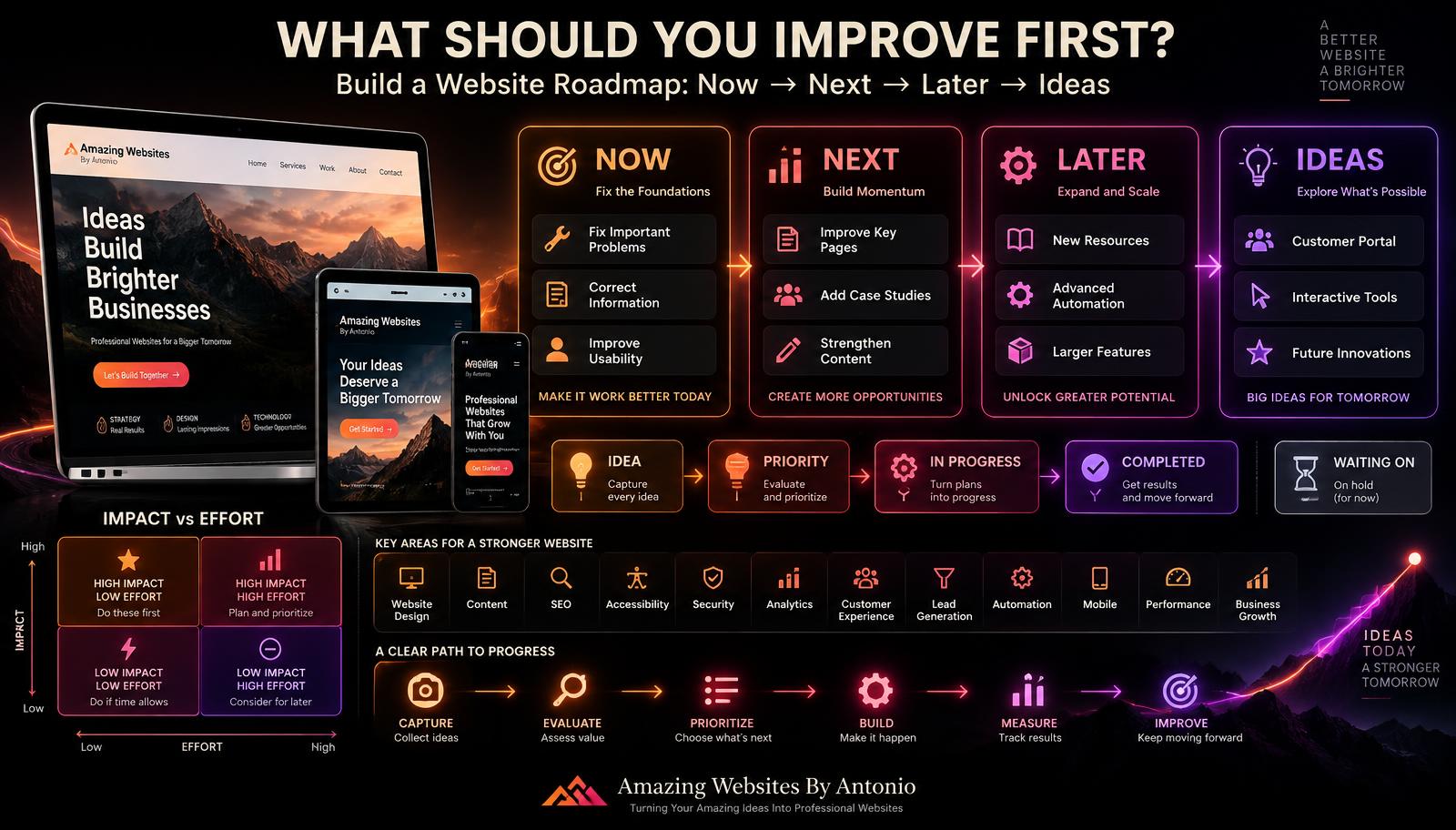
A website shouldn''t sit still after launch. But that doesn''t mean you need to change everything immediately. Instead, create a plan.
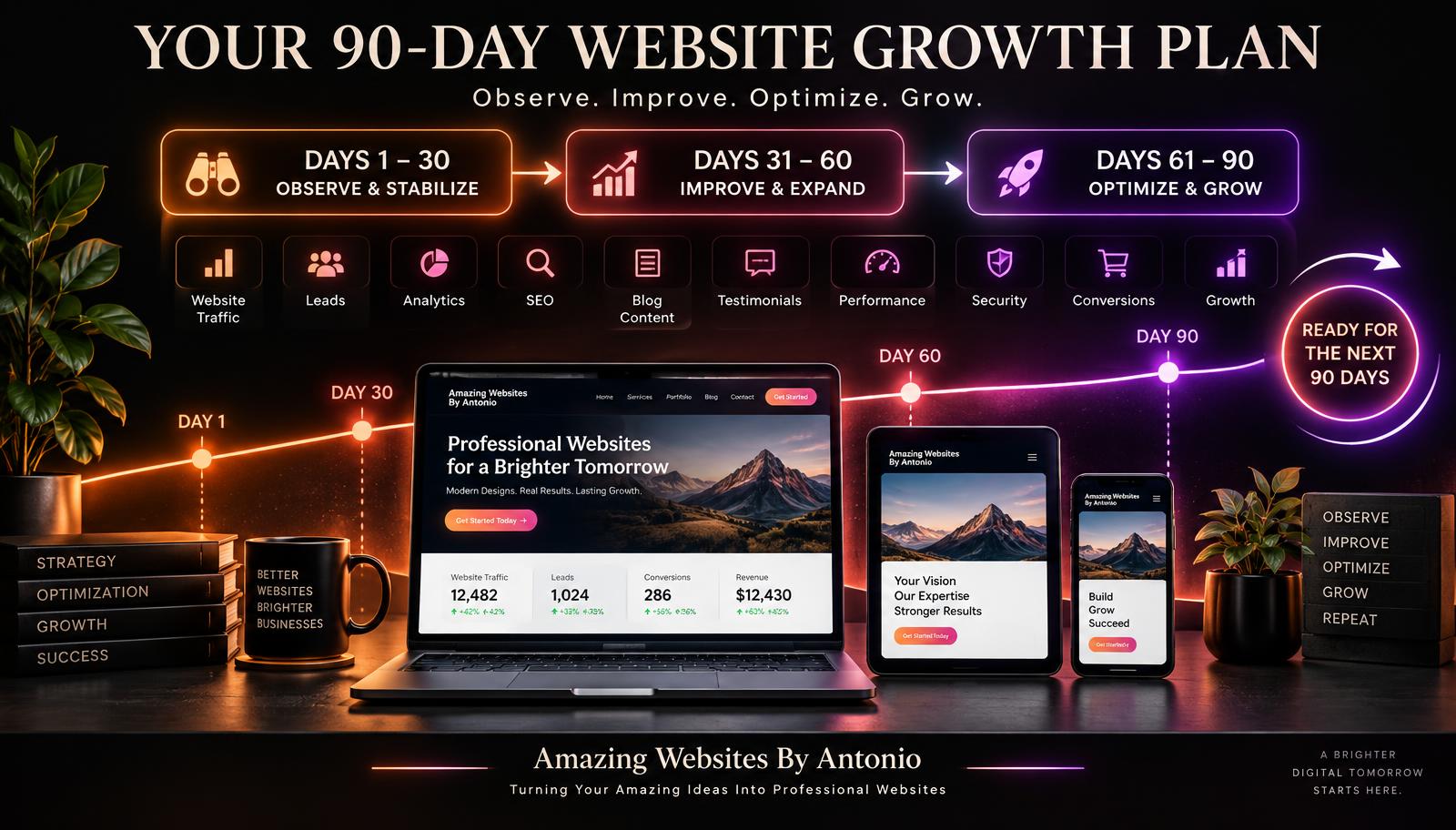
One of the easiest ways to organize your next steps is with a 90-Day Website Growth Plan.
Rather than trying to improve everything at once, divide the first 90 days into three stages:
- Days 1–30: Observe & Stabilize
- Days 31–60: Improve & Expand
- Days 61–90: Optimize & Grow
Let''s break it down.
Days 1–30: Observe & Stabilize
The first month isn''t about rebuilding your brand-new website. It''s about making sure the foundation works.
1. Monitor the Live Website
Regularly visit your website. Check important pages. Look for unexpected problems. Watch for:
- Broken links
- Missing images
- Layout problems
- Form issues
- Mobile problems
- Slow pages
- Incorrect information
Fix genuine problems quickly.
2. Test Your Forms Again
Continue checking important forms after launch. Test:
- Contact forms
- Project intake forms
- Newsletter forms
- Booking forms
- Quote requests
- Testimonial forms
Confirm that submissions are reaching the right destination.
3. Check Your Website on Real Devices
Visit the website from desktop, laptop, tablet, and smartphone. Different visitors may experience your website differently.
4. Monitor Website Performance
Watch how quickly important pages load. Pay attention to large images, videos, animations, and third-party integrations. If something is slowing down the experience, investigate it.
5. Verify Analytics
Make sure your analytics setup is collecting the information you intended. You might monitor:
- Website visits
- Popular pages
- Traffic sources
- Form submissions
- Purchases
- Bookings
- Important calls to action
Only collect and use data in ways appropriate for your privacy obligations and website setup.
6. Create Your Baseline
The first month gives you something important: a starting point. Record useful measurements so you can compare them later. For example:
- Website visits
- Top pages
- Top traffic sources
- Contact inquiries
- Bookings
- Sales
- Most-read blog
These numbers don''t need to be impressive. They''re your baseline.
7. List Customer Questions
Pay attention to what people ask after visiting the website. Questions may reveal information that is missing, hard to find, unclear, or too technical. These questions can inspire website improvements.
8. Collect Early Feedback
Ask a few trusted visitors or customers:
- Could you understand what the business does?
- Could you find the services?
- Was anything confusing?
- Was contacting the business easy?
- Did anything feel missing?
Look for patterns rather than reacting to one person''s preference.
9. Fix Clear Usability Problems
If multiple people struggle with the same thing, investigate it. For example:
- Visitors can''t find Contact
- A form is too long
- The mobile menu is confusing
- A button isn''t obvious
Fix problems that create unnecessary friction.
10. Don''t Change Everything
This is important. Your website is new. Give it time.
Don''t redesign the homepage because one person dislikes a color. Don''t replace every headline because traffic was low for three days. Don''t rebuild the navigation every week.
Observe first. Then improve with purpose.
Days 31–60: Improve & Expand
Now you have several weeks of experience. It''s time to begin making thoughtful improvements.
11. Review Your First Month of Data
Compare what you expected with what actually happened. Ask:
- Which pages attracted visitors?
- Which pages received little attention?
- Where did traffic come from?
- Did visitors contact the business?
- Which content attracted interest?
- What questions did people ask?
Use data to create questions — not automatic conclusions.
12. Improve Your Most Important Pages
Focus on pages that matter most to your customer journey. These might include the homepage, services, portfolio, about, contact, booking, or shop. Improve clarity before adding unnecessary complexity.
13. Review Your Homepage Message
Ask whether a new visitor can quickly understand:
- Who we are?
- What we do?
- Who we help?
- Why it matters?
- What to do next?
If not, improve the message.
14. Review Your Calls to Action
Look at important buttons. Are they clear, specific, visible, and relevant? Compare Submit with Start Your Project or Send My Project Details. The second approach can sometimes provide more context.
15. Improve Your Service Pages
Make sure service pages answer:
- What is this?
- Who is it for?
- What does it help accomplish?
- What is included?
- What happens next?
Reduce uncertainty.
16. Add or Improve Your FAQ
Use questions you''ve received during the first month. If multiple people ask the same question, consider answering it on the website. Your FAQ should grow from real customer needs.
17. Add Authentic Testimonials
If you''ve received new testimonials and have permission to publish them, add them strategically. Testimonials can appear on your homepage, services, testimonial page, and relevant landing pages. Use real customer experiences. Never invent social proof.
18. Update Your Portfolio
Have you completed a new project? Add it. Don''t let your newest work remain invisible.
19. Create a Case Study
Choose a project and explain the challenge, the goal, the approach, the solution, and the result. Case studies can help potential customers understand how you work.
20. Publish Helpful Content
Continue blogging. Create content around customer questions, industry topics, services, common problems, helpful explanations, case studies, and business insights. Each useful article can become another doorway into your website.
21. Connect Your Content
Add internal links between related blog posts, services, portfolio projects, FAQs, and resources. Help visitors continue exploring.
22. Review Your SEO Basics
Check important pages for:
- Clear page topics
- Descriptive page titles
- Useful headings
- Helpful content
- Internal links
- Understandable URLs
- Appropriate image alternative text
SEO is an ongoing process.
23. Review Search Performance
If you''re using appropriate search-performance tools, begin reviewing how your website is being discovered. Look for patterns in search queries, pages appearing in search, clicks, and impressions. Remember that a newer website may still have limited data.
24. Improve Content That Is Unclear
You don''t always need more content. Sometimes existing content simply needs to become clearer. Rewrite complicated sections. Break long paragraphs into readable pieces. Add helpful headings. Explain unfamiliar terms.
25. Improve the Customer Journey
Walk through the website again. Ask:
- Where does a visitor enter?
- What do they learn?
- What builds trust?
- Where do they go next?
- How do they contact us?
Every important page should help move the journey forward.
Days 61–90: Optimize & Grow
By the third month, you may have more useful information about how the website is performing. Now you can begin thinking more strategically about growth.
26. Compare Month 1 With Month 3
Review your baseline. Compare website visits, popular pages, traffic sources, inquiries, bookings, sales, and content performance. Look for meaningful changes and patterns.
27. Identify Your Strongest Pages
Which pages appear to be doing their job well? Maybe a blog attracts visitors. Maybe a service page generates inquiries. Maybe your portfolio gets strong engagement. Study what''s working. Then ask: Why?
28. Identify Weaker Areas
A weak page isn''t automatically a bad page. It may need better messaging, more visibility, a stronger call to action, more trust signals, better internal links, or improved content. Investigate before changing it.
29. Prioritize Improvements
Create three categories: High Priority, Medium Priority, and Future Idea.
High priority might include broken functionality, major usability problems, incorrect business information, and important conversion problems. Future ideas might include a new interactive feature, a new resource library, a new automation, or additional design enhancements.
Prioritization prevents random website changes.
30. Test One Meaningful Change at a Time
If you change the headline, the hero image, the button, the navigation, the page layout, and the service description all at once, it becomes difficult to understand what affected the results. When practical, make focused improvements and observe what happens.
31. Create More Content Around Successful Topics
If a topic attracts interest, expand it. One successful article might become a follow-up blog, an FAQ, a checklist, a guide, a service explanation, a video, or a social media post. Turn useful ideas into a content ecosystem.
32. Improve Lead Generation
Ask: are visitors interested but not contacting us? Consider whether you need clearer calls to action, better service explanations, more proof, simpler forms, better contact-page messaging, or a helpful lead magnet. Make the next step easier.
33. Review Your Lead Magnet
If you''re offering a free resource, evaluate it. Does it solve a real problem? Is it relevant to your services? Is the value clear? Is the signup process simple? Does the follow-up experience work?
34. Improve Follow-Up
A website can generate a lead. But what happens afterward? Create an organized follow-up process, for example:
Website inquiry → Confirmation → Personal response → Discovery → Next step
Don''t let good leads disappear because the process ends at the contact form.
35. Use Automation Where It Helps
Automation may help with form confirmations, lead organization, appointment reminders, follow-up reminders, project intake, internal notifications, and customer communication. Automation should reduce repetitive work — not remove the human experience where it matters.
36. Review Accessibility Again
Your website may have changed during the first 90 days. New images, blog posts, forms, videos, and features can introduce new accessibility considerations. Review accessibility as an ongoing process.
37. Review Security and Access
Check who has website access, whether old accounts are still needed, password practices, multi-factor authentication where available, platform updates, integrations, and backup or recovery options. Security deserves ongoing attention.
38. Create a Regular Maintenance Plan
The first 90 days are ending. Your maintenance shouldn''t. Create a schedule:
- Weekly: Check important forms and urgent issues.
- Monthly: Review analytics, links, content, and performance.
- Quarterly: Review services, portfolio, testimonials, SEO, accessibility, security, and larger improvement opportunities.
Adjust the schedule based on the needs of your website.
39. Create Your Next 90-Day Plan
Growth works best when it continues. At Day 90, ask: What worked? What didn''t? What did customers teach us? What did the data show? What needs improvement? What new opportunities appeared? Then create the next plan.
40. Celebrate the Progress
Don''t only look at what still needs work. Look at how far you''ve come.
- Day 1: The website had just launched.
- Day 30: You had early feedback and baseline data.
- Day 60: You were improving content and the customer experience.
- Day 90: You had real information to guide the next stage.
That''s progress.
Your 90-Day Website Growth Roadmap
Days 1–30: Observe & Stabilize
- Monitor the live website
- Test forms
- Review devices
- Verify analytics
- Create a baseline
- Collect feedback
- Fix clear problems
Days 31–60: Improve & Expand
- Review data
- Improve important pages
- Strengthen calls to action
- Expand FAQs
- Add testimonials
- Update portfolio
- Publish content
- Improve internal links
- Review SEO
Days 61–90: Optimize & Grow
- Compare results
- Identify strong pages
- Investigate weak areas
- Prioritize improvements
- Improve lead generation
- Strengthen follow-up
- Add useful automation
- Review accessibility
- Review security
- Create the next 90-day plan
Final Thoughts
Launching a website is exciting. But growth happens after launch.
Not through random changes. Not through constantly redesigning everything. And not by chasing every new trend.
Growth comes from paying attention.
Observe. Measure. Listen. Learn. Improve. Test. Maintain. And repeat.
Your website doesn''t have to become perfect in 90 days. It needs to become smarter. More useful. More intentional. And more connected to the people your business serves.
So don''t ask only: “Is my website finished?”
Ask: “What''s the next opportunity to make it better?”
Day 1 → Day 30 → Day 60 → Day 90 → Keep Growing.
Because a website that grows with your business can continue creating opportunities long after launch day.
Amazing Websites By Antonio
Turning Your Amazing Ideas Into Professional Websites