Potential customers can read about your services.
They can look through your portfolio.
They can read your About page.
They can even explore your testimonials.
But sometimes they still have one important question:
“Can this business actually do what it says it can do?”
That is where a strong case study can help.
A case study takes a real project and tells the story behind it.
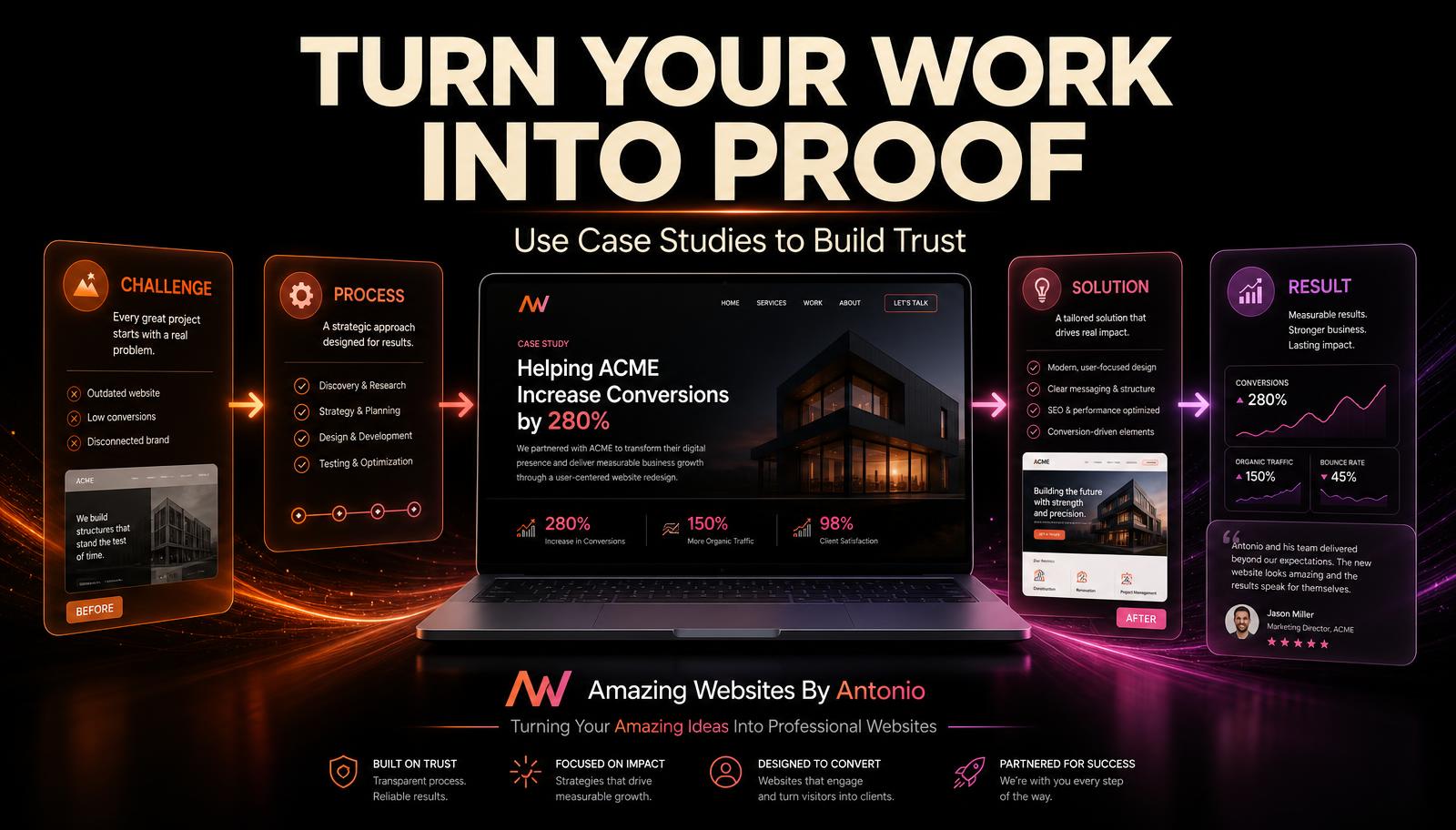
Instead of simply saying, “We create professional websites,” a case study allows you to show visitors:
- Here was the challenge.
- Here was our approach.
- Here is what we created.
- Here is the finished result.
That turns a claim into evidence.
Here are some ways to create powerful case studies for your website.
1. Start With a Real Project
Choose a project that represents the type of work you want customers to hire you for. It might be:
- A website
- A branding project
- A logo
- An AI-powered tool
- An automation
- A digital product
- A marketing project
- A business solution
The project does not necessarily have to be your biggest project. It should be a project that allows you to clearly demonstrate your abilities.
2. Give the Case Study a Strong Title
Avoid titles that simply say “Client Project #3.” Instead, create a title that tells visitors what the project was about. For example:
- “Creating a Professional Digital Presence for a Growing Small Business”
- “Transforming a Business Idea Into a Modern Website”
The title should make visitors want to learn more.
3. Introduce the Project
Give visitors enough background to understand the situation. Explain:
- What the business or project was
- What needed to be created
- What the customer wanted to accomplish
- What services were involved
Keep this section simple and focused.
4. Explain the Challenge
Every strong case study needs a challenge. What problem needed to be solved? Maybe the customer:
- Did not have a website
- Had an outdated website
- Needed stronger branding
- Needed a clearer customer experience
- Wanted to automate part of the business
- Needed a professional digital presence
- Had an idea but did not know how to bring it to life
The challenge gives the project context.
5. Explain Your Approach
Now explain how you approached the problem. This is where your expertise begins to show. You might discuss research, planning, website structure, brand strategy, design decisions, AI tools, automation, content development, testing, and customer feedback.
You do not have to reveal every technical detail. Give visitors enough information to understand that there was thought and strategy behind the work.
6. Show the Solution
This is the heart of the case study. Explain what you created. For a website project, that might include the homepage, About page, services, contact page, testimonials, blog, forms, mobile optimization, branding, calls to action, and AI-powered features.
Use screenshots, mockups, images, or videos whenever possible. Let visitors actually see the work.
7. Show Before and After When Possible
Before-and-after examples can be powerful. Maybe the business went from:
- No website → Professional website
- Outdated branding → Modern brand identity
- Confusing navigation → Simple customer journey
- Manual process → Automated workflow
The transformation helps visitors understand the value of the work.
8. Explain the Result
What happened after the solution was created? Results do not always need to be dramatic numbers. A result might be a professional online presence, easier navigation, better organization, stronger branding, a clearer customer journey, a faster process, a more polished customer experience, or a system that saves time.
If you have measurable results, use them. But never invent numbers or results. Authenticity matters more than impressive-looking statistics.
9. Include the Customer’s Voice
If the customer has given you permission, include a testimonial within the case study. This adds another perspective. Instead of the entire case study being written from the business owner’s point of view, visitors can also hear directly from the person who experienced the service.
10. Explain What Services Were Used
At the bottom or side of the case study, include a simple list such as:
Services Provided:
- Website Design
- Branding
- AI Solutions
- Automation
- Content Strategy
This helps visitors connect the finished project with the services you offer.
11. Include a Call to Action
A case study should not simply end. After visitors see what you accomplished, tell them what they can do next. For example:
- “Have an amazing idea of your own?”
- “Ready to build your professional website?”
- “Let’s turn your idea into something real.”
Then provide a clear button: Start Your Project.
12. Make Case Studies Easy to Find
Do not hide your best work. Case studies can appear in several places: your portfolio, homepage, services pages, blog, customer success section, or a dedicated Case Studies page. You can also link related case studies directly from individual service pages.
13. Use Visual Storytelling
A case study should not feel like a giant wall of text. Break it into sections. Use headlines, screenshots, project images, mockups, quotes, short paragraphs, before-and-after visuals, results, and calls to action. Make the story easy to follow.
14. Keep Your Case Studies Honest
Never exaggerate what happened. Never invent customer quotes. Never create fake results. Never take credit for work you did not perform.
A smaller authentic success story is more valuable than a dramatic story that cannot be supported.
15. Turn Your Portfolio Into Proof
A portfolio says, “Here is something I created.”
A case study goes further and says, “Here is why it was created, how I approached it, what I built, and what happened as a result.”
That additional context can help potential customers understand your value.
16. Build a Library Over Time
You do not need 20 case studies immediately. Start with one strong project. Then add another. And another.
Over time, your website can develop a library of real examples showing different services, industries, challenges, and solutions. Each case study becomes another piece of evidence supporting your expertise.
Final Thoughts
Customers do not only want promises. They want reasons to believe those promises.
Case studies can provide those reasons. They allow you to demonstrate your thinking, creativity, problem-solving, process, and results through real work.
Instead of telling visitors “Trust me,” you are showing them “Here is what I have done.”
That is one of the most powerful forms of credibility a business website can provide.
Show the challenge. Explain the process. Present the solution. Share the result.
Let your work become the proof.
Amazing Websites By Antonio
Turning Your Amazing Ideas Into Professional Websites